
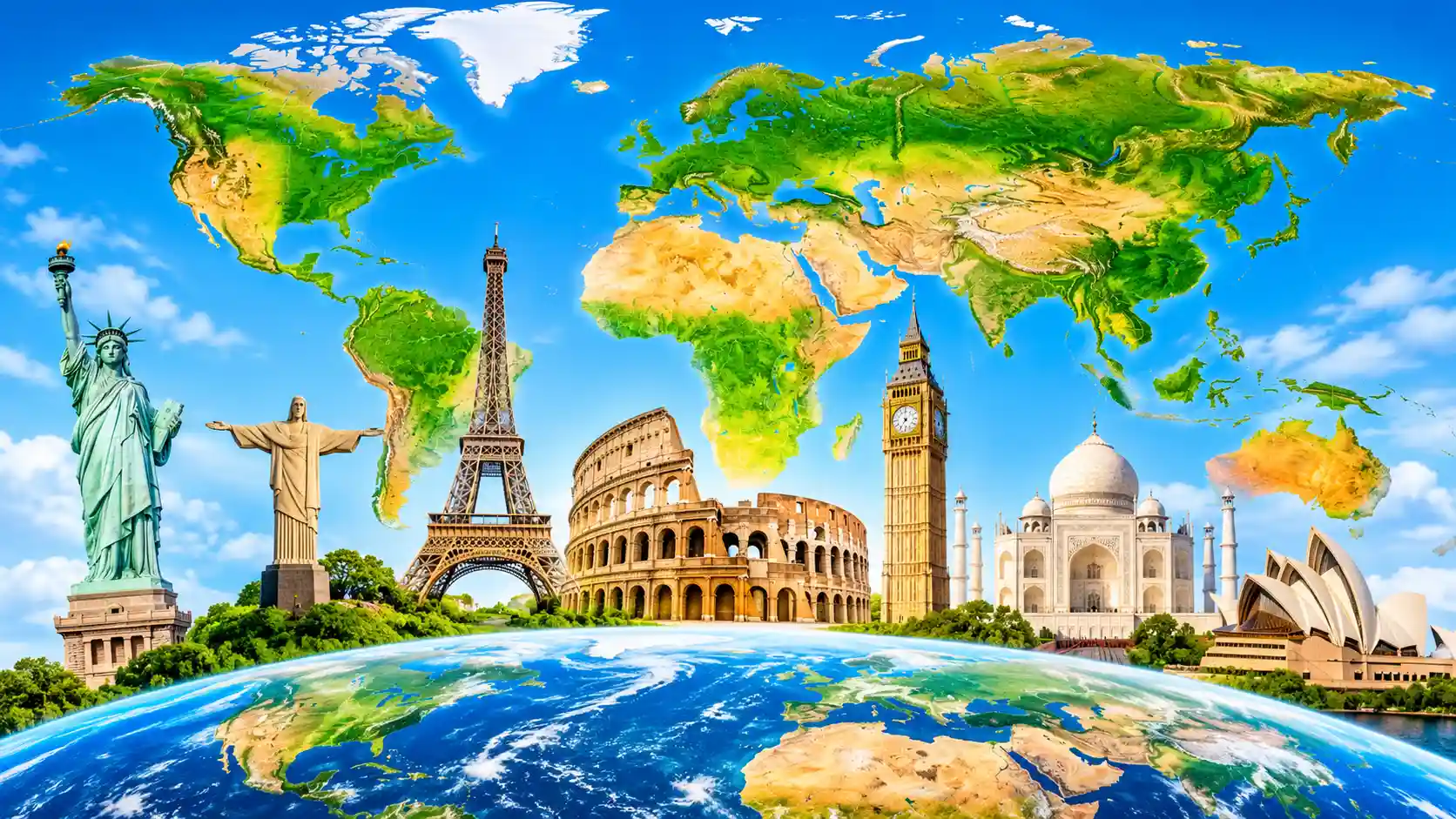
The Largest Countries in the World
2026 ranking of the largest countries by total area and population. Data and detailed profiles for each country.
Understanding the size of countries
A country's size can be measured in several ways. Total area (in km²) includes land and inland waters (lakes, rivers, inland seas). It is often used to rank the world's largest states. In 2026, Russia leads with 17,098,242 km², followed by Canada (9,984,670 km²), China (9,596,960 km²) and the United States (9,525,067 km²). Brazil completes the top 5 with 8,515,767 km².
However, population is another fundamental indicator of a country's "greatness". In 2026, India is the most populous country in the world with about 1.47 billion inhabitants, ahead of China (1.41 billion) and the United States (349 million). Indonesia, Pakistan, Nigeria and Brazil are also among the most populous countries.
This page presents the rankings of the largest countries according to these two criteria, with direct links to the detailed profiles of each country so you can explore their geography, demographics and social indicators.
Top 30 largest countries (total area, 2026)
The ranking below is based on total area in square kilometres, according to UN and Worldometer data for 2026. Countries are ranked from largest to smallest. Click on a country's name to access its detailed profile.
| # | Country | Area (km²) |
|---|---|---|
| 1 |  Russia | 17,098,242 |
| 2 |  Canada | 9,984,670 |
| 3 |  China | 9,596,960 |
| 4 |  United States | 9,525,067 |
| 5 |  Brazil | 8,515,767 |
| 6 |  Australia | 7,692,024 |
| 7 |  India | 3,287,263 |
| 8 |  Argentina | 2,780,400 |
| 9 |  Kazakhstan | 2,724,900 |
| 10 |  Algeria | 2,381,741 |
| 11 |  DR Congo | 2,345,410 |
| 12 |  Greenland | 2,166,086 |
| 13 |  Saudi Arabia | 2,149,690 |
| 14 |  Mexico | 1,964,375 |
| 15 |  Indonesia | 1,904,569 |
| 16 |  Sudan | 1,861,484 |
| 17 |  Libya | 1,759,540 |
| 18 |  Iran | 1,648,195 |
| 19 |  Mongolia | 1,564,116 |
| 20 |  Peru | 1,285,216 |
| 21 |  Chad | 1,284,000 |
| 22 |  Niger | 1,267,000 |
| 23 |  Angola | 1,246,700 |
| 24 |  Mali | 1,240,192 |
| 25 |  South Africa | 1,221,037 |
| 26 |  Colombia | 1,141,748 |
| 27 |  Ethiopia | 1,104,300 |
| 28 |  Bolivia | 1,098,581 |
| 29 |  Mauritania | 1,030,700 |
| 30 |  Egypt | 1,002,450 |
Source: UN, Worldometer (2026). Areas include inland waters. Only sovereign states are listed; Greenland is included as an autonomous territory.
Top 30 most populous countries (population, 2026)
Population is a key indicator of a country's greatness. In 2026, India remains the most populous country in the world with more than 1.47 billion inhabitants, ahead of China (1.41 billion) and the United States (349 million). Click on a country to access its full profile.
| # | Country | Population (2026) |
|---|---|---|
| 1 | India | 1,476,625,576 |
| 2 | China | 1,412,914,089 |
| 3 | United States | 349,035,494 |
| 4 | Indonesia | 287,886,782 |
| 5 |  Pakistan | 259,299,791 |
| 6 |  Nigeria | 242,431,832 |
| 7 | Brazil | 213,562,666 |
| 8 |  Bangladesh | 177,818,044 |
| 9 | Russia | 143,394,458 |
| 10 | Ethiopia | 138,902,185 |
| 11 | Mexico | 132,997,658 |
| 12 |  Japan | 122,427,731 |
| 13 | Egypt | 120,101,175 |
| 14 |  Philippines | 117,724,471 |
| 15 | DR Congo | 116,452,162 |
| 16 |  Vietnam | 102,177,431 |
| 17 | Iran | 93,168,497 |
| 18 |  Turkey | 87,926,082 |
| 19 |  Germany | 83,644,258 |
| 20 |  Tanzania | 72,563,780 |
| 21 |  Thailand | 71,559,614 |
| 22 |  United Kingdom | 69,931,528 |
| 23 |  France | 66,746,401 |
| 24 | South Africa | 65,453,084 |
| 25 |  Italy | 58,926,166 |
| 26 |  Kenya | 58,636,412 |
| 27 |  Myanmar | 55,184,819 |
| 28 | Colombia | 53,936,226 |
| 29 | Sudan | 53,282,719 |
| 30 |  Uganda | 52,761,469 |
Source: UN, Worldometer (2026). Population figures are projections.
Data visualization
Top 10 areas (km², 2026)
Top 10 populations (millions, 2026)
Key indicators of the largest countries
Beyond area and population, other indicators help explain a country's "greatness": population density, share of the world's land area, the number of land borders or geographic diversity. The largest countries often have a wide variety of climates and natural resources.
 Senegal
 Ivory Coast
 South Korea
 Spain
 Ukraine
 Netherlands
 Belgium
 Switzerland
 New Zealand