
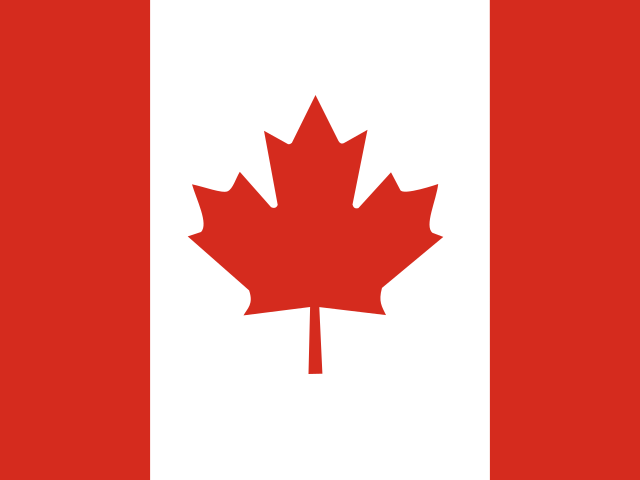
Canada
Complete data on Canada: geography, population, economy, culture, institutions, key indicators and statistics. Information updated in real time.
Time and date in Canada (Ottawa)
Overview
Canada is a federal state in North America, composed of ten provinces and three territories. It is bordered by the Atlantic Ocean to the east, the Pacific Ocean to the west and the Arctic Ocean to the north. With an area of 9,984,670 km², it is the second largest country in the world by total area. Its population is estimated at about 41.5 million inhabitants in 2026.
Canada is a constitutional monarchy and a parliamentary democracy. It is a member of the G7, the G20, NATO, the Commonwealth and the World Trade Organization. Its capital is Ottawa, and its two official languages are English and French. The country is known for its political stability, its universal healthcare system and its diversified economy, which is largely open to international trade.
Data on Canada
Geography of Canada
Canada is the second largest country in the world with an area of 9,984,670 km². Its territory extends over more than 5,500 km from north to south and over more than 7,500 km from east to west. It shares the longest land border in the world with the United States (8,891 km). The country is bordered by three oceans: the Atlantic, the Pacific and the Arctic.
Canadian relief is dominated by the Canadian Shield, a vast region of Precambrian rock that covers nearly half of the territory. To the west, the Rocky Mountains contain peaks exceeding 4,000 metres, including Mount Logan (5,959 m), the country's highest point. The centre of the country is occupied by vast plains and by the Shield, while the east consists of the Appalachians and the St. Lawrence lowlands. Canada also has the largest number of lakes in the world (more than 2 million), including the Great Lakes, shared with the United States.
The country is crossed by major rivers: the St. Lawrence (3,058 km), the Mackenzie (4,241 km), the Yukon (3,185 km) and the Fraser (1,375 km). Canada also has exceptional wildlife (moose, polar bears, beavers, belugas) and vast boreal forests, which cover nearly 40% of the territory.
Population and demographics
Canada has about 41.5 million inhabitants (Statistics Canada estimate, January 2026). Its population density is one of the lowest in the world: about 4 inhabitants/km². The population is highly urbanised (over 80%) and concentrated in a narrow strip along the American border, particularly in major cities such as Toronto, Montreal, Vancouver and Ottawa.
The country is experiencing moderate demographic ageing: the median age is about 40.8 years. The fertility rate is low (1.33 children per woman), and life expectancy is high (82.1 years). Immigration plays a crucial role in population growth: the country welcomes hundreds of thousands of newcomers every year, making it one of the most immigration-friendly countries in the world.
| Indicator | Value |
|---|---|
| Total population (2026) | 41.5 million |
| Population density | ~4 inhab/km² |
| Fertility rate | 1.33 children per woman |
| Life expectancy | 82.1 years |
| Median age | 40.8 years |
| Urban population | ~80.2% |
| Immigrant population | ~23% of the population |
| Visible minorities | South Asian, Chinese, Black, Filipino, Arab |
The Canadian population is multicultural: about 23% of residents are foreign-born, and more than 200 ethnic origins are recorded. The main cities are Toronto (2.8 million in the city, 6.4 million in Greater Toronto), Montreal (1.8 million, 4.3 million in the metropolitan area), Vancouver (0.7 million, 2.6 million in the metropolitan area), Calgary (1.3 million) and Ottawa (1.0 million).
Population change (1950-2026)
Population by age (2026)
Climate in Canada: temperatures and precipitation
Canada has a very wide variety of climates due to its immense size. Broadly speaking, there is an oceanic climate on the west coast (Vancouver, Victoria), a continental climate in the Prairies and the centre (Toronto, Montreal, Calgary), a subarctic climate in the North and an arctic climate in the far northern territories. Winters are long and harsh in most regions, with temperatures that can drop below -30 °C in the Prairies and the North. Summers are generally warm and humid in the southeast, cooler on the coasts.
Precipitation varies greatly: the west coast (British Columbia) receives more than 1,500 mm/year, while the Prairies and the North are much drier (sometimes less than 300 mm/year). Extreme phenomena are frequent: blizzards, ice storms, tornadoes in the Prairies, wildfires in the West and spring floods.
Average monthly temperatures (°C) - Toronto
Monthly precipitation (mm) - Toronto
Data based on 1991-2020 climate normals for Toronto. Regional variations are considerable.
Languages
Canada has two official languages: English and French. According to the most recent data, English is the mother tongue of about 58.1% of the population, and French of about 21.4%. Other mother tongues (about 20.5%) reflect immigrant diversity: Chinese, Punjabi, Spanish, Arabic, Tagalog, etc. Official bilingualism is a pillar of Canadian identity, and French is the majority language in Quebec and in certain communities in New Brunswick and Ontario.
French is the sole official language in Quebec (since the Charter of the French Language, Bill 101). Bilingualism (English-French) is widespread among about 18% of the population. Canada also recognises Indigenous languages (Cree, Inuktitut, Ojibwe, etc.), spoken by about 200,000 people, and Inuktitut is an official language in Nunavut.
Mother tongues spoken in Canada
Multiculturalism has been an official policy since 1971 and a law since 1988. About 66% of Canadians believe that multiculturalism contributes positively to the country's identity. This linguistic and cultural diversity is one of Canada's distinctive traits on the world stage.
Religions practised in Canada
Canada is a country of great religious diversity, marked by growing secularisation and a multicultural society. Christianity remains the majority religion: about 67.3% of the population declares itself Christian. Catholics represent the largest denomination (about 43.6% according to some sources, or 29.9% according to others), followed by Protestants (about 29.2% or 12% depending on definitions).
The share of the religiously unaffiliated ("no religion") is growing strongly: it reaches about 16.5% according to official data, but some recent surveys place it at over 34%. Other religions (Islam, Hinduism, Sikhism, Buddhism, Judaism) together represent about 7.2% of the population. Islam is the most practised non-Christian religion (about 4.9%), followed by Hinduism (2.3%) and Sikhism (2.1%).
Religions in Canada
Freedom of religion is guaranteed by the Canadian Charter of Rights and Freedoms (1982). Canada is a plural society where many faiths coexist, and where secular values are taking a growing place in the public sphere. Indigenous communities also practise traditional spiritualities, often alongside Christianity.
Economy and GDP
Canada has an advanced and diversified economy, ranked among the ten largest economies in the world. In 2026, its nominal GDP is estimated at about 2,490 billion dollars, and its GDP per capita at about 60,105 dollars. The country is a member of the G7 and the G20, and its currency is the Canadian dollar (CAD).
The sectoral structure of the Canadian economy is dominated by services (about 66.4% of GDP), followed by industry (about 25.3%) and agriculture (about 1.6%). Natural resources (oil, gas, minerals, forests) play a crucial role, but the country is also a technology hub (artificial intelligence, aerospace, life sciences) and a major exporter of goods and services. The main trading partners are the United States (about 75% of exports), China, the United Kingdom and Japan.
Evolution of Canadian GDP (billions $)
The unemployment rate is about 6.7% (2026), and inflation is around 2.1%. Public debt is high (about 110.8% of GDP), but the country maintains an AAA credit rating. The average gross salary is about C$7,125 per month (full-time, 2024). The minimum wage varies by province, from C$15.00/h (Alberta) to C$19.75/h (Nunavut). Income inequality is relatively moderate (Gini coefficient of 0.300).
Breakdown of the economy by sector (% GDP)
Socio-economic indicators
History
The history of Canada goes back thousands of years, with the Indigenous peoples (First Nations, Inuit and Métis) who inhabited the territory long before the arrival of Europeans. First European contacts took place around the year 1000 with the Vikings, then in the 15th century with English and French explorers. Jacques Cartier explored the St. Lawrence in 1534, and Samuel de Champlain founded Quebec in 1608, giving birth to New France.
After the Seven Years' War (1756-1763), France ceded New France to Great Britain by the Treaty of Paris (1763). The Canadian Confederation was created on 1 July 1867 by the British North America Act, which united Ontario, Quebec, Nova Scotia and New Brunswick. The country then expanded westward (purchase of Rupert's Land, creation of Manitoba, entry of British Columbia in 1871) and northward.
The 20th century was marked by World War I (Battle of Vimy), the Great Depression, World War II (major participation, notably in the Normandy landings) and the assertion of independence from the United Kingdom (Statute of Westminster in 1931, patriation of the Constitution in 1982). The Canadian Charter of Rights and Freedoms was adopted in 1982. The 1995 Quebec sovereignty referendum (defeated 50.6% to 49.4%) and the Clarity Act (2000) shaped Canadian federalism. Today, Canada is a stable, prosperous and multicultural country, fully integrated into the liberal international order.
History of Canada: major periods
Culture
Canadian culture reflects its Indigenous history, its colonial heritage (French and British) and its multiculturalism. The country is officially bilingual and multicultural, and this diversity is a source of national pride. In literature, authors such as Margaret Atwood, Alice Munro (Nobel Prize 2013), Michael Ondaatje and Gabrielle Roy have left their mark on Canadian letters. In music, Canada has produced Leonard Cohen, Joni Mitchell, Neil Young, Céline Dion, Drake and The Weeknd.
Canadian cinema is dynamic (Denys Arcand, Xavier Dolan, Atom Egoyan), and the Toronto International Film Festival (TIFF) is one of the most important in the world. Sport occupies a central place: ice hockey is the national sport, and the Montreal Canadiens are the most decorated team in the NHL. Canadian football, curling and basketball (invented by a Canadian, James Naismith) are also popular.
Canadian gastronomy reflects regional diversity: poutine (fries, cheese curds and brown gravy), tourtière (Quebec meat pie), smoked salmon (British Columbia), maple syrup (Quebec), Tim Hortons donuts and Montreal bagels. The emblematic festivals are Canada Day (1 July), Thanksgiving (2nd Monday of October), Halloween, Christmas and the Quebec Winter Carnival. Canada is also recognised for its quality of life, its safety and its openness to immigration.
 Nigeria
 Senegal
 Ivory Coast
 South Africa
 Algeria
 United States
 China
 India
 Japan
 South Korea
 Turkey
 Saudi Arabia
 Iran
 France
 Germany
 Italy
 United Kingdom
 Spain
 Ukraine
 Russia
 Netherlands
 Belgium
 Switzerland
 Australia
 New Zealand