
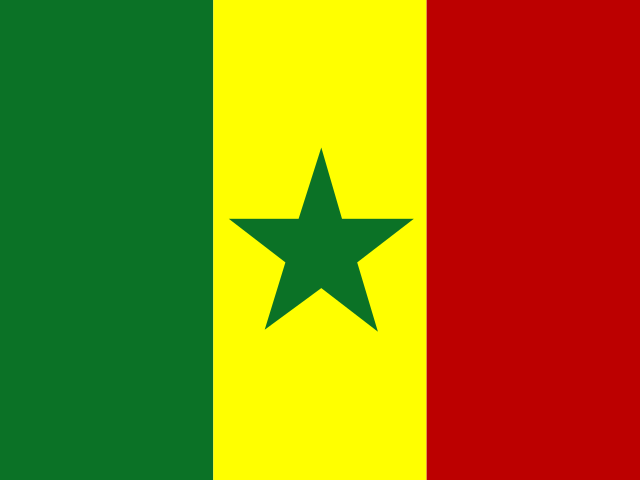
Senegal
Complete data on Senegal: geography, population, economy, culture, key indicators and statistics. Factual information, regularly updated.
Time and date in Senegal (Dakar)
Overview
Senegal (Republic of Senegal) is a country in West Africa located at the westernmost tip of the continent, in the Sahel region. With a population estimated at about 19.4 million inhabitants in 2026, it is one of the most populous countries in the sub-region. Its capital is Dakar, which concentrates most of the economic and administrative activity.
Senegal is a republic divided into 14 regions. The official language is French, but Wolof is the most widely spoken lingua franca (about 80% of the population). The country is recognised for its political stability and its democratic tradition, having experienced several peaceful transitions of power.
Data on Senegal
Geography of Senegal
Senegal covers an area of 196,722 km². It is bordered to the west by the Atlantic Ocean (with a coastline of about 500 to 700 km), to the north by Mauritania, to the east by Mali, to the south by Guinea and Guinea-Bissau, and it almost entirely surrounds The Gambia.
The terrain is generally flat, with some hills and plateaus. The highest point is a hill near Népène Diakha (about 581 m). Three main rivers cross the country: the Senegal River (1,700 km) in the north, the Gambia River (750 km) and the Casamance River (300 km) in the south.
The climate is tropical Sahelian, with two seasons: a dry season from November to June (harmattan) and a rainy season from July to October, more abundant in the south (Casamance). Precipitation ranges from less than 300 mm/year in the north to over 1,200 mm/year in the south.
Population and demographics
Senegal has a population estimated at 19.4 million inhabitants in 2026. The population density is about 102.7 inhab/km², but distribution is very uneven: the Dakar region concentrates a large share of the population on a very small territory, while the east and north are less densely populated.
Senegalese demographics are young: over 50% of the population is under 18. Life expectancy is about 68.9 years. The country is experiencing growing urbanisation (about 49% urban population), with cities such as Dakar (metropolitan area of about 3.8 million inhabitants), Touba (over 1 million) and Thiès.
| Indicator | Value |
|---|---|
| Total population (2026) | ~19.4 million |
| Population density | ~102.7 inhab/km² |
| Birth rate | ~32 / 1,000 |
| Life expectancy | ~68.9 years |
| Median age | ~19 years |
| Urban population | ~49% |
| Ethnic groups | Wolof (~43%), Fula (~24%), Serer (~15%), others |
The population is ethnically diverse. The Wolof constitute the majority group (~43%), followed by the Fula (or Halpulaar, ~24%) and the Serer (~15%). Other groups such as the Diola, Mandinka and Soninke complete this picture. The largest cities are Dakar (capital and economic centre), Touba (religious city), Thiès, Saint-Louis and Kaolack.
Population change (1950-2026)
Population by age (2026)
Climate in Senegal: temperatures and precipitation
Senegal has a tropical Sahelian climate, with marked regional variations. The north (Saint-Louis, Podor) is semi-arid, with a long dry season and low annual precipitation (often below 400 mm). The centre (Dakar, Thiès, Kaolack) has a savannah climate, with a rainy season from July to October. The south (Ziguinchor, Casamance) is more humid, with precipitation that can exceed 1,200 mm/year and gallery forest vegetation.
Temperatures are high throughout the year inland, with averages of 25 to 35°C. On the Atlantic coast, temperatures are more moderate thanks to the sea breeze. The harmattan, a dry, dusty wind from the Sahara, blows from December to February, bringing a dry haze and cooler nights.
Average monthly temperatures (°C) - Dakar
Monthly precipitation (mm) - Dakar
Indicative data for Dakar. Regional variations are considerable (drought in the north, heavy rain in the south).
Languages
The official language of Senegal is French, used in administration, education and business. However, Wolof is the most widely spoken lingua franca, understood by about 80% of the population, and serves as a lingua franca throughout the country. The other main national languages are Fula (Pulaar), Serer, Diola (Jola) and Mandinka.
Senegal has over twenty ethnic languages, reflecting its cultural diversity. Most belong to the Niger-Congo family. Arabic is also used in religious education and trade.
Language breakdown in Senegal (estimate)
French remains the language of administration and official writing, while Wolof dominates daily exchanges, the media and popular culture. The use of national languages is growing in bilingual education.
Religions practised in Senegal
Senegal is a country with a very large Muslim majority. Islam is practised by about 95% of the population, mainly in the form of Sufism, organised into large brotherhoods (Tijaniyya, Mouride, Qadiriyya, etc.). Christianity (mainly Catholic) represents about 4% of the population, concentrated in certain regions such as Casamance and among the Serer. Traditional religions survive in a minority form.
Senegal is renowned for its religious tolerance and peaceful coexistence between communities. The great holy cities such as Touba (Mouride) and Tivaouane (Tijaniyya) play a major spiritual and social role. Religious festivals (Korité, Tabaski, Magal de Touba, Gamou) are national events.
Religions in Senegal
Freedom of religion is guaranteed by the Constitution. The President and the highest authorities attend ceremonies of the various brotherhoods, highlighting the importance of religion in national cohesion.
Economy and GDP
Senegal is one of the most dynamic economies in West Africa. Its nominal GDP is estimated at about $40.5 billion in 2026, compared with $37.1 billion in 2025. GDP per capita remains around $2,000. Economic growth was strong in 2025 (+7.9%), supported by the start of oil and gas production (Sangomar field, GTA project) and a rebound in agriculture.
Services dominate the economy (over 57% of GDP), driven by trade, telecommunications, transport and tourism. Industry (including hydrocarbons and processing) accounts for about 27%, and agriculture about 16% of GDP, employing a large share of the rural population (peanuts, millet, rice, fishing). The country is also a major financial and services hub in the sub-region.
Evolution of Senegal's GDP (billions $)
Growth is sustained, but the country faces challenges: high public debt (over 100% of GDP after the revelation of the "hidden debt" in 2025), significant youth unemployment and persistent poverty. Inflation has remained low (about 1.4% in 2025).
Breakdown of the economy by sector (% GDP)
Socio-economic indicators
History and civilisations
The territory of Senegal has been inhabited since prehistory. Over the centuries, several political entities developed: the Djolof Empire (founded in the 13th century by Ndiadiane Ndiaye), the kingdoms of Cayor, Baol, Sine and Saloum, as well as the influence of the Mali Empire.
From the 15th century, Europeans (Portuguese, Dutch, French, English) established trading posts on the coast, notably at Saint-Louis and on the island of Gorée, which became a major site of the Atlantic slave trade. Senegal became a French colony in the 19th century. Dakar became the capital of French West Africa (AOF).
Senegal gained independence on 4 April 1960, after the dissolution of the Mali Federation. Léopold Sédar Senghor, poet and statesman, became its first president. The country experienced a historic political transition in 2000 with the election of Abdoulaye Wade, then another transition in 2012 (Macky Sall) and in 2024 (Bassirou Diomaye Faye), consolidating its reputation as a stable democracy.
Major periods of Senegalese history
Culture
Senegalese culture is rich and plural, reflecting the diversity of ethnic groups (Wolof, Fula, Serer, Diola, Mandinka, etc.). The country is world-renowned for its music: mbalax (Youssou N'Dour, Baaba Maal), but also jazz, Senegalese rap (highly engaged) and traditional music. Literature is prestigious with Léopold Sédar Senghor (négritude), Mariama Bâ, Birago Diop and Boubacar Boris Diop.
Senegalese cinema is one of the most dynamic in Africa, with directors such as Ousmane Sembène (considered the father of African cinema) and Safi Faye. Téranga (hospitality) is a central value of Senegalese society. Senegalese wrestling (laamb) is a very popular national sport.
Gastronomy is tasty: thiéboudienne (fish rice, the national dish), yassa poulet (chicken with lemon and onions), mafé (peanut sauce), thiakry (dessert based on millet couscous and curdled milk). The major festivals are Tabaski, Korité, the Magal de Touba, the Gamou, Independence Day (4 April) and cultural festivals such as the World Festival of Black Arts (FESMAN) and the Saint-Louis Jazz Festival.
 Nigeria
 Ivory Coast
 South Africa
 Algeria
 United States
 Canada
 China
 India
 Japan
 South Korea
 Turkey
 Saudi Arabia
 Iran
 France
 Germany
 Italy
 United Kingdom
 Spain
 Ukraine
 Russia
 Netherlands
 Belgium
 Switzerland
 Australia
 New Zealand