
Germany
Complete data on Germany: geography, population, economy, culture, institutions, key indicators and statistics. Information updated in real time.
Time and date in Germany
Overview
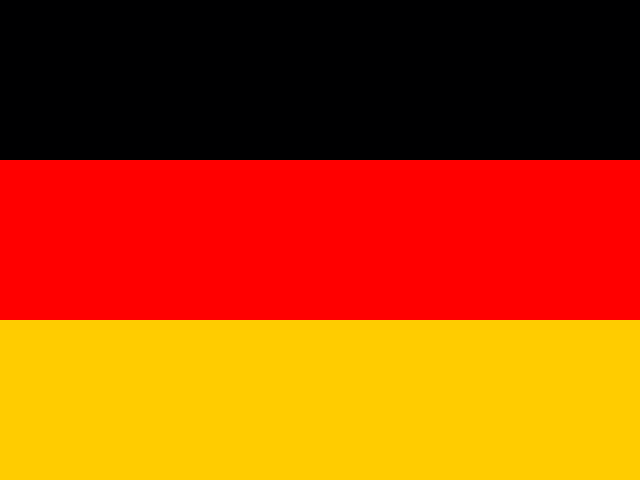
Germany, officially the Federal Republic of Germany (Bundesrepublik Deutschland), is a federal state in Central Europe. It is bordered by nine neighbouring countries: Denmark, Poland, the Czech Republic, Austria, Switzerland, France, Luxembourg, Belgium and the Netherlands. With 83.5 million inhabitants (2025), it is the most populous country in the European Union and the second migration destination in the world after the United States.
Germany is a major economic power, the 3rd largest economy in the world (nominal GDP) and the largest in Europe. It is also a central political player within the EU, the G7 and the G20. Its capital is Berlin, and its official language is German. The country is divided into 16 Länder (federal states) and has a rich history, marked by the Holy Roman Empire, the unification of 1871, the two world wars, the division of 1949-1990 and reunification.
Data on Germany
Geography of Germany
Germany is a Central European country whose varied geography stretches from the coasts of the North Sea and the Baltic Sea in the north to the imposing Bavarian Alps in the south. With an area of approximately 357,000 km², it is the seventh largest country in Europe and shares its borders with nine neighbouring countries: Denmark, Poland, the Czech Republic, Austria, Switzerland, France, Luxembourg, Belgium and the Netherlands. This central position makes Germany an essential geographic and cultural crossroads at the heart of the continent.
The German relief is divided into three main natural zones. In the north, the vast Germanic plains stretch to the maritime coasts, offering agricultural landscapes dotted with heaths and lakes. In the centre, the Mittelgebirge (medium mountain ranges) such as the Black Forest, the Harz and the Ore Mountains form wooded and rolling reliefs, generally culminating between 500 and 1,500 metres. In the south, the Bavarian Alps are home to the country's highest point, the Zugspitze, which rises to 2,962 metres.
The hydrographic network is dominated by major rivers that structure the territory. The Rhine, a true river artery, crosses the west of the country for about 865 km and constitutes a major navigable waterway for trade. The Danube rises in the Black Forest and flows east for 647 km, linking Germany to Eastern Europe. The Elbe, meanwhile, runs through the northeast for 727 km before flowing into the North Sea.
Population and demographics
Germany is the most populous country in the European Union, with a population of about 84 million inhabitants (2025 estimate). Its average density is about 232 inhabitants/km², but this distribution is very uneven across the territory. The most densely populated region is North Rhine-Westphalia, where metropolises such as Cologne, Düsseldorf and Essen are concentrated.
The country is experiencing a marked demographic ageing phenomenon, with a median age of about 47 years, making it one of the oldest populations in the world. The birth rate is relatively low, around 1.6 children per woman, well below the generational renewal threshold (2.1). At the same time, life expectancy is high: 81 years on average.
| Indicator | Value |
|---|---|
| Total population (2025) | 83.5 million |
| Population density | 233 inhab/km² |
| Fertility rate | 1.6 children per woman |
| Infant mortality rate | 3.2 ‰ |
| Life expectancy | 81.2 years (men: 78.7 - women: 83.8) |
| Median age | 47.8 years |
| Urban population | 77.5 % |
| Immigrant population | 18.6 million (22% of the population) |
To compensate for this natural deficit, Germany relies on significant immigration. The country welcomes hundreds of thousands of newcomers each year, making it the second migration destination in the world after the United States. The main foreign communities come from Turkey, Poland, Syria, Italy and Romania. About 26% of inhabitants have immigrant backgrounds.
The urban distribution is dominated by large agglomerations. The capital, Berlin, has nearly 3.8 million inhabitants, followed by Hamburg (1.9 million) and Munich (1.5 million). The German population is predominantly Christian (about 50%), but the share of Muslims (about 6%) and people without religious affiliation (nearly 40%) continues to grow.
Population change (1950-2025)
Population by age (2025)
Climate in Germany: temperatures and precipitation
Germany lies in a temperate climate zone, but its regional variations are marked by a transition between oceanic influences from the west and continental influences from the east. The country experiences well-differentiated seasons, with generally mild to warm summers and cold but rarely extreme winters, except in certain mountainous regions.
Regarding temperatures, annual averages range from about 8°C in the north to 10°C in the southwest (Rhine valley). Summers show averages between 16°C and 22°C, with peaks reaching 35°C. Winters are colder in the east and south, with averages of -1°C to 3°C.
Precipitation is also very contrasted. The national annual average is around 700 to 800 mm. The rainiest regions receive up to 1,500 mm per year. Conversely, the driest areas are in the east of the country, particularly around Berlin and Brandenburg, where annual precipitation drops to barely 500 mm.
Average monthly temperatures (°C)
Monthly precipitation (mm)
Data based on historical averages (1991-2020) for Germany. Source: DWD.
Languages
The official language and the most spoken in Germany is German (Deutsch), a West Germanic language with about 95 million native speakers worldwide. Standard German (Hochdeutsch) is used in administration, education, media and professional life, but the country is characterized by an exceptional dialectal richness.
Native languages spoken in Germany
Germany is also a country of immigration and linguistic diversity. The most widely practised foreign languages are English (about 56%), followed by French, Russian, Italian and Spanish. Turkish is the most spoken non-European foreign language, with more than 2.5 million speakers.
Religions practised in Germany
Germany is a country of great religious diversity. Historically, German territory was the birthplace of the Protestant Reformation initiated by Martin Luther in the 16th century. Today, about 50% of the population declares itself Christian, with an almost balanced split between Catholics (about 20%) and Protestants (about 25%).
Religions in Germany
One of the most striking developments is the rapid growth of Islam, which has become the country's second religion. The number of Muslims in Germany is estimated at about 5.5 million, i.e. nearly 6.5% of the population. The most striking phenomenon is the spectacular growth of the non-religious: nearly 40% of the population claims no religious affiliation.
Economy and GDP
Germany is the leading economy in Europe and the third in the world, with a GDP of about 4,500 billion euros (2025 estimate). This economic weight alone accounts for nearly 25% of the total GDP of the European Union. GDP per capita stands at about 53,000 euros.
Evolution of German GDP (billions €)
The structure of the German economy relies on a powerful industrial model, often described as "Made in Germany". The secondary sector (industry) accounts for about 30% of GDP. The flagships are automobiles (Volkswagen, BMW, Mercedes-Benz, Audi), precision engineering, chemicals (BASF, Bayer) and electronics (Siemens, Bosch). The tertiary sector dominates with nearly 65% of GDP.
Germany is a global export power, with exports exceeding 1,600 billion euros annually. Its main trading partners are the United States, France, the Netherlands, China and the United Kingdom. SMEs form the backbone of the German economy and are known as the "Mittelstand".
Breakdown of the economy by sector (% GDP)
Socio-economic indicators
History
The history of Germany is a complex and turbulent epic. The Germanic territory appears for the first time under the name Germania in the writings of Tacitus in the 1st century AD. The Holy Roman Empire was founded in 800 with the coronation of Charlemagne. This empire lasted more than 1,000 years (until 1806).
History of Germany: major periods
The 16th century is marked by the Protestant Reformation, initiated by Martin Luther in 1517. It was under the impetus of Otto von Bismarck that Germany was finally unified in 1871, giving birth to the Second Reich.
The 20th century is the century of tragedies: World War I, the Weimar Republic, Nazism, World War II and the Holocaust. The defeat of 1945 led to the division of the country into two states: the FRG and the GDR, separated by the Berlin Wall, erected in 1961.
The fall of the Berlin Wall on 9 November 1989 is the founding event of modern Germany. Official reunification took place on 3 October 1990, a date now celebrated as national day.
Culture
Germany has an exceptional cultural heritage. In literature, figures such as Goethe, Schiller, Thomas Mann and Hermann Hesse revolutionised the German language. In music, Germany gave birth to Bach, Beethoven, Wagner, Brahms and Schumann.
In philosophy, Germany was the birthplace of Kant, Hegel, Nietzsche, Marx and Heidegger. The country also excelled in sciences with Einstein, Planck and Koch. The Bauhaus school, founded in Weimar in 1919 by Walter Gropius, revolutionised modern architecture.
Popular culture is just as lively. Germany is world-famous for its popular festivals such as Munich's Oktoberfest, the largest beer festival in the world. German gastronomy, with its sausages (more than 1,500 varieties), its sauerkraut and its breads (more than 300 types), reflects the country's regional diversity.
 Nigeria
 Senegal
 Ivory Coast
 South Africa
 Algeria
 United States
 Canada
 China
China India
India Japan
Japan South Korea
 Turkey
 Saudi Arabia
 Iran
Iran France
 Germany
 Italy
Italy United Kingdom
 Spain
Spain Ukraine
 Russia
 Netherlands
 Belgium
 Switzerland
 Australia
 New Zealand