
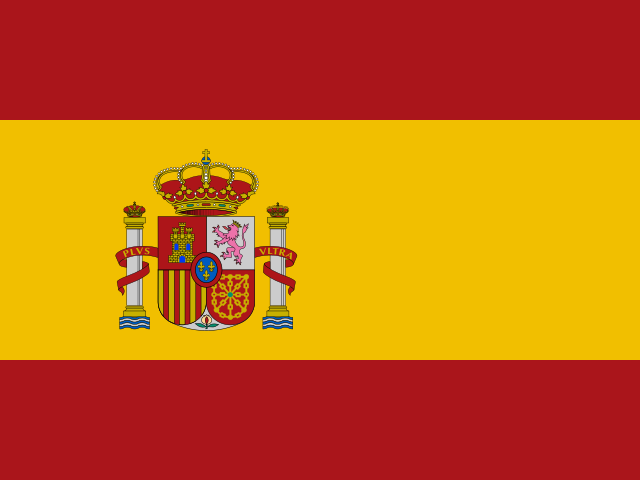
Spain
Complete data on Spain: geography, population, economy, culture, institutions, key indicators and statistics. Information updated in real time.
Time and date in Spain
Overview
Spain, officially the Kingdom of Spain (Reino de España), is a unitary state in Southern Europe. It occupies most of the Iberian Peninsula, which it shares with Portugal, and is bordered by France and Andorra to the north, and Gibraltar to the south. It also includes the Balearic Islands in the Mediterranean and the Canary Islands in the Atlantic. With a population of about 49.9 million inhabitants (October 2026), it is the fourth most populous country in the European Union.
Spain is a major economic power, the 15th economy in the world and the fourth in the euro area, with a GDP of about $1,910 billion (2025, IMF). It is a member of the EU, NATO, the G20 and the OECD. Its capital is Madrid, and its official language is Spanish (Castilian). The country is a constitutional monarchy whose head of state is King Felipe VI since 2014. Spain is divided into 17 autonomous communities and 2 autonomous cities.
Data on Spain
Geography of Spain
Spain is a Southern European country that occupies about 84% of the Iberian Peninsula, shared with Portugal. With an area of 505,990 km², it is the fourth largest country in Europe. It also includes two archipelagos: the Balearic Islands in the Mediterranean and the Canary Islands in the Atlantic Ocean, off the coast of Morocco. The country shares land borders with France and Andorra to the north, and Portugal to the west, as well as a border with Gibraltar to the south.
Spanish relief is dominated by a central plateau (the Meseta) at an average altitude of 600 to 700 metres, surrounded by mountain ranges. To the north rise the Pyrenees, culminating at 3,404 metres at Aneto Peak, and the Cantabrian Range. To the south, the Sierra Nevada is home to the highest point of the peninsula, Mulhacén (3,479 m). The country also has vast coastal plains, notably in Andalusia and the Valencia region.
The hydrographic network is marked by major rivers that cross the peninsula. The Tagus (Tajo) is the longest river of the peninsula (1,007 km), followed by the Ebro (910 km) and the Douro (Duero, 897 km). The Guadalquivir crosses Andalusia and is navigable up to Seville. Spain also has an extensive coastline of nearly 8,000 km, with very popular Mediterranean and Atlantic beaches.
Population and demographics
Spain has about 49.9 million inhabitants as of 1 October 2026, according to provisional INE data. Its average density is about 99 inhabitants/km², but this distribution is very uneven: coastal regions and Madrid are densely populated, while the interior (Castile, Aragon, Extremadura) is much less dense, with areas described as a "demographic desert".
The country is experiencing a gradual demographic ageing, with a median age of about 45 years. The birth rate is low, around 1.2 children per woman. Life expectancy is one of the highest in the world: 83.5 years on average. The foreign population represents about 15% of the total, with 7.5 million foreign nationals in 2026. The main immigrant nationalities are Colombian, Venezuelan and Moroccan.
| Indicator | Value |
|---|---|
| Total population (Oct. 2026) | 49.9 million |
| Population density | 99 inhab/km² |
| Fertility rate | 1.2 children per woman |
| Life expectancy | 83.5 years |
| Median age | 45.0 years |
| Urban population | 81 % |
| Foreign population | 7.5 million (15 %) |
Urban distribution is dominated by the major metropolises. The capital, Madrid, has about 3.3 million inhabitants (6.7 million in the agglomeration), followed by Barcelona (1.6 million, 5.5 million in the agglomeration), Valencia (0.8 million), Seville (0.7 million) and Bilbao (0.35 million).
Population change (1950-2026)
Population by age (2026)
Climate in Spain: temperatures and precipitation
Spain is characterised by a great climatic diversity, due to its size, its relief and its position between the Atlantic and the Mediterranean. Three main climatic zones can be distinguished: the Mediterranean climate (coastal and inland), the oceanic climate (northwest) and the semi-arid climate (southeast).
Temperatures vary greatly from region to region. Summers are very hot in the interior and the south, with averages exceeding 30 °C in July-August and peaks that can reach 45 °C in Andalusia. Winters are mild on the Mediterranean coast (averages around 10-12 °C) but colder in the interior (averages around 5 °C in Madrid, with night frosts).
Precipitation is very uneven. The northwest (Galicia, Asturias, the Basque Country) is the wettest region, with more than 1,000 mm per year. The interior receives between 400 and 600 mm, while the southeast (Almería, Murcia) is semi-arid, with less than 300 mm per year. Most of the rain falls in autumn and spring, with a generally dry summer, especially on the Mediterranean coast.
Average monthly temperatures (°C) - Madrid
Monthly precipitation (mm) - Madrid
Data based on historical averages for Madrid. Source: AEMET.
Languages
The official language of Spain is Spanish (or Castilian), spoken by the vast majority of the population. According to the CIA World Factbook, Castilian is the mother tongue of 74% of Spaniards. Spanish is the second most spoken mother tongue in the world, with more than 480 million native speakers.
Languages spoken in Spain
Spain recognises several co-official languages in certain autonomous communities. Catalan is co-official in Catalonia, the Balearic Islands and the Valencian Community (where it is called Valencian), spoken by about 17% of the population. Galician is co-official in Galicia (about 7%), and Basque (euskara) is co-official in the Basque Country and part of Navarre (about 2%). Aranese is also co-official in the Val d'Aran (Catalonia). These regional languages are protected by the Constitution and the European Charter for Regional or Minority Languages.
Religions practised in Spain
Spain is a country with a Catholic tradition, but society is rapidly secularising. According to CIS (Centre for Sociological Research) surveys, about 52.8% of Spaniards declare themselves Catholic, but only 17.3% consider themselves practising. The share of Catholics has fallen by more than 15 points in a decade.
Religions in Spain (CIS 2025)
Secularisation is a major phenomenon: about 15.9% of Spaniards declare themselves atheist, 10.9% agnostic and 13.6% indifferent or non-believers. Religious minorities represent about 8% of the population according to the new Barometer on Religion and Beliefs (BREC), with a significant presence of Muslims, Protestants and Jehovah's Witnesses. Spain is a secular state, with no official religion, although the Catholic Church enjoys a special status and partial public funding.
Economy and GDP
Spain is the fourth economy of the euro area and the 15th in the world, with a GDP of about $1,910 billion in 2025 according to the IMF. GDP per capita stands at about $38,000. The country experienced robust growth of 2.5% in 2025, driven by household consumption, tourism and exports.
Evolution of Spanish GDP (billions $)
The structure of the Spanish economy is dominated by the tertiary sector (services), which represents about 70% of GDP. Tourism is a major pillar: Spain is the second tourist destination in the world, with more than 85 million visitors per year. The secondary sector (industry) represents about 23% of GDP, with strengths in automobiles (Seat, Volkswagen, Renault), food processing, chemicals and renewable energies. Agriculture represents about 2.5% of GDP, but Spain is a major producer of olive oil, wine and fruit.
The labour market has improved considerably: the unemployment rate fell below 10% for the first time since 2008, reaching 9.93% at the end of 2025, with 22.46 million jobs created. Spain is an exporting power, with goods exports exceeding €350 billion annually. Its main trading partners are France, Germany, Italy, Portugal and the United States.
Breakdown of the economy by sector (% GDP)
Socio-economic indicators
History
The history of Spain is a millennial history marked by cultural diversity and great powers. The territory has been inhabited since Prehistory, as evidenced by the cave paintings of Altamira. The Celts and Iberians populated the peninsula before the Roman conquest (2nd century BC), which made Hispania one of the most prosperous provinces of the Empire. After the fall of Rome, the Visigoths established a Christian kingdom.
History of Spain: major periods
In 711, the Muslim conquest gave birth to Al-Andalus, a brilliant civilisation that lasted nearly eight centuries and left a major architectural and cultural heritage (Alhambra, Mosque of Córdoba). The Reconquista, a long Christian reconquest, ended in 1492 with the capture of Granada by the Catholic Monarchs. That same year, Christopher Columbus reached America, opening the era of the Spanish Empire, one of the largest in history.
The Golden Age (16th-17th centuries) saw the apogee of Spanish power and exceptional cultural influence (Cervantes, Velázquez, Lope de Vega). The 19th century was marked by the Napoleonic invasion, the wars of independence of the American colonies and political instability. The 20th century was tragic: civil war (1936-1939), Franco's dictatorship (1939-1975), then democratic transition and adoption of the 1978 Constitution. Spain joined the European Community in 1986.
The national day is 12 October (Spain's National Day), which commemorates the arrival of Christopher Columbus in America. 6 December (Constitution Day) is also an important date.
Culture
Spain has an exceptional cultural heritage, with the third largest number of UNESCO World Heritage sites. In literature, Miguel de Cervantes, author of Don Quixote, is considered the father of the modern novel. Other figures such as Federico García Lorca, Antonio Machado and, more recently, Javier Marías have left their mark on Spanish letters.
In art, Spain has given birth to universal geniuses: Diego Velázquez, Francisco de Goya, Pablo Picasso, Salvador Dalí and Joan Miró. The Prado Museum in Madrid is one of the most important in the world. In architecture, the Alhambra of Granada, Gaudí's Sagrada Família in Barcelona and the Escorial are world-famous masterpieces.
Popular culture is just as lively. Spain is world-famous for paella, jamón ibérico, tapas and sangria. The siesta and the fiesta are part of the Spanish art of living. Traditional festivals such as the Feria de Abril in Seville, the Fallas of Valencia, San Fermín in Pamplona (with the famous bull runs) and Holy Week attract visitors from all over the world. Flamenco, born in Andalusia, is inscribed on UNESCO's intangible heritage list.
 Nigeria
 Senegal
 Ivory Coast
 South Africa
 Algeria
 United States
 Canada
 China
 India
 Japan
 South Korea
 Turkey
 Saudi Arabia
 Iran
 France
 Germany
 Italy
 United Kingdom
 Ukraine
 Russia
 Netherlands
 Belgium
 Switzerland
 Australia
 New Zealand