
Europe
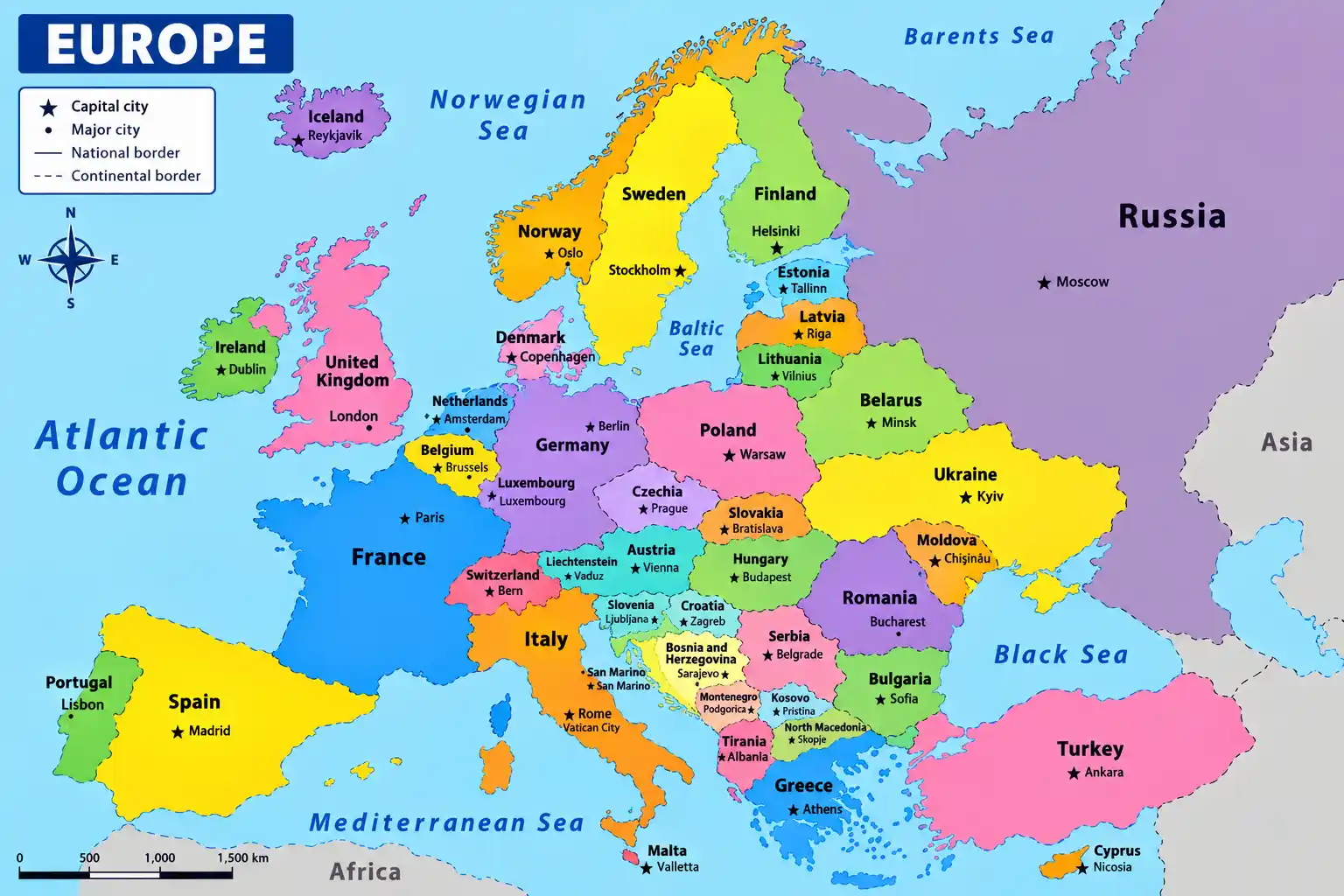
Comprehensive overview of the European continent: 50 internationally recognized sovereign countries, updated demographic data, economy, climate mosaic and geopolitics.
Europe is composed of 50 internationally recognized sovereign countries (UN members), plus several entities with limited recognition (Kosovo, Abkhazia, South Ossetia, Nagorno-Karabakh, Transnistria) depending on the count. The European continent covers approximately 10.18 million km² (including the European part of Russia), i.e. about 6.8% of the world's emerged land. European coastlines total approximately 112,483 km. These nations have about 743 million inhabitants (whole Europe, including Russia up to the Urals), i.e. about 9.2% of the world population, and generate about 22 to 25% of world GDP depending on the calculation method (in nominal terms, Europe exceeds the United States in aggregate).
Russia is considered a European country: although only 23% of its territory is in Europe (4.2 million km²), about 78% of its 146 million inhabitants live in the European part, west of the Ural Mountains, the conventional border between Europe and Asia. Moscow, located west of the Urals, is a European capital. The European part of Turkey (Eastern Thrace) concentrates only about 12% of the Turkish population (about 10 million out of 85 million), while Cyprus, although an EU member, belongs geographically to Asia (near the Middle East), but is culturally and politically considered European.
Western Europe
 Germany
 Austria
 Belgium
 France
 Liechtenstein
 Luxembourg
 Netherlands
 Monaco
 Switzerland
Eastern Europe
 Belarus
 Bulgaria
 Hungary
 Moldova
 Poland
 Romania
 Russia
 Slovakia
 Czechia
 Ukraine ⚠️ active conflict
 Denmark
 Estonia
 Finland
 Guernsey ¹
 Isle of Man ¹
 Åland Islands ¹
 Faroe Islands ¹
 Iceland
 Ireland
 Jersey ¹
 Latvia
 Lithuania
 Norway
 United Kingdom
 Sweden
 Svalbard ¹
 Albania
 Andorra
 Bosnia and Herzegovina
 Croatia
 Spain
Spain Gibraltar ¹
 Greece
 Italy
Italy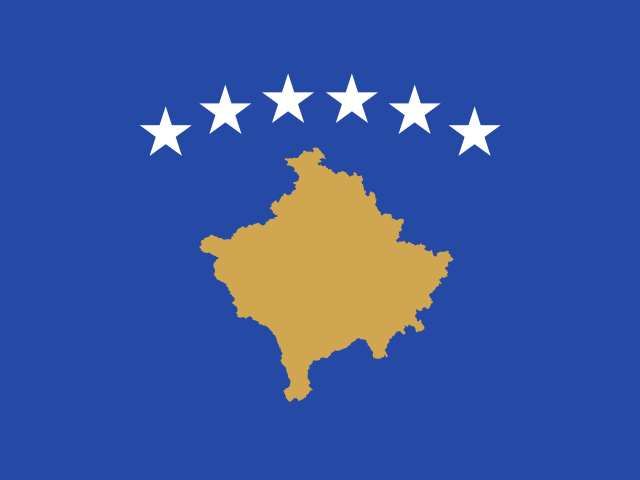 Kosovo
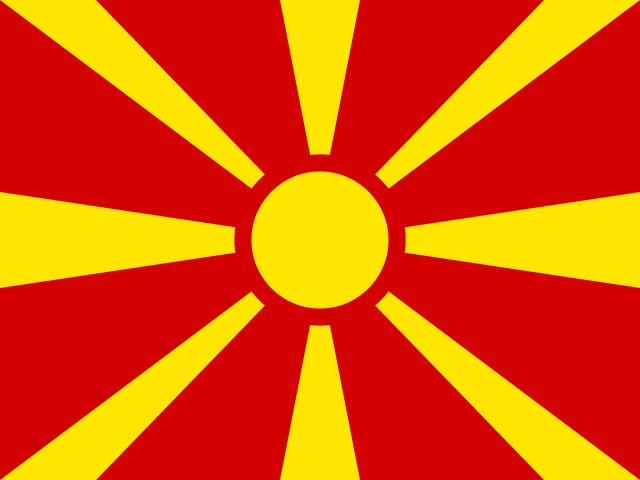 North Macedonia
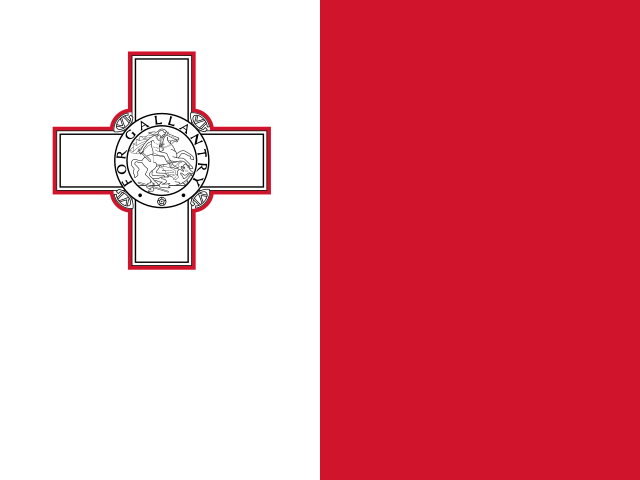 Malta
Malta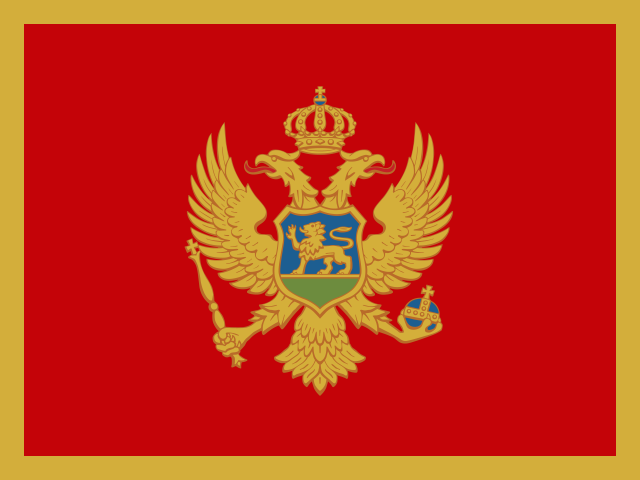 Montenegro
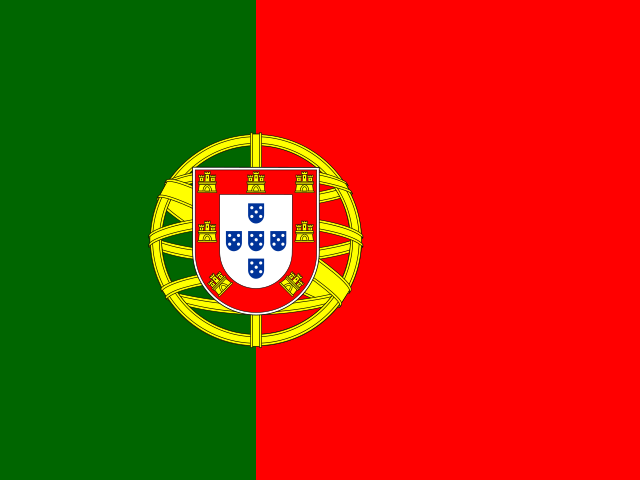 Portugal
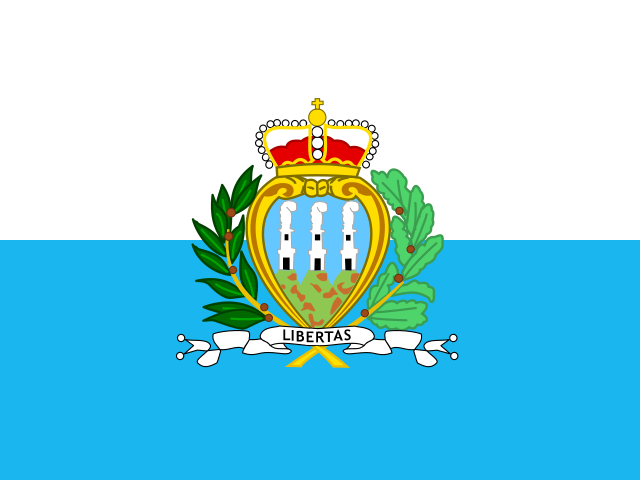 San Marino
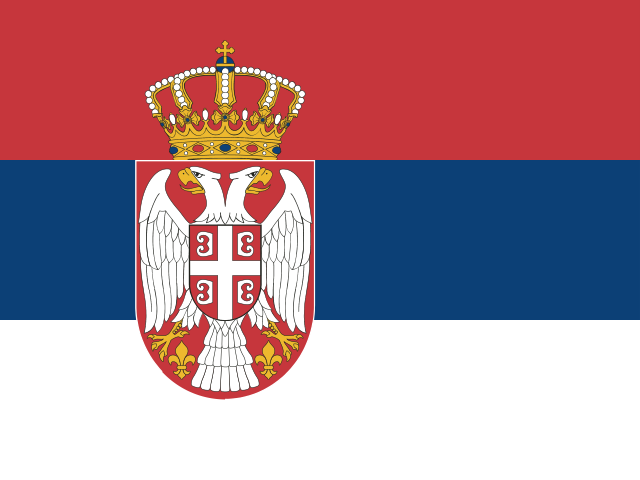 Serbia
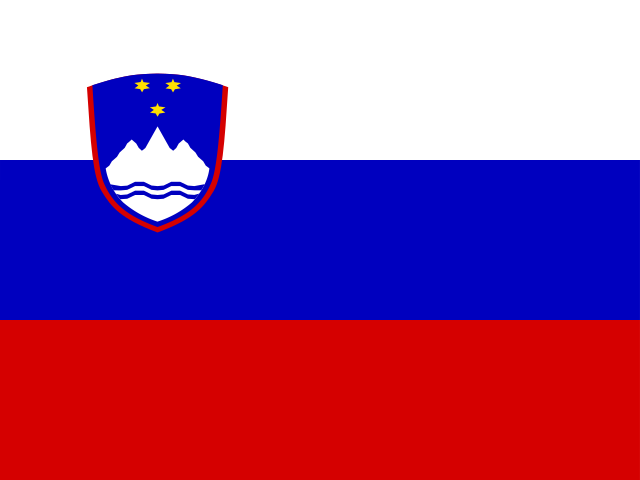 Slovenia
 Vatican
European state alliances and trade agreements
- CEFTA - Central European Free Trade Agreement
- CETA - Canada-Europe Trade Agreement
- EFTA - European Free Trade Association
- BENELUX - Belgium-Netherlands-Luxembourg Economic Union
- EMU - Economic and Monetary Union
- EU - European Union
- NATO - North Atlantic Treaty Organization
- PESCO - Permanent Structured Cooperation
- BSEC - Black Sea Economic Cooperation
- Schengen Area
- Visegrád Group (V4)
- Nordic Council
Most spoken native languages in Europe
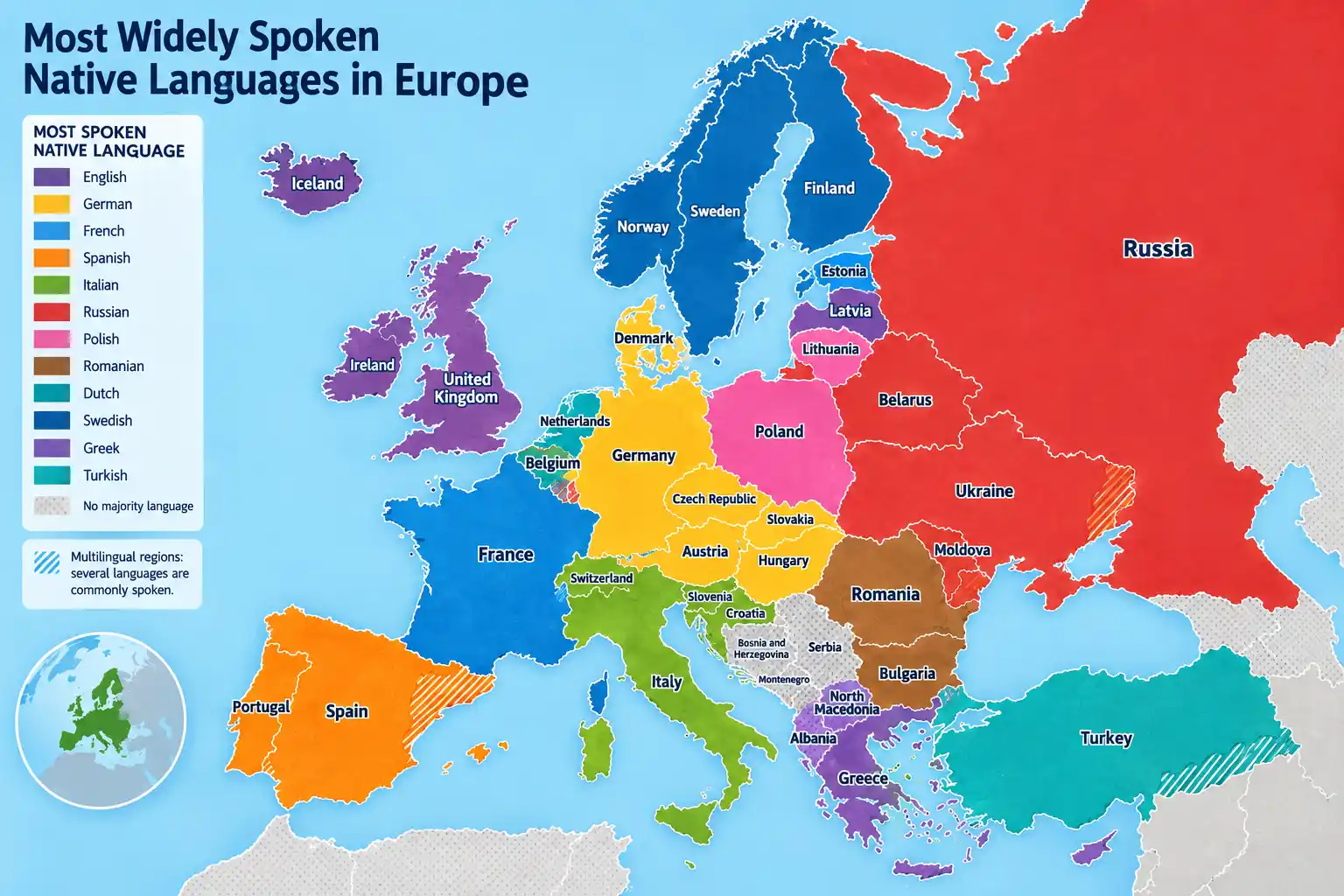
| Language | Share of Europeans | Native speakers (millions) |
|---|---|---|
| Russian | 16.5% | 120 million |
| German | 12.8% | 93 million |
| English | 11.2% | 81 million |
| French | 9.5% | 69 million |
| Italian | 7.8% | 57 million |
| Spanish | 6.9% | 50 million |
| Polish | 5.2% | 38 million |
| Ukrainian | 5.0% | 36 million |
| Romanian | 3.4% | 25 million |
| Dutch | 3.1% | 22.5 million |
| Portuguese | 2.1% | 15 million |
| Greek | 1.9% | 13.5 million |
| Hungarian | 1.6% | 12 million |
| Swedish | 1.4% | 10.5 million |
| Czech | 1.4% | 10 million |
Almost all European languages belong to the Indo-European family (Slavic, Germanic, Romance, Baltic, Hellenic, Albanian, Celtic groups), with the exception of Finnish, Estonian and Hungarian (Uralic family), Maltese (Semitic) and Basque (isolated language). The main religions follow a marked geographical distribution: Christianity dominant in the west, north and east (Catholicism, Protestantism, Orthodoxy), Islam present mainly in the Balkans (Albania, Bosnia, Kosovo) and Turkey, and Judaism as a minority.
Population and density in Europe
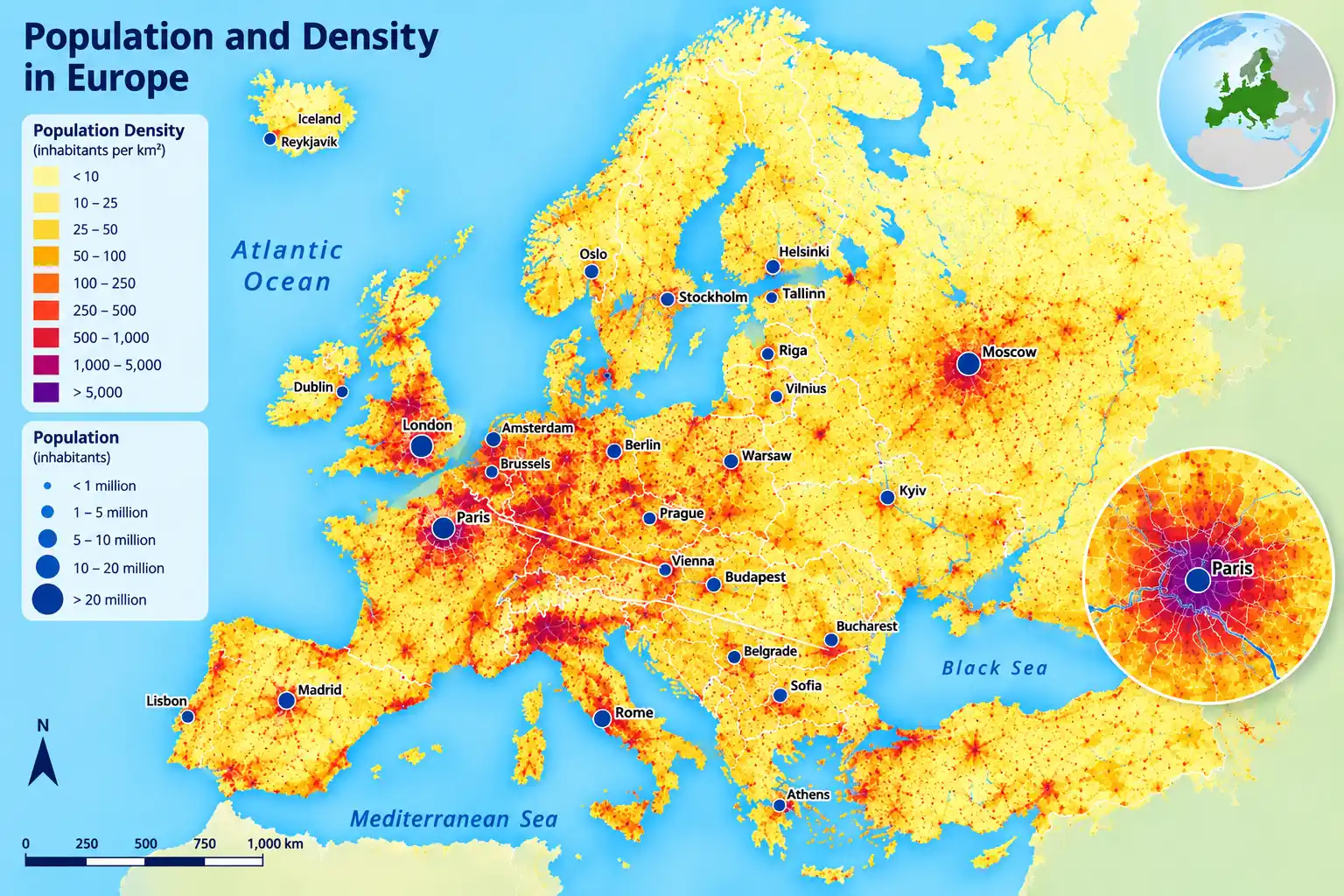
Compared to other continents, Europe is quite densely populated and highly urbanized: about 75% of Europeans live in cities. The average population density of the European continent (excluding Asian Russia) is about 70 to 75 inhabitants per km², with strong regional disparities. This density is significantly lower in Scandinavia and some Eastern European regions. Conversely, Central and Western Europe are densely populated:
Netherlands: (508 inhabitants/km²),
Belgium: (383 inhabitants/km²),
England: (434 inhabitants/km²),
Germany: (240 inhabitants/km²),
Italy: (206 inhabitants/km²),
Metropolitan France: (119 inhabitants/km²).
Almost all European languages belong to the large Indo-European family (Slavic, Germanic, Romance, Baltic, Hellenic, Albanian, Celtic and Armenian groups). Several languages have completely different origins: Finnish, Estonian and Hungarian (Uralic/Finnic-Ugric family), Maltese (Semitic, close to Arabic) and Basque (isolated pre-Indo-European language). The main religions also follow a marked geographical distribution: Christianity dominates the entire continent (Catholicism in Southern and Western Europe, Protestantism in Northern Europe, Orthodoxy in Eastern Europe and the Balkans), while Islam is majority or very present in the Balkans (Albania, Bosnia-Herzegovina, Kosovo) and in European Turkey. There are also significant Muslim communities in France, Germany, the United Kingdom and the Netherlands resulting from recent immigration.
European demographics
With a median age of 44.5 years in the European Union, Europe is the oldest continent in the world, ahead of North America (38.5 years) and Asia (32 years). This demographic data is structural and will not reverse in the short term, despite pro-natalist policies and immigration.
The average fertility rate in the European Union is 1.52 children per woman, well below the generational renewal threshold. The most fertile countries are France (1.84), Czechia (1.71), Romania (1.71), Ireland (1.70) and Sweden (1.67). The least fertile are Malta (1.13), Spain (1.19), Italy (1.20), Poland (1.26) and Finland (1.32).
Without migratory intake, the population of the European Union would already be decreasing by about 500,000 people per year. On average, 1.8 to 2.2 million net migrants enter the EU each year, mainly from Africa (Maghreb, sub-Saharan Africa), the Middle East (Syria, Iraq, Afghanistan, Turkey), Eastern Europe outside the EU (Ukraine, Belarus, Moldova) and South Asia (India, Pakistan, Bangladesh).
Immigration is a key factor of demographic stabilization for Europe, but it does not fully compensate for the natural deficit (births - deaths) in most countries. For example, in Germany, the population would have already decreased by more than 5 million since 1990 without migration flows.
📊 Summary demographic table of the European Union
| Indicator | Value |
|---|---|
| Total EU population (27 Countries) | 449 million |
| Median age | 44.5 years |
| Fertility rate | 1.52 children / woman |
| Infant mortality rate | 3.3 % |
| Life expectancy | 81.5 years (men: 78.9 - women: 84.1) |
| Population aged 65 and over | 21.2 % |
| Population aged 0-14 | 14.7 % |
Time zones in Europe
Europe extends over 4 main time zones (excluding overseas territories):
- UTC±0 (WET - Western European Time): Iceland, Ireland, Portugal, United Kingdom (including Gibraltar).
- UTC+1 (CET - Central European Time): Albania, Germany, Andorra, Austria, Belgium, Bosnia-Herzegovina, Croatia, Denmark, Spain (except Canary Islands), France (metropolitan), Hungary, Italy, Kosovo, Liechtenstein, Luxembourg, North Macedonia, Malta, Monaco, Montenegro, Norway, Netherlands, Poland, Czechia, San Marino, Serbia, Slovakia, Slovenia, Sweden, Switzerland, Vatican.
- UTC+2 (EET - Eastern European Time): Bulgaria, Cyprus, Estonia, Finland, Greece, Latvia, Lithuania, Moldova, Romania, Turkey, Ukraine (majority of territory).
- UTC+3 (MSK - Moscow Time): Belarus, Russia (European part).
Special cases and exceptions: Kazakhstan (a small part of which is in Europe) uses UTC+3 to UTC+5 (Aqtöbe, Atyrau, Western Urals). Russia, although spanning 11 time zones in total, only uses UTC+3 for its European part (from Kaliningrad to the Urals). Turkey abandoned daylight saving time in 2016 and remains on UTC+3 all year round. Belarus is also on permanent winter time (UTC+3) since 2011.
European institutions
European geology and geography
From a strictly geological point of view, Europe is not a distinct continent in terms of tectonic plates. It lies on the Eurasian plate, which extends from the middle of the North Atlantic to the Pacific. However, the Iberian Peninsula, Italy, the Balkans, Greece and much of Turkey also lie on the Eurasian plate, but with adjacent microplates (Anatolian plate, Aegean plate).
Part of Iceland, meanwhile, straddles the Mid-Atlantic Ridge, at the boundary between the Eurasian and North American plates. The conventional cultural, historical and geographical boundary between Europe and Asia is drawn in the east along the Ural Mountains, the Ural River, the Caspian Sea, the Caucasus Mountains and the Bosphorus Strait.
Main European geological features:
- Scandinavian Shield (or Fennoscandia): Precambrian rocks among the oldest in the world (up to 3.5 billion years), outcropping in Norway, Sweden, Finland and northwestern Russia.
- Great plains of Central and Eastern Europe: vast sedimentary deposits stretching from northern France to western Russia.
- Alpine chains (Alps, Carpathians, Balkans, Apennines, Pyrenees): recent geological formation (Tertiary era) due to the collision between the African plate and the Eurasian plate.
- Paris Basin and London Basin: Cretaceous and Tertiary sedimentary basins.
- Active volcanism: Iceland (Mid-Atlantic Ridge), Italy (Vesuvius, Etna, Stromboli), Greece (Santorini), Portugal (Azores archipelago).
Climate in Europe
Europe extends from the Arctic Circle (Norwegian island of Svalbard) to the shores of the Mediterranean Sea (Crete) and even to the Spanish Canary Islands (off the coast of Africa). Five main climatic regimes share the territory, with well-established annual recurrences.
| Climate zone | European climate |
|---|---|
| Oceanic | Mild winters (2-7°C), cool summers (15-22°C), regular rain all year round (600-1200 mm) |
| Continental | Cold winters (-10 to 0°C), hot summers (18-28°C), maximum precipitation in summer, frequent snow in winter |
| Mediterranean | Hot to very hot summers (25-40°C) and dry, mild winters (5-15°C), stormy autumns, precipitation concentrated in winter and spring |
| Alpine | Extreme altitudinal variations, significant winter snowfall (November to May), cool summers. |
| Subarctic | Very long and harsh winters (-30 to -10°C), short and cool summers (5-15°C), low winter sunshine |
Weather records in Europe
🌧️ Rainiest city in Europe: Bergen (Norway) ≈ 2,250 mm/year (some Norwegian villages exceed 3,500 mm/year)
☀️ Driest city in Europe: Almería (Spain)
🔥 Highest temperature officially recorded in Europe: 48.8°C in Sicily (Italy), Floridia, 11 August 2021 (previous record 48.0°C in Athens in 1977)
❄️ Lowest temperature in geographical Europe: -58.1°C in Ust'-Ščugor (Komi Republic, European Russia), 31 December 1978.
🌡️ Official cold record (outside Russia): -52.6°C in Vuoggatjålme (Sweden), 4 February 1966.
Energy in Europe
The EU imports about 55 to 60% of its energy, a figure that remains high despite transitions and independence efforts since 2022. This rate varies considerably depending on the member state: Denmark (about 35%) and Estonia (about 15%) are less dependent, while Cyprus (>95%), Malta (>95%), Luxembourg (>90%) and Italy (>75%) remain very vulnerable to imports.
The main European energy models are:
- Nuclear model: France (≈64.8% of electricity from nuclear in 2024), Slovakia (59%), Belgium (46%), Finland (41%), Sweden (29%, complemented by hydropower), Bulgaria (38%), Hungary (47%), Czechia (34%). France remains the most nuclearized country in Europe in proportion.
- Renewable model (hydropower + wind + solar): Norway (88% hydro), Sweden (40% hydro + 20% wind + nuclear), Denmark (58% wind, world record), Portugal (55% renewables), Spain (50% renewables, including 23% wind, 14% solar), Austria (78% renewables, dominated by hydro), Germany (55% renewables in 2024: 31% wind, 12% solar, 9% biomass, 3% hydro).
- Gas/coal model: Poland (≈68% coal, still very dependent, but declining), Italy (≈45% natural gas, 35% renewables, the rest imported), Netherlands (≈40% gas, 48% renewables after the gradual closure of the Groningen field), Ireland (≈50% gas), Greece (≈45% gas).
 Nigeria
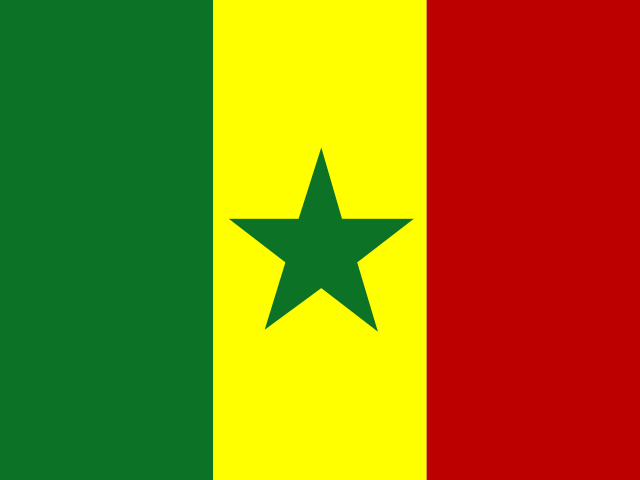 Senegal
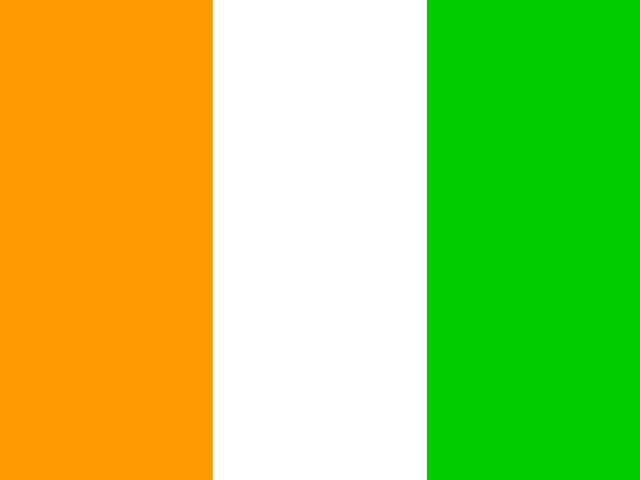 Ivory Coast
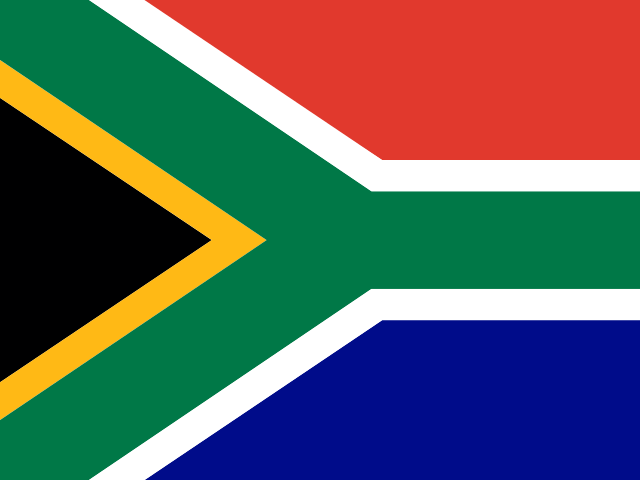 South Africa
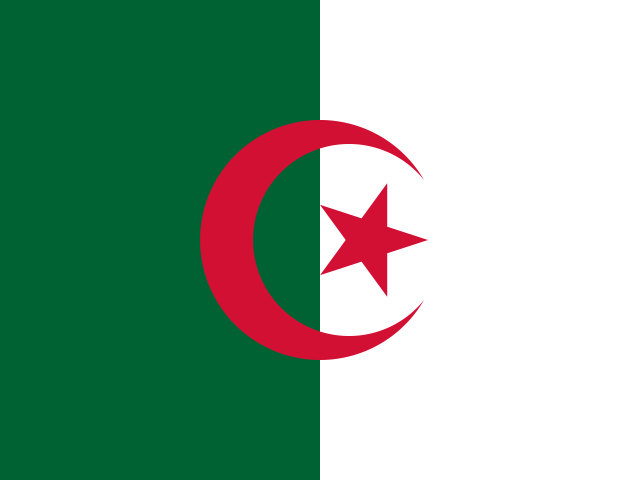 Algeria
 United States
 Canada
 China
China India
India Japan
Japan South Korea
 Turkey
 Saudi Arabia
 Iran
Iran Australia
 New Zealand