
Oceania
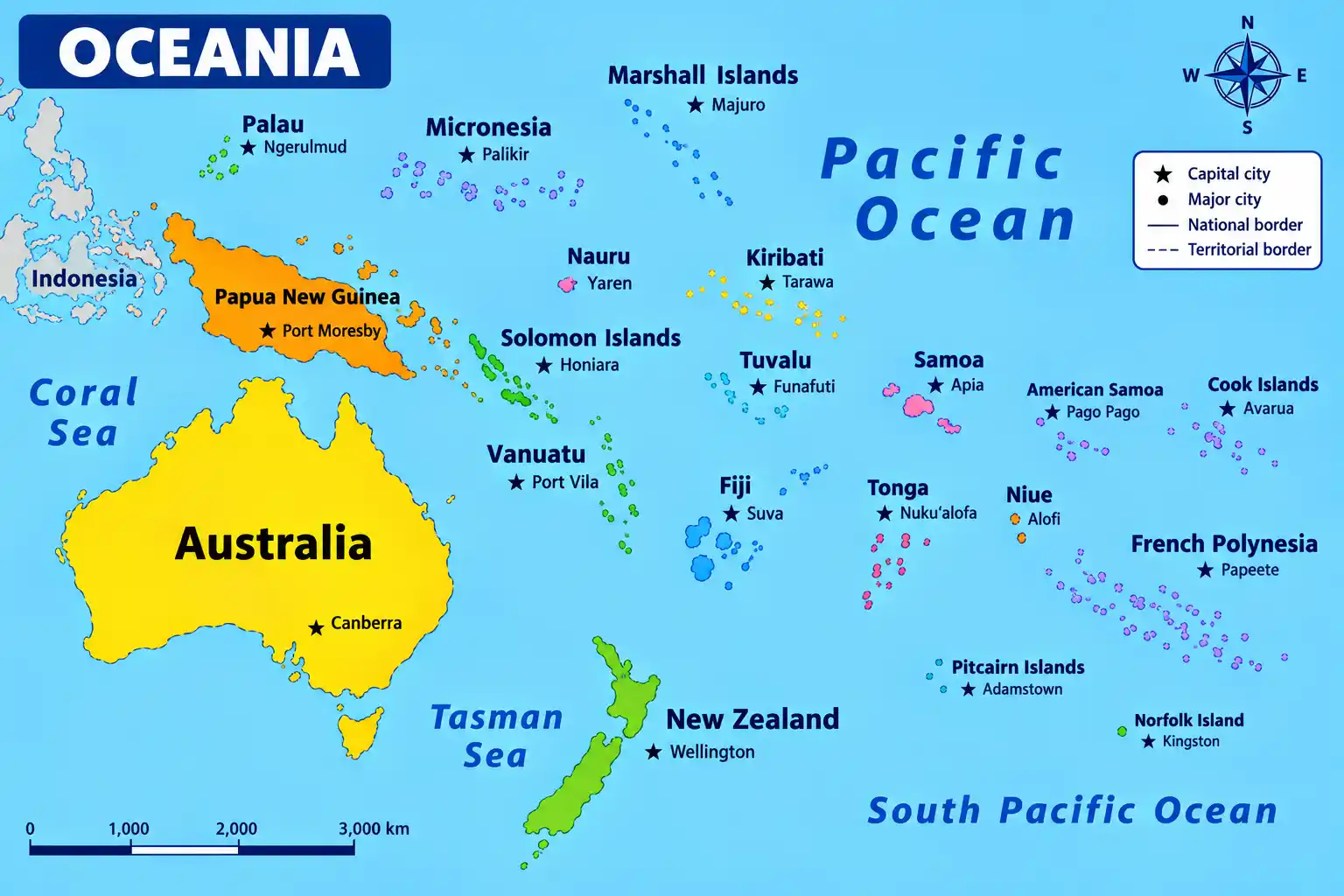
Complete overview of the Oceanian continent: 14 internationally recognized sovereign countries, up-to-date demographic data, economy, climate mosaic and Pacific geopolitics.
Oceania is made up of 14 internationally recognized sovereign countries (UN members), plus around twenty dependent territories or autonomous regions (New Caledonia, French Polynesia, Guam, American Samoa, Cook Islands, Niue, Tokelau, Wallis and Futuna, Pitcairn, etc.). The Oceanian continent covers about 8.53 million km², making it the smallest of the six continents, of which 7.69 million km² is Australia alone (about 90% of the total area). These nations have about 45 million inhabitants, barely 0.56% of the world population, making it the least populated continent after Antarctica.
The geographic particularity of Oceania lies in its immense maritime space: the countries of the Pacific Islands Forum alone control more than 30 million km² of exclusive economic zones (EEZs), an area four times larger than the African continent. This considerable maritime sovereignty gives the Pacific micro-states geopolitical weight far greater than their demographic weight. Australia and New Zealand alone account for about 85% of Oceania's GDP and 78% of the continent's population. Conversely, states such as Tuvalu (11,000 inhabitants), Nauru (12,000 inhabitants) or Niue are among the smallest nations in the world.
 Australia
 New Zealand
 Fiji
Fiji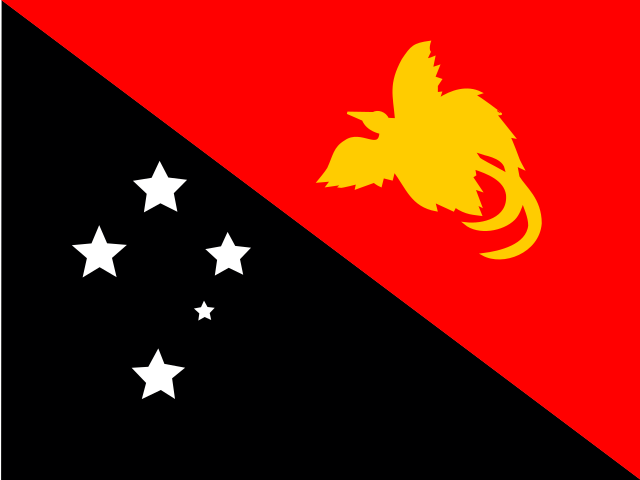 Papua New Guinea
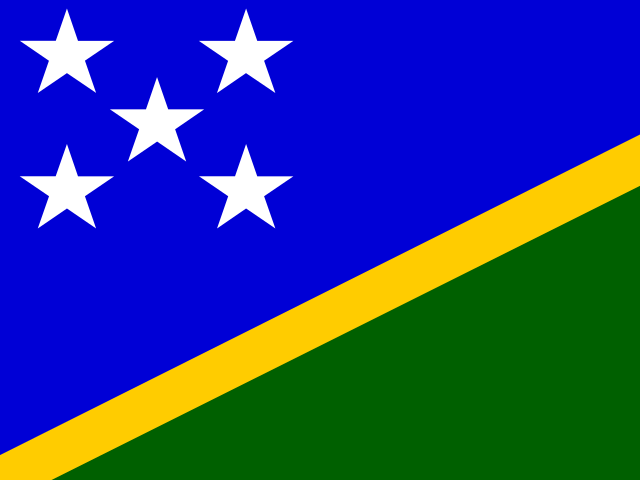 Solomon Islands
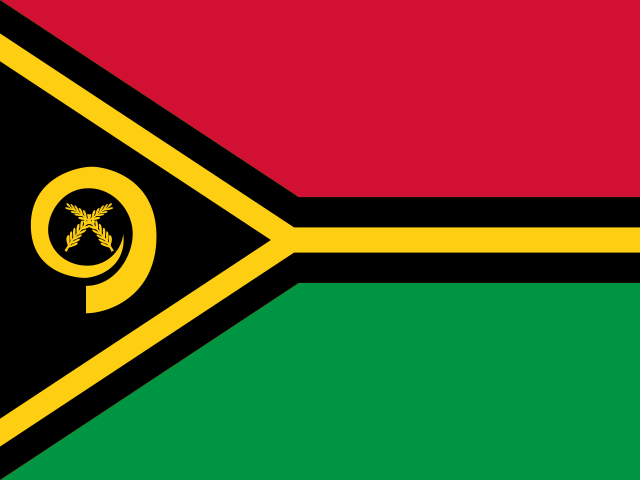 Vanuatu
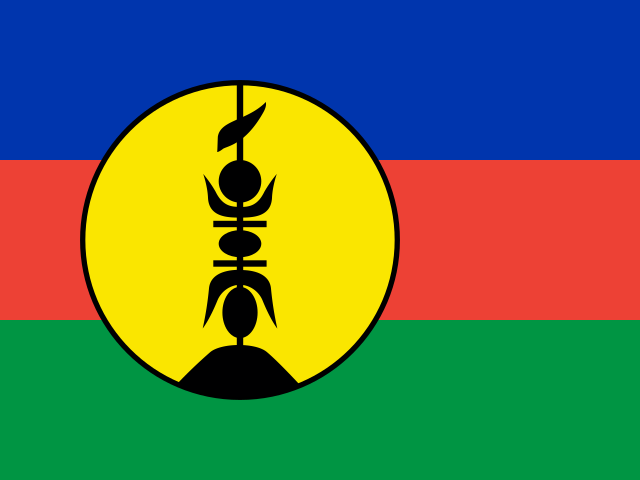 New Caledonia ¹
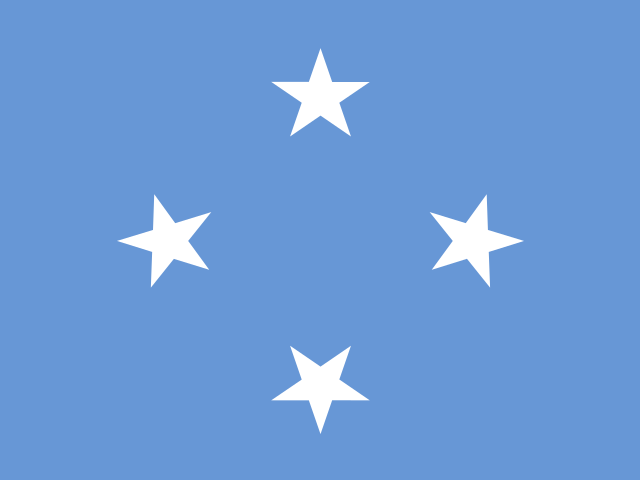 Federated States of Micronesia
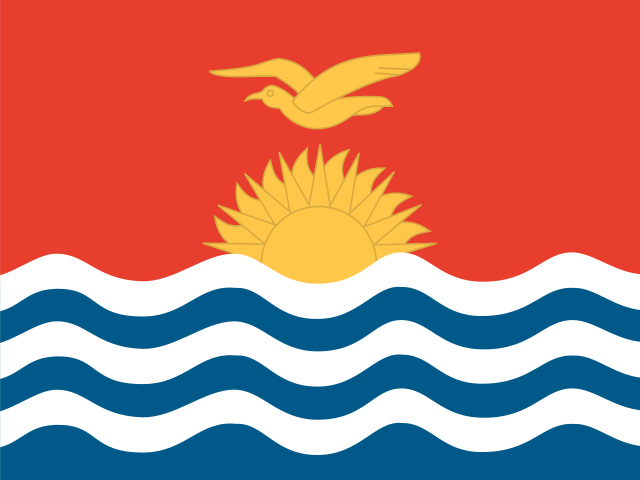 Kiribati
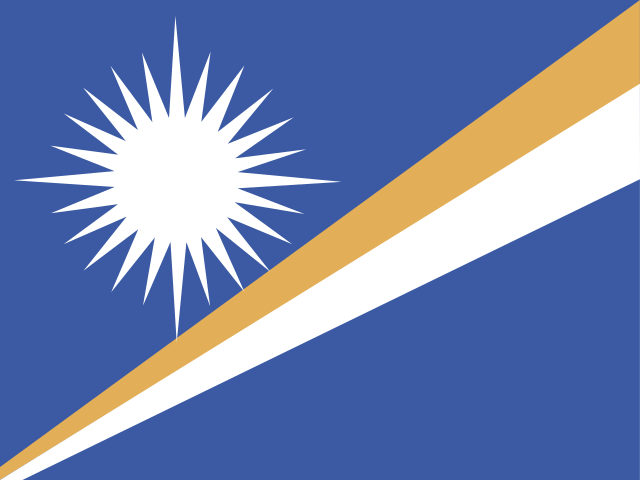 Marshall Islands
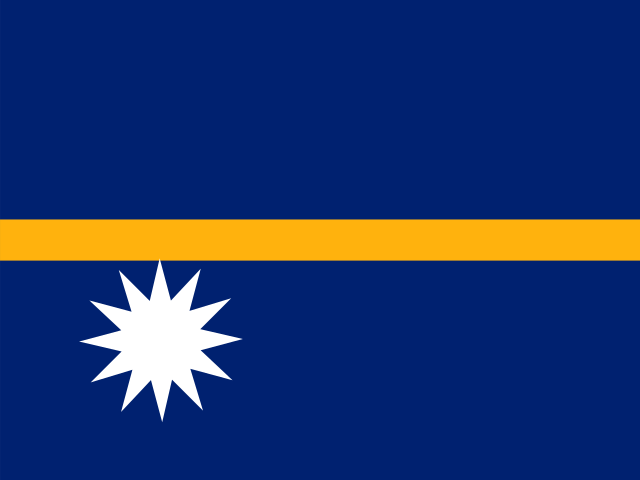 Nauru
Nauru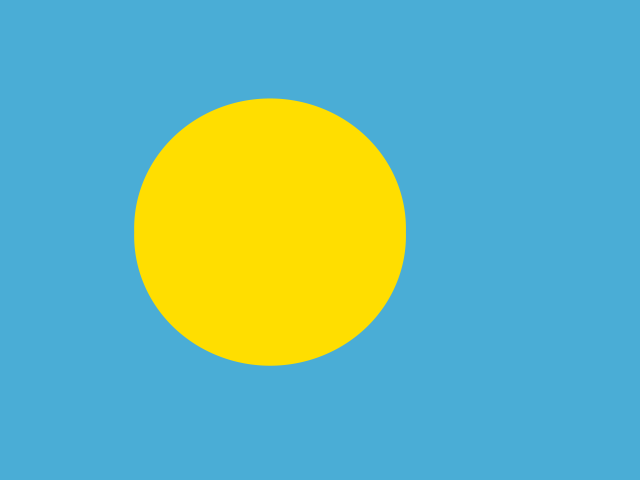 Palau
Palau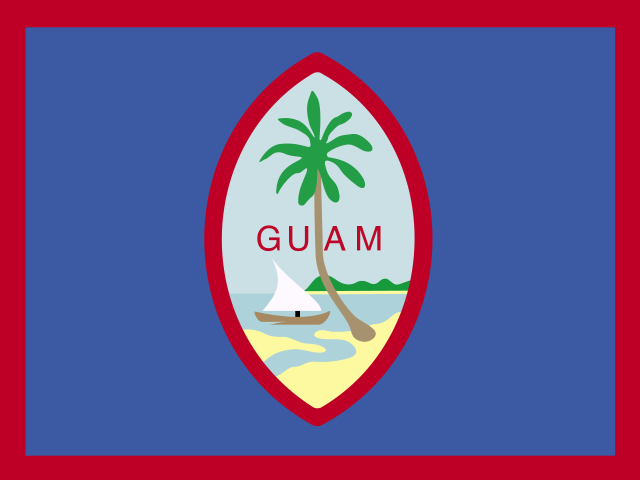 Guam ¹
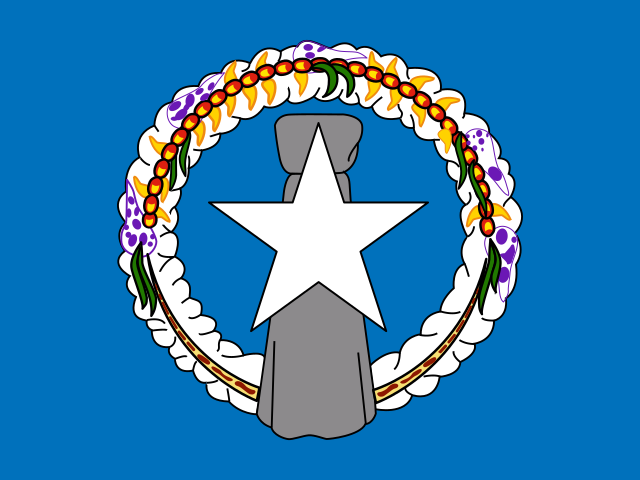 Northern Mariana Islands ¹
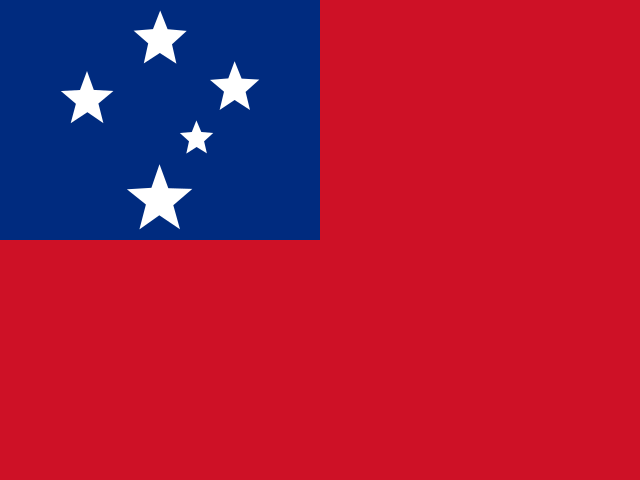 Samoa
Samoa Tonga
Tonga Tuvalu
 French Polynesia ¹
 American Samoa ¹
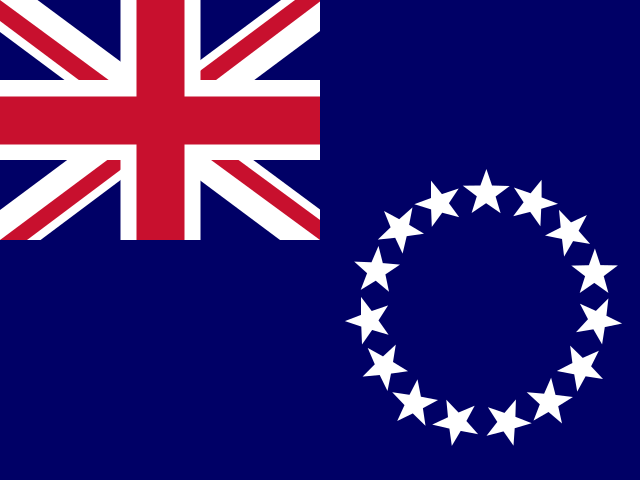 Cook Islands ¹
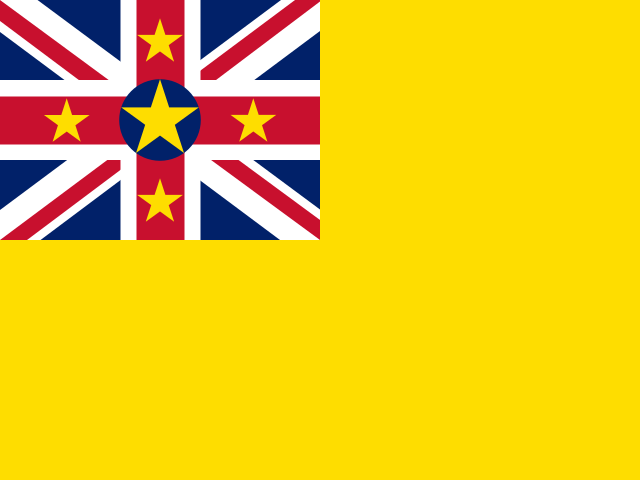 Niue ¹
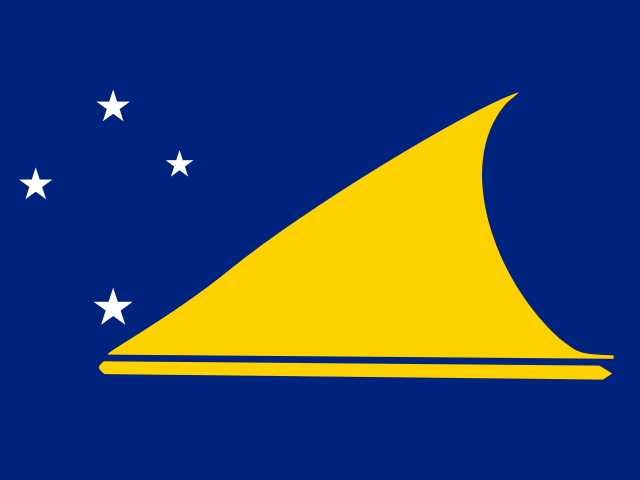 Tokelau ¹
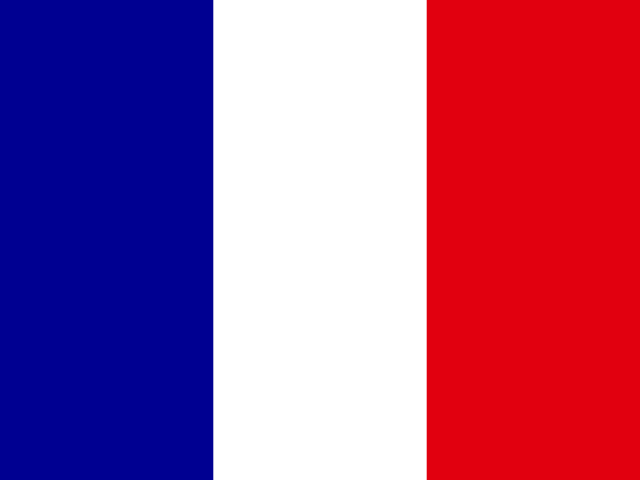 Wallis and Futuna ¹
 Pitcairn ¹
Oceanian state alliances and regional agreements
- PIF - Pacific Islands Forum
- SPC - Pacific Community
- FFA - Forum Fisheries Agency
- SPREP - Secretariat of the Pacific Regional Environment Programme
- ANZUS - Australia/NZ/United States Pact
- CER - Australia/NZ Closer Economic Relations
- PACER Plus - Pacific Agreement on Closer Economic Relations
- RCEP - Regional Comprehensive Economic Partnership
- AOSIS - Alliance of Small Island States
- Melanesian Spearhead Group
- Polynesian Leaders Group
- Commonwealth
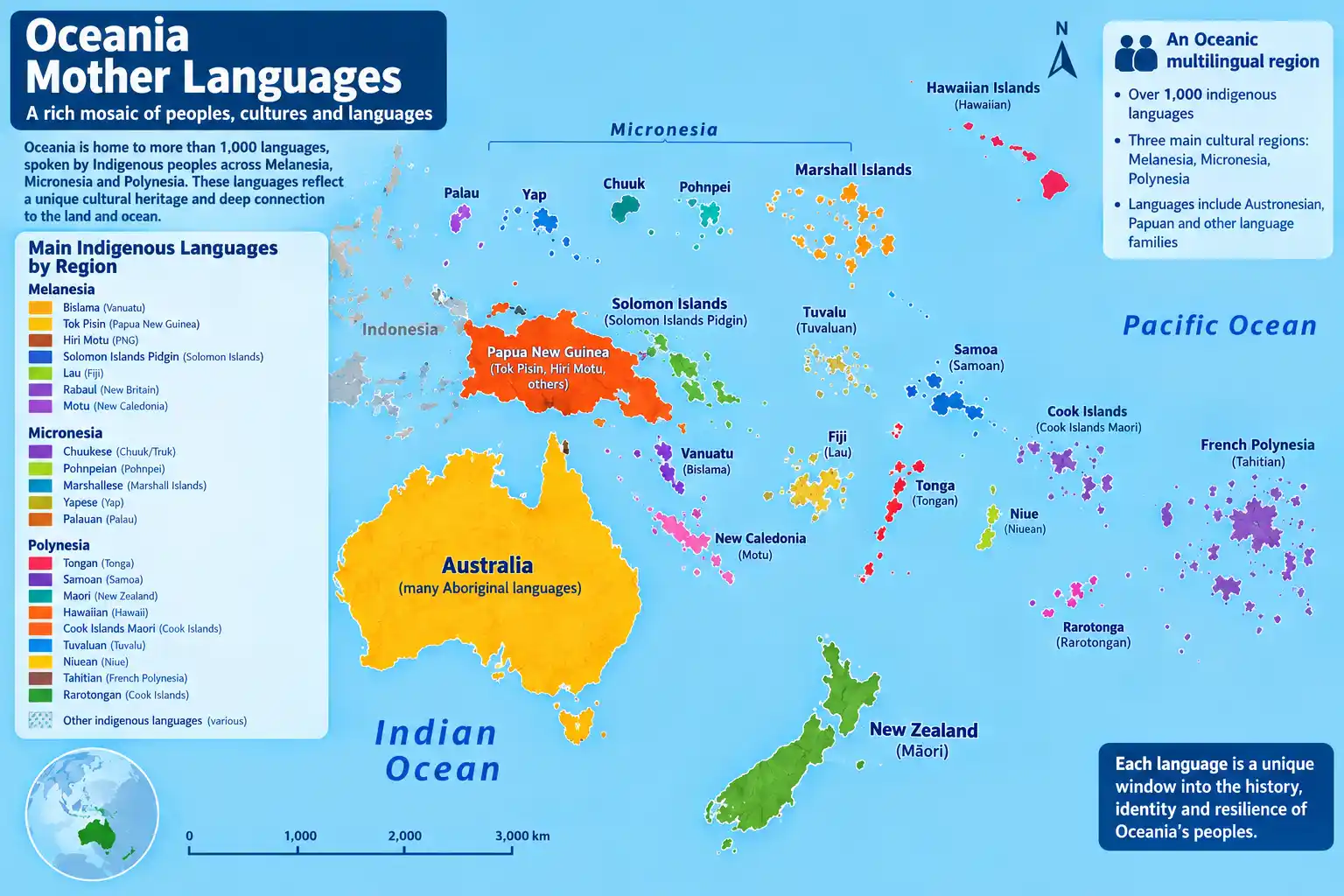
Most spoken native languages in Oceania
| Language | Share of Oceanians | Native speakers (millions) |
|---|---|---|
| English | 60.5% | 27.0 million |
| Tok Pisin | 9.0% | 4.0 million |
| French | 1.6% | 0.72 million |
| Samoan | 1.1% | 0.50 million |
| Fijian | 0.9% | 0.40 million |
| Tongan | 0.4% | 0.19 million |
| Māori | 0.35% | 0.16 million |
| Hiri Motu | 0.27% | 0.12 million |
| Kiribati | 0.27% | 0.12 million |
| Bislama | 0.07% | 0.033 million |
| Nauruan | 0.03% | 0.012 million |
| Tuvaluan | 0.02% | 0.011 million |
| Marshallese | 0.02% | 0.010 million |
| Palauan | 0.01% | 0.005 million |
| Rotuman | <0.01% | 0.002 million |
Oceania is the most linguistically diverse continent in the world in proportion to its population. Papua New Guinea alone has more than 800 living languages (about 12% of the world's languages), making it the most multilingual country on the planet. Oceanian languages belong mainly to the Austronesian family (Polynesian, Micronesian and Melanesian groups), except for the Papuan languages of New Guinea (a non-Austronesian family, with more than 700 languages) and the Aboriginal Australian languages (about 250 languages, many of them endangered). Tok Pisin (PNG) and Bislama (Vanuatu) are English-based creoles that have become lingua francas. The dominant religion is Christianity (Catholicism, Protestantism, Anglicanism), with traditional beliefs still alive in some communities.
Population and density in Oceania
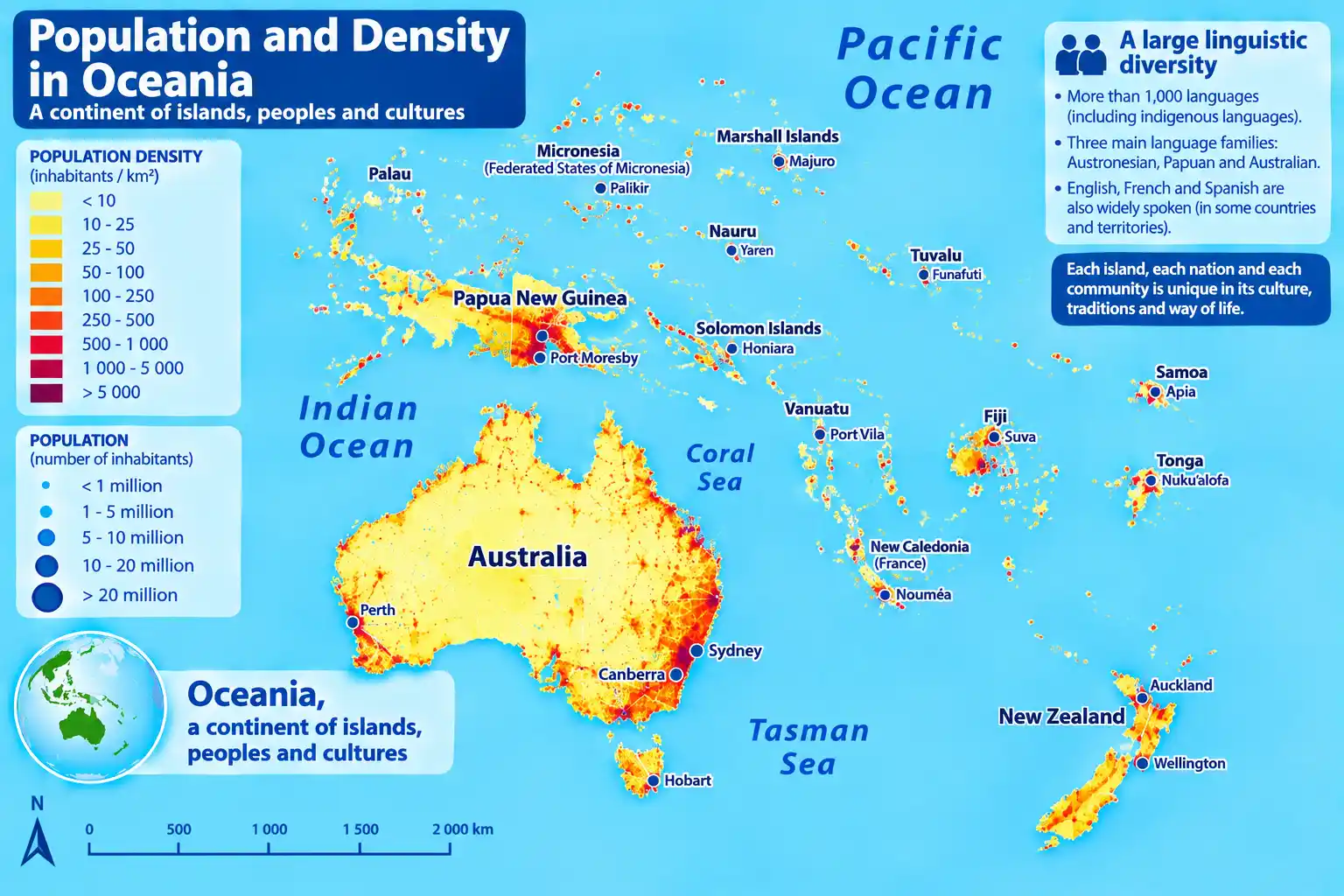
Oceania is the least densely populated continent in the world, with an average of about 5.3 inhabitants per km², but this average masks extreme contrasts. More than 68% of Oceanians live in cities, with highly advanced urbanisation in Australia (86%) and New Zealand (87%), compared with only 13% in Papua New Guinea. The highest densities are found in the small island micro-states:
Nauru: (≈ 600 inhabitants/km²),
Tuvalu: (≈ 470 inhabitants/km²),
Marshall Islands: (≈ 330 inhabitants/km²),
Samoa: (≈ 70 inhabitants/km²),
Tonga: (≈ 140 inhabitants/km²),
Fiji: (≈ 50 inhabitants/km²),
Australia: (≈ 3.5 inhabitants/km²).
The Oceanian population is characterised by a very uneven distribution: 60% of the population lives in Australia, 24% in Papua New Guinea, 12% in New Zealand and only 4% in all the other island states combined. Indigenous peoples (Aboriginal and Torres Strait Islander peoples in Australia, Māori in New Zealand, Papuans in New Guinea, Polynesians, Melanesians, Micronesians) make up a significant share of the population, with rates sometimes above 90% in the island states. The main Oceanian metropolises are Sydney (5.3 million), Melbourne (5.2 million), Brisbane (2.6 million), Perth (2.2 million) and Auckland (1.7 million).
Oceanian demography
With a median age of about 33 years for Oceania as a whole, the continent has very heterogeneous demographic profiles. Australia (38.5 years) and New Zealand (38.1 years) follow the pattern of ageing developed countries, while Papua New Guinea (22 years), the Solomon Islands (23 years) and Vanuatu (24 years) have very young structures, typical of developing countries.
The average fertility rate in Oceania is about 2.1 children per woman, but with considerable variation: Australia (1.63) and New Zealand (1.61) are below replacement level, while the Solomon Islands (4.0), Samoa (3.9), Vanuatu (3.7) and Papua New Guinea (3.4) record some of the highest rates in the world. This high birth rate explains the rapid population growth of Melanesia and western Polynesia.
Emigration is a major demographic factor for the small island states: Polynesian, Melanesian and Micronesian communities are very present in Australia, New Zealand and the United States (Hawaii, California). Remittances from diasporas sometimes represent more than 20% of GDP in some states (Tonga, Samoa, Kiribati). In Australia and New Zealand, immigration remains the main driver of population growth, with large flows from Asia, the United Kingdom and the Pacific islands.
📊 Summary demographic table for Oceania
| Indicator | Value |
|---|---|
| Total population of Oceania | ≈ 45 million |
| Population of Australia | 27.0 million |
| Population of Papua New Guinea | 10.6 million |
| Population of New Zealand | 5.3 million |
| Median age | ≈ 33 years |
| Average fertility rate | ≈ 2.1 children / woman |
| Life expectancy (Australia) | 83.2 years (men: 81.3 - women: 85.2) |
| Life expectancy (Papua New Guinea) | 65.4 years |
| Urbanisation rate | 68% |
| Annual population growth | ≈ 1.3% |
Time zones in Oceania
Oceania spans 7 main time zones, due to its immense maritime area. It is the continent with the greatest time range in the world:
- UTC+8 (AWST - Australian Western Standard Time): Western Australia (Perth).
- UTC+9 (PWT - Palau Time): Palau.
- UTC+9:30 (ACST - Australian Central Standard Time): South Australia, Northern Territory (Alice Springs, Darwin).
- UTC+10 (AEST - Australian Eastern Standard Time): Queensland, New South Wales, Victoria, Tasmania, Australian Capital Territory, Guam, Northern Mariana Islands, Papua New Guinea.
- UTC+11 (NCT - New Caledonia Time): New Caledonia, Solomon Islands, Vanuatu.
- UTC+12 (NZST - New Zealand Standard Time): New Zealand, Fiji, Nauru, Tuvalu, Marshall Islands, Wallis and Futuna, Gilbert Islands (Kiribati).
- UTC+13 (WST - Samoa and Tonga Time): Samoa, Tonga, Tokelau, Phoenix Islands (Kiribati).
- UTC+14 (LINT - Line Islands Time): Line Islands (Kiribati) — the most advanced time zone in the world.
Special cases and exceptions: The Chatham Islands (New Zealand) use UTC+12:45, a unique time zone in the world. Lord Howe Island (Australia) is at UTC+10:30 in winter and UTC+11 in summer. Kiribati, straddling the equator and the International Date Line, voluntarily unified its territory in 1995 by moving the Date Line: the Line Islands are therefore the first in the world to enter each new day (UTC+14). French Polynesia is at UTC-10 (22 hours behind New Caledonia).
Oceanian institutions
- PIF - Pacific Islands Forum (Suva)
- SPC - Pacific Community (Nouméa)
- SPREP - Secretariat of the Pacific Regional Environment Programme (Apia)
- FFA - Forum Fisheries Agency (Honiara)
- USP - University of the South Pacific (Suva)
- Asian Development Bank (Manila)
- Secretariat of the Pacific Regional Programme
- Pacific Community (SPC)
Oceanian geology and geography
From a strictly geological point of view, Oceania is not a single continent: it consists of a large continental landmass (Australia, on the Australian Plate) and countless volcanic and coral islands scattered across the Pacific Ocean. Australia rests on the Australian Plate, one of the oldest and most stable in the world, which explains the absence of active volcanism and the rarity of earthquakes on its territory. Conversely, the Pacific Ring of Fire crosses New Zealand, Papua New Guinea, the Solomon Islands, Vanuatu, Tonga and the Marianas, subduction zones among the most active on the planet.
New Zealand is the emerged summit of the almost submerged continent of Zealandia (5 million km², 94% of which is underwater), which separated from Antarctica about 80 million years ago. Papua New Guinea occupies the eastern half of the island of New Guinea, the second largest island in the world after Greenland, born from the collision between the Australian and Pacific plates.
Main Oceanian geological features:
- Australian Shield: a Precambrian craton among the oldest in the world (up to 3.5 billion years old), rich in minerals (iron, gold, uranium, bauxite).
- Great Barrier Reef: the largest coral reef in the world (2,300 km long, 344,400 km²), a UNESCO World Heritage Site.
- New Zealand's Southern Alps: the Southern Alps with Aoraki/Mount Cook (3,724 m), a recent formation linked to the collision of the Pacific and Australian plates.
- Active volcanism: Ruapehu and Taupo (New Zealand), Tavurvur and Ulawun (Papua New Guinea), Yasur (Vanuatu), Tofua (Tonga), Kilauea (Hawaii).
- Uluru / Ayers Rock: a red sandstone monolith 348 m high, a geological emblem of central Australia.
- Tonga Trench: the deepest oceanic trench in the Southern Hemisphere (10,882 m).
Climate in Oceania
Oceania extends from the equator (Papua New Guinea, Kiribati) to cold temperate latitudes (New Zealand, Tasmania) and covers arid deserts (central Australia). Five main climate regimes share the territory, with well-established annual patterns.
| Climate zone | Oceanian climate |
|---|---|
| Tropical equatorial | Hot and humid all year round (25-32°C), abundant rainfall (2,000-5,000 mm/year), cyclone season from November to April |
| Tropical monsoon | Marked dry and wet seasons, high temperatures (22-32°C), frequent cyclones (Fiji, Vanuatu, Solomon Islands) |
| Humid subtropical | Hot, humid summers (22-30°C), mild winters (8-18°C), regular rainfall (1,000-1,600 mm/year) |
| Desert and semi-arid | Very low rainfall (< 250 mm/year), extreme temperature ranges (0-45°C), central and western Australia |
| Temperate oceanic | Mild summers (15-25°C), cool winters (5-12°C), regular rain, New Zealand, Tasmania, Victoria |
| Alpine | Snow and ice at altitude, New Zealand's Southern Alps, Australian Snowy Mountains, harsh winters |
Weather records in Oceania
🌧️ Wettest place in Oceania: Milford Sound (New Zealand) ≈ 6,800 mm/year; Mount Waialeale (Hawaii) ≈ 11,500 mm/year (among the wettest in the world)
☀️ Driest place in Oceania: Oodnadatta region and Lake Eyre (South Australia), with less than 150 mm of rain per year
🔥 Highest temperature officially recorded in Oceania: 50.7 °C at Oodnadatta (South Australia) on 2 January 1960 (Australian national record)
❄️ Lowest temperature in Oceania: -25.6 °C at Ranfurly (New Zealand) on 18 July 1903.
🌪️ Most intense cyclone: Cyclone Winston (Fiji, February 2016), winds up to 280 km/h, more than 40 deaths and damage estimated at US$1.4 billion.
🌡️ Heat record in New Zealand: 42.4 °C at Rangiora on 7 February 1973.
Energy in Oceania
Oceania shows a major energy contrast between Australia, a world exporter of coal and gas, and the small island states, which are highly dependent on diesel imports. Australia is the world's leading exporter of coal and liquefied natural gas (LNG), but its electricity generation remains dominated by fossil fuels (about 60% in 2024), despite rapid growth in solar and wind power. New Zealand stands out as a model with about 82 to 88% renewable electricity, dominated by hydropower and geothermal energy.
The main Oceanian energy models are:
- Coal and gas model: Australia (≈60% fossil fuels, including 45% coal, but 40% renewables growing rapidly: 19% solar, 13% wind, 6% hydro).
- Renewable model (hydro + geothermal + wind): New Zealand (≈82% renewables: 60% hydro, 18% geothermal, 6% wind), Fiji (≈60% hydro), Samoa and Vanuatu (hydro and solar under development).
- Island diesel and solar model: Most small island states (Tuvalu, Kiribati, Nauru, Marshall Islands, Palau) depend on imported diesel for more than 80% of their energy, but are massively developing solar photovoltaics to reduce their energy bills. Tuvalu aims for 100% renewable electricity by 2030.
- Gas and exporter model: Papua New Guinea (LNG), Australia (world's leading LNG exporter).
 Nigeria
 Senegal
 Ivory Coast
 South Africa
 Algeria
 United States
 Canada
 China
China India
India Japan
Japan South Korea
 Turkey
 Saudi Arabia
 Iran
Iran France
 Germany
 Italy
Italy United Kingdom
 Spain
Spain Ukraine
 Russia
 Netherlands
 Belgium
 Switzerland