
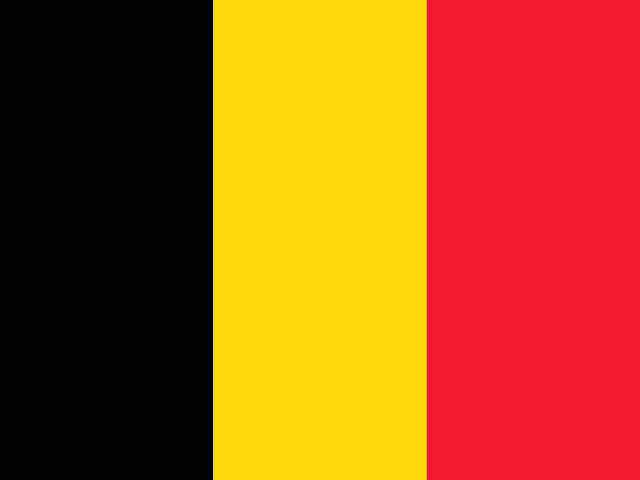
Belgium
Complete data on Belgium: geography, population, economy, culture, institutions, key indicators and statistics. Information updated in real time.
Time and date in Belgium
Overview
Belgium, officially the Kingdom of Belgium (Koninkrijk België / Royaume de Belgique / Königreich Belgien), is a federal state in Western Europe. It is bordered by four neighbouring countries: the Netherlands to the north, Germany and Luxembourg to the east, and France to the south. With a population of about 11.87 million inhabitants as of 1 January 2026, it is one of the most densely populated countries in Europe.
Belgium is an open economy and one of the six founding members of the European Union. Brussels, its capital, hosts the main European institutions (Commission, Council, Parliament) as well as the NATO headquarters. The country is a federal constitutional monarchy, divided into three regions (Flanders, Wallonia, Brussels-Capital) and three linguistic communities (Dutch-speaking, French-speaking, German-speaking). Its official languages are Dutch, French and German.
Data on Belgium
Geography of Belgium
Belgium is a Western European country with an area of about 30,688 km². It is bordered by the North Sea to the northwest over about 65 km, and shares its borders with the Netherlands to the north, Germany to the east, Luxembourg to the southeast and France to the south. Its central position in the heart of Western Europe makes it a major economic and political crossroads.
Belgian relief is divided into three main zones. Lower Belgium (coastal plains and polders) extends to the northwest along the North Sea. Middle Belgium (central plateau) occupies the centre of the country, with gentle hills and fertile valleys. Upper Belgium (Ardennes) in the southeast is a region of plateaus and wooded hills, culminating at the Signal de Botrange at 694 metres, the country's highest point.
The hydrographic network is dominated by the Meuse and the Scheldt, two rivers that cross the country and are important navigable waterways. The Sambre, the Lys and the Ourthe are other notable watercourses. Belgium also has a coastline of sandy beaches and major seaports such as Antwerp (second European port) and Zeebrugge.
Population and demographics
Belgium has 11,867,634 inhabitants as of 1 January 2026, according to Statbel. Its average density is about 387 inhabitants/km², making it one of the most densely populated countries in Europe. The population is unevenly distributed: the Flemish Region has about 6.9 million inhabitants, the Walloon Region about 3.7 million, and the Brussels-Capital Region about 1.26 million.
The country is experiencing a gradual demographic ageing, with a growing share of people aged 65 and over. Life expectancy is high, around 82 years. Belgium is also a country of immigration, with a significant population of foreign origin, notably Italian, Moroccan, Turkish, Polish and Congolese.
| Indicator | Value |
|---|---|
| Total population (2026) | 11,867,634 |
| Population density | ~387 inhab/km² |
| Population (Flanders) | 6,898,350 |
| Population (Wallonia) | 3,713,450 |
| Population (Brussels) | 1,255,834 |
| Urban population | ~98 % |
Urban distribution is dominated by the Brussels agglomeration. Other major cities are Antwerp (~530,000), Ghent (~265,000), Charleroi (~200,000), Liège (~195,000) and Bruges (~120,000).
Population change (1950-2026)
Population by age (2026)
Climate in Belgium: temperatures and precipitation
Belgium enjoys a temperate oceanic climate, characterised by mild winters, cool summers and precipitation spread throughout the year. The influence of the North Sea and the Atlantic Ocean softens temperatures, but the country is often subject to disturbances coming from the west.
In Brussels, the average annual temperature is around 12 °C. Summers (July-August) show average highs around 24-25 °C, with peaks that can exceed 30 °C. Winters (January-February) are mild, with lows around 2 °C and highs around 6-7 °C.
Precipitation is abundant and regular, with about 109 rainy days per year in Brussels. The wettest month is generally August (up to 73 mm), while April is the driest (about 34 mm). The wettest regions are the Ardennes and the coast.
Average monthly temperatures (°C) - Brussels
Monthly precipitation (mm) - Brussels
Data based on historical averages for Brussels. Source: METEO CONSULT / ECMWF Reanalyses (2026).
Languages
Belgium is a multilingual federal state with three official languages: Dutch (spoken in Flanders, about 60% of the population), French (spoken in Wallonia and Brussels, about 40%) and German (spoken by a small community of about 78,000 people in eastern Wallonia).
Linguistic distribution in Belgium
Belgium is divided into four linguistic regions: the Dutch-language region (Flanders), the French-language region (Wallonia), the German-language region (9 municipalities in the east) and the bilingual Brussels-Capital region. Brussels is officially bilingual French-Dutch, but French is largely dominant in daily life. Dutch is the most spoken language in the country. English is widely used as an international communication language, especially in Flanders where English-language media are omnipresent (subtitled films, not dubbed).
Religions practised in Belgium
Belgium is a country with a Catholic tradition, but society is increasingly secularised. According to official data, about 50% of the population declares itself Catholic, 6% Muslim, and about 40% with no religious affiliation.
Religions in Belgium
Belgium officially recognises several faiths (Catholicism, Protestantism, Judaism, Islam, Orthodoxy, Anglicanism) and organises their funding. Islam is the country's second religion, with a community estimated at about 6% of the population, mainly of Moroccan and Turkish origin. Freemasonry and organised secularism also play a recognised institutional role. Regular religious practice is low, especially in cities.
Economy and GDP
Belgium is a small open economy and one of the richest countries in Europe. In 2025, its GDP amounted to about €641.9 billion, ranking it 24th in the world. GDP per capita is about €53,931, and in purchasing power parity it stands at 114 relative to the EU average (base 100). GDP growth was 1.0% in 2025.
Evolution of Belgian GDP (billions €)
The Belgian economy is dominated by the services sector, but manufacturing remains an important pillar. The main industrial sectors are the pharmaceutical industry (20.4%), food processing (15.3%), chemicals (15%), metallurgy (11%) and machine manufacturing. The country is also a major logistics hub thanks to the port of Antwerp and its central position in Europe.
Belgium is an exporting power, with exports of €503.7 billion in 2025, of which 69% go to the EU. Its main trading partners are Germany, France, the Netherlands, the United States and the United Kingdom. The country also attracts significant foreign investment, ranking in the European top 10 according to the EY's attractiveness survey 2026.
Breakdown of the economy by sector (% GDP)
Socio-economic indicators
History
The history of Belgium is a history of crossroads and conflicts. The territory, inhabited since Prehistory, was known in Antiquity as Gallia Belgica, populated by Celtic tribes (Belgae) whom Julius Caesar mentions in his Commentaries. In the Middle Ages, the region saw the rise of counties and duchies (Flanders, Brabant, Hainaut, Liège) which became major economic and cultural centres, notably thanks to the cloth industry.
History of Belgium: major periods
The Spanish then Austrian Netherlands (16th-18th centuries) were marked by wars of religion and foreign domination. After the French Revolution, the territory was annexed to France (1795-1814), then integrated into the Kingdom of the Netherlands (1815-1830). The Belgian Revolution of 1830 proclaimed the country's independence, which became a constitutional monarchy under King Leopold I.
The 19th century was that of early industrialisation (coal, steel, railways). Belgium was the theatre of fighting during the two World Wars and suffered German occupation. After 1945, the country was one of the founders of the European Community (1957) and of the European Union. Successive institutional reforms (1970-1993) transformed Belgium into a federal state, with three regions and three linguistic communities with broad powers.
Belgium's national day is 21 July, commemorating the oath of King Leopold I in 1831.
Culture
Belgium has a rich and diverse cultural heritage, reflecting its Latin and Germanic influences. In painting, Belgium gave birth to the Flemish Primitives (Van Eyck, Van der Weyden, Memling), to Peter Paul Rubens, Bruegel the Elder, and more recently to surrealists such as René Magritte and Paul Delvaux.
In literature, French-speaking Belgian writers such as Georges Simenon, Amélie Nothomb and Maurice Maeterlinck (Nobel Prize 1911) have left their mark on letters, while Hendrik Conscience and Hugo Claus are major figures of Dutch-language literature. In music, Jacques Brel and Stromae are international icons. Belgium is also famous for its comic books (Tintin, The Smurfs, Lucky Luke, Blake and Mortimer), which are an integral part of its cultural identity.
Belgian gastronomy is world-renowned: fries, waffles, chocolate (Neuhaus, Godiva, Leonidas), beers (over 1,000 varieties, Trappist, lambics), moules-frites, waterzooi and Flemish carbonnades. Belgium is also the country of surrealism and the art of living, with its zwanze (Brussels humour) and its many festivals (Carnival of Binche, Gentse Feesten, Tomorrowland).
 Nigeria
 Senegal
 Ivory Coast
 South Africa
 Algeria
 United States
 Canada
 China
 India
 Japan
 South Korea
 Turkey
 Saudi Arabia
 Iran
 France
 Germany
 Italy
 United Kingdom
 Spain
 Ukraine
 Russia
 Netherlands
 Switzerland
 Australia
 New Zealand