
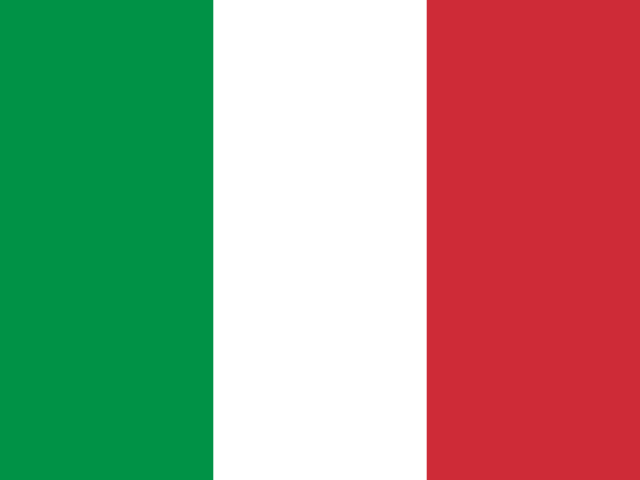
Italy
Complete data on Italy: geography, population, economy, culture, institutions, key indicators and statistics. Information updated in real time.
Time and date in Italy
Overview
Italy, officially the Italian Republic (Repubblica Italiana), is a unitary state in Southern Europe. It is bordered by four neighbouring countries: France, Switzerland, Austria and Slovenia, and encloses two independent states: San Marino and the Vatican. With about 58.9 million inhabitants (2025), it is the third most populous country in the European Union after Germany and France.
Italy is a major economic power, the 8th economy in the world (nominal GDP) and the third in the euro area. It is a founding member of the EU, the G7 and the G20, and has an exceptional cultural and artistic heritage. Its capital is Rome, and its official language is Italian. The country is divided into 20 regions and has a millennial history, marked by Ancient Rome, the Renaissance, the unification of 1861 and the founding of the Republic in 1946.
Data on Italy
Geography of Italy
Italy is a Southern European country whose geography is dominated by its boot-shaped peninsula, stretching about 1,000 km from north to south between the Tyrrhenian Sea, the Adriatic Sea and the Ionian Sea. With an area of about 302,073 km², it also includes the large islands of Sicily and Sardinia. It shares its borders with four countries: France, Switzerland, Austria and Slovenia, and hosts two independent states: San Marino and the Vatican.
Italian relief is very varied. In the north, the Alps form a spectacular natural border, home to the country's highest point, Mont Blanc (4,806 m), shared with France. The Po Valley, the largest in the country, covers about 46,000 km² and is the agricultural and industrial heart of Italy. The Apennines run through the entire peninsula, from Liguria to Calabria, and are home to many active volcanoes, including Vesuvius, Etna and Stromboli.
The hydrographic network is dominated by the Po, the longest river in Italy (652 km), which crosses the northern plain from west to east before flowing into the Adriatic Sea. The Tiber, on which Rome is built, is the country's second river (405 km). Italy also has many famous lakes in the north, such as Lake Garda, Lake Maggiore and Lake Como, of glacial origin.
Population and demographics
Italy is the third most populous country in the European Union, with a population of about 58.9 million inhabitants (2025). Its average density is about 195 inhabitants/km², but this distribution is very uneven: the northern regions (Lombardy, Veneto) are densely populated and industrialised, while some areas of the south and the islands are much less dense.
The country is experiencing a very marked demographic ageing, with a median age of about 48 years, one of the highest in the world. The birth rate is one of the lowest in Europe, around 1.2 children per woman, well below the generational replacement threshold (2.1). Life expectancy, on the other hand, is very high: about 83 years.
| Indicator | Value |
|---|---|
| Total population (2025) | 58.9 million |
| Population density | 195 inhab/km² |
| Fertility rate | 1.2 children per woman |
| Infant mortality rate | 2.6 ‰ |
| Life expectancy | 83.0 years (men: 80.5 - women: 85.6) |
| Median age | 48.0 years |
| Urban population | 71 % |
| Immigrant population | 5.3 million (9% of the population) |
To compensate for this natural deficit, Italy relies on significant immigration. The country welcomes hundreds of thousands of newcomers each year, mainly from Romania, Albania, Morocco, China and Ukraine. About 9% of the population is of foreign nationality.
Urban distribution is dominated by the major metropolises of the north and centre. The capital, Rome, has about 2.8 million inhabitants, followed by Milan (1.4 million), Naples (0.9 million), Turin (0.8 million) and Palermo (0.6 million). The Italian population is predominantly Christian (about 71%), mainly Catholic.
Population change (1950-2025)
Population by age (2025)
Climate in Italy: temperatures and precipitation
Italy lies in a temperate climate zone, but its geography stretching from north to south and the presence of the Alps and Apennines create a great climatic diversity. The north has a continental climate, with cold winters and hot, humid summers. The centre and south enjoy a Mediterranean climate, with hot, dry summers and mild, rainy winters.
Regarding temperatures, annual averages range from about 12 °C in the Po Valley to 18 °C in Sicily. Summers show averages between 22 °C and 28 °C, with peaks that can reach 40 °C in the south during heatwaves. Winters are cold in the Alps (averages around 0 °C) and mild on the Mediterranean coasts (averages around 10 °C).
Precipitation is also very contrasted. The national annual average is around 700 to 1,000 mm depending on the region. The Alps and the northern Apennines are the wettest areas, with up to 1,500 mm per year. Conversely, Apulia and southern Sicily are much drier, with annual precipitation sometimes below 500 mm.
Average monthly temperatures (°C) - Rome
Monthly precipitation (mm) - Rome
Data based on historical averages (1991-2020) for Rome. Source: Servizio Meteorologico dell'Aeronautica Militare.
Languages
The official language and the most spoken in Italy is Italian, a Romance language with about 65 million native speakers in Italy and more than 85 million worldwide. Standard Italian is used in administration, education, media and professional life. According to ISTAT, in 2024, nearly one in two people (48.4%) speaks only or mainly Italian in all relational contexts.
Languages spoken in Italy (2024)
Italy is characterised by an exceptional dialectal richness, although the use of dialects has declined sharply: in 2024, 9.6% of the population uses exclusively or mainly a dialect at home, compared to 32% in 1988. The most widely practised foreign languages are English (58.6%), followed by French (33.7%) and Spanish (16.9%). The main foreign mother tongues are Romanian, Arabic, Albanian and Spanish.
Religions practised in Italy
Italy is a country with a Catholic tradition, but the 1948 Constitution enshrines the principle of laïcité and guarantees religious freedom for all faiths. Historically, Italian territory hosts the seat of the Catholic Church (the Vatican), and the Catholic religion has played a central role in Italian culture and society. Today, about 71% of the population declares itself Catholic, but only 15.3% consider themselves practising.
Religions in Italy
Italian society is experiencing growing secularisation and increasing religious diversity due to immigration. Muslims represent about 3 to 4% of the population, mainly from Maghreb and Albanian immigration. Orthodox (about 2%) are mostly Romanian. Protestants and Jehovah's Witnesses represent significant minorities. About 15 to 20% of the population claims no religious affiliation.
Economy and GDP
Italy is the third economy of the euro area and the eighth in the world, with a GDP of about $2,550 billion (2025, IMF). This economic weight represents about 12% of the total GDP of the European Union. GDP per capita stands at about $43,270.
Evolution of Italian GDP (billions $)
The structure of the Italian economy relies on a diversified industrial fabric and a highly developed tertiary sector. The tertiary sector (services) accounts for about 73% of GDP, driven by tourism, trade, finance and business services. The secondary sector (industry) accounts for about 24% of GDP. The flagships are automobiles (Ferrari, Lamborghini, Fiat/Stellantis), fashion and luxury (Gucci, Prada, Armani, Versace), precision engineering, food processing and chemicals. The primary sector (agriculture) accounts for about 2% of GDP, but Italy is a major producer of wine, olive oil and cheese.
Italy is a global export power, with goods exports exceeding €600 billion annually. Its main trading partners are Germany, France, the United States, Spain and the United Kingdom. The country is also famous for its craftsmanship and SMEs, which form the backbone of its economy. Italy is the fifth tourist destination in the world, with more than 50 million foreign visitors per year.
Breakdown of the economy by sector (% GDP)
Socio-economic indicators
History
The history of Italy is a millennial epic that has profoundly shaped Western civilisation. Italian territory saw the emergence of the Etruscan civilisation and then Ancient Rome, founded according to legend in 753 BC. Rome dominated the Mediterranean world for centuries and left an immense legal, political and cultural legacy. After the fall of the Western Roman Empire (476), the peninsula was fragmented into many states and city-states.
History of Italy: major periods
The Middle Ages saw the rise of the maritime republics (Venice, Genoa, Pisa, Amalfi) and the Papal States. The Renaissance, born in Florence in the 15th century, revolutionised art, science and thought, with figures such as Leonardo da Vinci, Michelangelo, Raphael and Galileo. The peninsula remained fragmented until the Risorgimento, the national unification movement that led to the proclamation of the Kingdom of Italy in 1861, driven by Giuseppe Garibaldi and King Victor Emmanuel II.
The 20th century was marked by World War I, the rise of fascism under Benito Mussolini (1922-1943), World War II and the Resistance. After the fall of the fascist regime and the end of the war, an institutional referendum in 1946 abolished the monarchy and proclaimed the Italian Republic. The Constitution came into force in 1948. Italy is a founding member of the European Community (1957) and of the European Union.
Italy's national day is 2 June (Festa della Repubblica), which commemorates the 1946 referendum. 25 April is also an important date, commemorating the liberation of Italy from fascism in 1945.
Culture
Italy has an exceptional cultural heritage, with the largest number of UNESCO World Heritage sites in the world. In literature, figures such as Dante Alighieri (author of the Divine Comedy), Petrarch, Boccaccio, Machiavelli and more recently Umberto Eco have left their mark on world culture. In art, Italy was the cradle of the Renaissance and gave birth to universal geniuses such as Leonardo da Vinci, Michelangelo, Raphael, Botticelli and Caravaggio.
In music, Italy is the birthplace of opera (Verdi, Puccini, Rossini) and has profoundly influenced European classical music. The country also shone in sciences with Galileo, Volta, Marconi and Meucci. Italian cinema experienced a golden age with neorealism and directors such as Federico Fellini, Vittorio De Sica and Luchino Visconti.
Popular culture is just as lively. Italy is world-famous for its gastronomy (pasta, pizza, risotto, cheeses, wines), inscribed on UNESCO's intangible heritage list. Italian fashion (Milan is one of the world's fashion capitals) and design are also flagships of Italian identity. Traditional festivals such as the Carnival of Venice, the Palio of Siena and religious processions attract visitors from all over the world.
 Nigeria
 Senegal
 Ivory Coast
 South Africa
 Algeria
 United States
 Canada
 China
 India
 Japan
 South Korea
 Turkey
 Saudi Arabia
 Iran
 France
 Germany
 United Kingdom
 Spain
 Ukraine
 Russia
 Netherlands
 Belgium
 Switzerland
 Australia
 New Zealand