
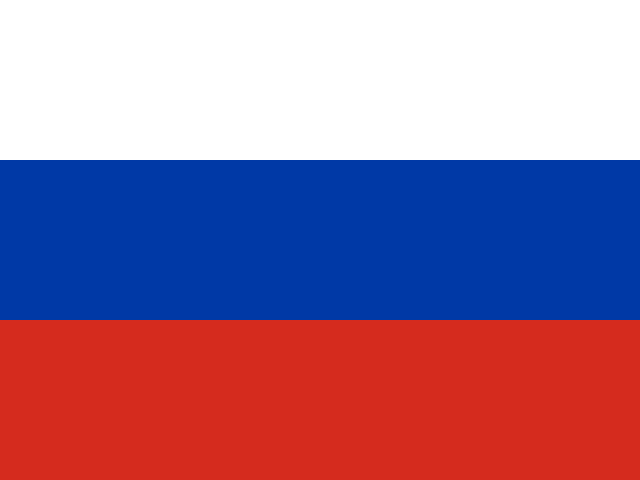
Russia
Complete data on Russia: geography, population, economy, culture, institutions, key indicators and statistics. Information updated in real time.
Time and date in Russia
Overview
Russia, officially the Russian Federation (Российская Федерация), is a transcontinental federal state, the largest country in the world with an area of 17,098,242 km², or about 11% of the world's landmass. It spans Eastern Europe and Northern Asia, sharing borders with 14 countries: Norway, Finland, Estonia, Latvia, Lithuania, Poland, Belarus, Ukraine, Georgia, Azerbaijan, Kazakhstan, China, Mongolia and North Korea.
Russia is a major economic power, ranked as the 4th economy in the world by purchasing power parity (PPP) with a PPP GDP of about $7.24 trillion in 2025, ahead of Japan and Germany. It is a permanent member of the UN Security Council, the G20, OPEC+ and the Eurasian Economic Union. Its capital is Moscow, and its official language is Russian. The country is a semi-presidential federal republic, led by President Vladimir Putin.
Data on Russia
Geography of Russia
Russia is the largest country in the world, spanning 17,098,242 km², or about 11% of the Earth's landmass. It covers all of northern Asia and part of Eastern Europe, with an east-west distance of 9,000 km and a north-south distance of 4,000 km. The country has 11 time zones (UTC+2 to UTC+12) and the longest land border in the world (22,408 km), as well as a maritime frontage on the Arctic, the Pacific, the Baltic, the Black Sea and the Caspian.
Russian relief is dominated by vast plains and plateaus. To the west lies the East European Plain, where most of the population is concentrated. In the centre, the Central Siberian Plateau separates the Ob and Yenisei basins. To the east, the East Siberian Mountains and the Kamchatka Peninsula are home to many active volcanoes. To the south, the Caucasus is home to the highest point in the country and in Europe, Mount Elbrus (5,642 m).
The hydrographic network is dominated by major rivers that flow mainly towards the Arctic. The Volga (3,530 km) is the longest river in Europe and flows into the Caspian Sea. The Ob, Yenisei and Lena are among the longest rivers in the world and drain Siberia. Lake Baikal in Siberia is the deepest and oldest lake in the world, containing about 20% of the planet's unfrozen fresh water.
Population and demographics
Russia has about 143 million inhabitants (2026), making it the most populous country in Europe and the ninth in the world. Its average density is very low, about 8.4 inhabitants/km², because most of the population is concentrated in the European part of the country, west of the Urals. Siberia, which represents more than 75% of the territory, is very sparsely populated.
The country is experiencing a worrying demographic decline, with a low birth rate (about 1.5 children per woman) and a life expectancy relatively low for a developed country. Life expectancy is about 67 years for men and 77 years for women. The population is made up of 194 ethnic groups, with Russians representing about 77.7% of the population, followed by Tatars (3.7%), Ukrainians (1.4%) and Bashkirs (1.1%).
| Indicator | Value |
|---|---|
| Total population (2026) | 143 million |
| Population density | 8.4 inhab/km² |
| Fertility rate | 1.5 children per woman |
| Life expectancy | 72.0 years (men: 67.4 - women: 77.4) |
| Urban population | 75 % |
| Immigrant population | ~11.6 million (8% of the population) |
Urban distribution is dominated by Moscow, which has about 13.3 million inhabitants (2026) and is the largest city in Europe. Other major cities are Saint Petersburg (5.6 million), Novosibirsk (1.6 million), Yekaterinburg (1.5 million) and Kazan (1.3 million).
Population change (1950-2026)
Population by age (2026)
Climate in Russia: temperatures and precipitation
Russia has a continental climate over most of its territory, with long, harsh winters and short, hot summers. Temperatures can drop below -40 °C in Siberia in January, while summers can reach 30 °C in some regions. The coastal areas of the Arctic and Pacific have a harsher climate, while the Black Sea coast enjoys a subtropical climate.
Regarding temperatures, Moscow experiences cold winters (average of -6 °C in January) and mild summers (average of 19 °C in July). Precipitation is moderate, about 700 mm per year in Moscow, but decreases towards the east and south. Eastern Siberia is particularly dry, with less than 300 mm per year in some areas.
Average monthly temperatures (°C) - Moscow
Monthly precipitation (mm) - Moscow
Data based on historical averages (1991-2020) for Moscow. Source: Roshydromet.
Languages
The official language and the most spoken in Russia is Russian, an East Slavic language with about 150 million native speakers in Russia and more than 250 million worldwide. Russian is used in administration, education, media and business and is one of the official languages of the UN.
Languages spoken in Russia
Russia is a multi-ethnic and multilingual country, with more than 100 minority languages spoken on its territory. The most important are Tatar (5.3 million speakers), Bashkir, Chechen, Chuvash and Ukrainian. However, most of these languages are declining in favour of Russian.
Religions practised in Russia
Russia is an officially secular state, but the dominant traditional religion is Orthodox Christianity, practised by about 41% of the population according to the most recent surveys. The Russian Orthodox Church plays an important role in society and is closely linked to the state.
Religions in Russia
Russia also hosts a significant Muslim community (about 6.5% of the population), mainly in the North Caucasus and Tatarstan. Other religions include Buddhism (Kalmykia, Buryatia, Tuva), Judaism and various Christian denominations. A significant share of the population declares itself without religion (about 25%) or atheist (about 13%).
Economy and GDP
Russia is the 4th economy in the world by purchasing power parity, with a PPP GDP of about $7.24 trillion in 2025, ahead of Japan and Germany. In nominal terms, its GDP is estimated at about $2.55 trillion in 2025. GDP per capita in PPP is about $17,546.
Evolution of Russian nominal GDP (billions $)
The Russian economy is heavily dependent on the extraction and export of natural resources, including oil, natural gas, coal and metals. The country has the largest natural gas reserves in the world (about 25% of global reserves) and is among the leading oil producers. The tertiary sector (services) accounts for about 61% of GDP, industry about 35% and agriculture about 4%.
Since 2014 and especially since 2022, Russia has faced Western economic sanctions due to the annexation of Crimea and the invasion of Ukraine. These sanctions have limited access to technology and financial markets, but the economy has maintained some activity thanks to increased public spending and trade with other countries, notably China and India. Inflation remains high (about 8-9% in 2025) and the country has a very low unemployment rate (about 2.1%).
Breakdown of the economy by sector (% GDP)
Socio-economic indicators
History
The history of Russia is a millennial epic that has its origins in Kievan Rus' (9th-13th century), the first East Slavic state that adopted Orthodox Christianity in 988. After the Mongol invasion (13th century), Muscovy gradually emerged as the centre of unification of Russian lands. Ivan the Terrible (1533-1584) was the first to take the title of tsar and considerably expanded the territory.
History of Russia: major periods
The 18th century was marked by the reign of Peter the Great (1682-1725), who modernised the country and founded Saint Petersburg, and by Catherine II (1762-1796), who expanded the empire to the south and west. The 19th century saw Russia play a major role in the Napoleonic wars and expansion in Central Asia and the Caucasus. The Revolution of 1917 overthrew tsarism and brought the Bolsheviks to power, leading to the creation of the USSR in 1922.
The USSR became a superpower after World War II, rival to the United States during the Cold War. The dissolution of the USSR in 1991 gave birth to the Russian Federation. After a period of economic chaos in the 1990s, Russia experienced sustained growth in the 2000s thanks to high commodity prices. The national day is 12 June (Russia Day), commemorating the 1990 declaration of sovereignty.
Culture
Russia has an exceptional cultural heritage. In literature, figures such as Alexander Pushkin, Leo Tolstoy (War and Peace, Anna Karenina), Fyodor Dostoevsky (Crime and Punishment, The Brothers Karamazov), Anton Chekhov and Vladimir Nabokov have left their mark on world literature. In music, Russia gave birth to genius composers such as Tchaikovsky (Swan Lake, The Nutcracker), Rachmaninoff, Mussorgsky and Stravinsky.
In sciences, the country shone with Dmitri Mendeleev (periodic table), Ivan Pavlov (conditioned reflexes) and Yuri Gagarin, the first man in space (1961). Russian cinema is renowned for its directors such as Sergei Eisenstein (Battleship Potemkin) and Andrei Tarkovsky. Russian ballet (Bolshoi, Mariinsky) is world-famous.
Popular culture is just as lively. Russia is known for its Russian dolls (matryoshkas), its vodka, its samovar tea and its cuisine (borscht, pelmeni, blinis). Traditional festivals such as Maslenitsa (spring festival) and New Year (the most important holiday in the country) are very popular. The Trans-Siberian Railway, the longest railway in the world, is a symbol of the country's immensity.
 Nigeria
 Senegal
 Ivory Coast
 South Africa
 Algeria
 United States
 Canada
 China
 India
 Japan
 South Korea
 Turkey
 Saudi Arabia
 Iran
 France
 Germany
 Italy
 United Kingdom
 Spain
 Ukraine
 Netherlands
 Belgium
 Switzerland
 Australia
 New Zealand