
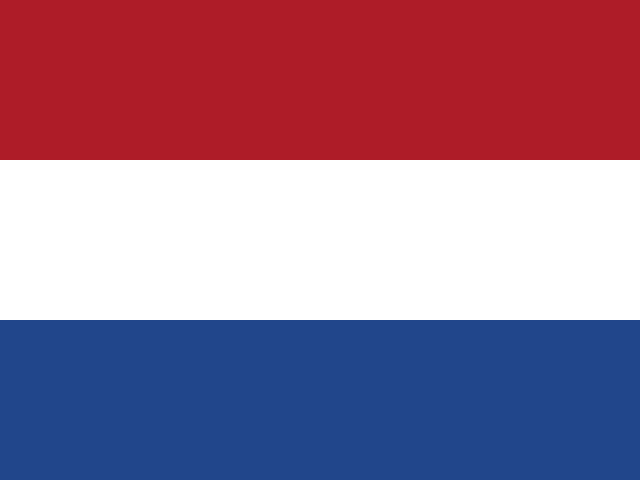
Netherlands
Complete data on the Netherlands: geography, population, economy, culture, institutions, key indicators and statistics. Information updated in real time.
Time and date in the Netherlands
Overview
The Netherlands, officially the Kingdom of the Netherlands (Koninkrijk der Nederlanden), is a state in Western Europe. It is bordered by the North Sea to the north and west, Germany to the east and Belgium to the south. With a population of about 18.2 million inhabitants (2026), the country is one of the most densely populated in the world.
The Netherlands is a constitutional monarchy whose head of state is King Willem-Alexander since 2013. The capital is Amsterdam, but the government sits in The Hague. The country is a founding member of the European Union, NATO and the euro area. Its economy is one of the most competitive in the world, driven by the Port of Rotterdam (the largest European port), agri-food, chemicals and financial services.
Data on the Netherlands
Geography of the Netherlands
The Netherlands is a Western European country with an area of 41,528 km² (land). The country is famous for its exceptionally flat relief: about 24% of the territory lies below sea level, and one third does not exceed one metre in altitude. The highest point, the Vaalserberg, rises only to 321 metres at the border with Belgium and Germany.
Dutch geography is largely the result of human intervention. Since the 13th century, the Dutch have reclaimed land from the sea through polders and dyke systems, adding about 6,000 km² to the national territory. The main rivers are the Rhine, the Meuse and the Scheldt, which form a complex delta in the west of the country. The country is divided into 12 provinces.
The Dutch coastline stretches over 1,075 km and includes vast sandy beaches, dunes and islands (notably the Frisian Islands). The Wadden Sea to the north is a protected natural area listed as a UNESCO World Heritage Site.
Population and demographics
The Netherlands has about 18.2 million inhabitants (2026), making it one of the most densely populated countries in Europe with a density of about 536 inhabitants/km². The population is mostly urban (about 93%) and concentrated in the Randstad conurbation, which includes Amsterdam, Rotterdam, The Hague and Utrecht.
The country is experiencing a gradual demographic ageing, with a median age of about 42 years. The fertility rate is 1.43 children per woman (2025). Life expectancy is high: about 83-84 years for women and 80-81 years for men. Immigration plays an important role in population growth, with large Turkish, Moroccan, Surinamese and Antillean communities.
| Indicator | Value |
|---|---|
| Total population (2026) | 18.2 million |
| Population density | 536 inhab/km² |
| Fertility rate | 1.43 children per woman |
| Life expectancy | 82.0 years (men: 80-81 - women: 83-84) |
| Median age | ~42 years |
| Urban population | 93 % |
| Immigrant population | ~2.5 million (14% of the population) |
The main cities are Amsterdam (935,000 inhab.), Rotterdam (674,000 inhab.), The Hague (568,000 inhab.), Utrecht (377,000 inhab.) and Eindhoven (250,000 inhab.). The population is mostly without religious affiliation (56%), followed by Catholics (17%) and Protestants (14%).
Population change (1950-2026)
Population by age (2026)
Climate in the Netherlands: temperatures and precipitation
The Netherlands enjoys a temperate oceanic climate, influenced by the North Sea and the Gulf Stream. Winters are mild and summers are cool to temperate, with precipitation spread throughout the year. The country is often swept by westerly winds.
According to official data, the average temperature is about 16 °C in summer on the coast and 17 °C inland. In winter, averages are 3 °C on the coast and 2 °C inland. Average annual precipitation amounts to 797 mm.
The Dutch climate is characterised by high variability and frequent precipitation, often in the form of showers. Sunshine averages 1,500 to 1,700 hours per year. The country is vulnerable to climate change, particularly to sea level rise.
Average monthly temperatures (°C) - De Bilt
Monthly precipitation (mm) - De Bilt
Data based on historical averages (1991-2020) for De Bilt (reference station). Source: KNMI.
Languages
The official language of the Netherlands is Dutch, a West Germanic language spoken by about 24 million speakers worldwide (Netherlands, Flemish Belgium, Suriname, Antilles). Dutch is also very close to Afrikaans, spoken in South Africa.
Languages spoken in the Netherlands
In the province of Friesland, the Frisian language is officially recognised and spoken by about 350,000 people. Papiamento and English are used in the Caribbean territories of the Kingdom. The most widely practised foreign languages are English (over 90% of the population), German and French. Immigrant communities also speak Turkish, Arabic and Berber.
Religions practised in the Netherlands
The Netherlands is a country with a Christian tradition, historically marked by Calvinism, but society is now one of the most secularised in Europe. According to official 2026 data, among the population aged 15 and over, 56% declare no religious affiliation, 17% are Catholic and 14% are Protestant.
Religions in the Netherlands (15 and over)
The Muslim community represents about 5% of the population, mainly of Turkish and Moroccan origin. Other religions (Hinduism, Buddhism, Judaism) represent significant minorities. The country is also known for its tradition of religious tolerance and freedom of worship, inherited from the time of the Dutch Republic.
Economy and GDP
The Netherlands is the 18th economy in the world and the fifth in the European Union, with a GDP of about €1,079 billion (2025). GDP per capita (PPP) stands at about €55,600, placing the country among the richest in the EU. The Dutch economy is very open to the world: exports of goods and services represent about one third of GDP.
Evolution of Dutch GDP (billions €)
The tertiary sector (services) largely dominates the economy, accounting for about 78% of GDP and employing more than 80% of the working population. Strengths are logistics and transport (Port of Rotterdam, the largest European port with 467 million tonnes in 2022), financial services (ING, Rabobank, ABN AMRO), trade and business services. The secondary sector (industry) accounts for about 20% of GDP, with agri-food, chemicals, pharmaceuticals, electronics and petroleum products. Agriculture accounts for only 1.9% of GDP, but the Netherlands is the world's second largest exporter of agricultural products after the United States, thanks to ultra-intensive agriculture and horticulture.
The Netherlands is a major player in world trade. In 2025, goods exports amounted to about $683 billion and imports to $599 billion. The European Union is by far the main trading partner (about 55% of goods trade), followed by the United States and China. The country shows a structural trade surplus, driven by transit activities and agri-food and chemical exports.
Breakdown of the economy by sector (% GDP)
Socio-economic indicators
History
The history of the Netherlands is marked by the struggle against the sea and by a tradition of trade and tolerance. In the Middle Ages, the territory was fragmented into counties and duchies (Holland, Zeeland, Friesland, Brabant, Guelders). In the 15th century, the Dukes of Burgundy and then the Habsburgs took control of the region. In 1581, the Dutch Republic proclaimed its independence from Spain, giving birth to a prosperous merchant republic.
History of the Netherlands: major periods
The 17th century is the Dutch Golden Age: the Dutch East India Company (VOC) dominated world trade, and the arts (Rembrandt, Vermeer) and sciences (Huygens, Leeuwenhoek) flourished. After the Napoleonic wars, the Kingdom of the Netherlands was created in 1815. The country remained neutral during World War I, but was invaded by Nazi Germany in 1940 and suffered a painful occupation until 1945.
After the war, the Netherlands rebuilt and became a founding member of the European Coal and Steel Community (1951) and then of the EEC (1957). The country is also a founding member of NATO (1949) and of the European Union. The national day is Koningsdag (King's Day), celebrated on 27 April (or 26 if the 27th falls on a Sunday).
Culture
The Netherlands has a rich cultural heritage, marked by the 17th-century Golden Age. In painting, the Dutch Masters (Rembrandt, Vermeer, Frans Hals) are world-famous, as are Vincent van Gogh and Piet Mondrian. The country is home to major museums: the Rijksmuseum and the Van Gogh Museum in Amsterdam, the Mauritshuis in The Hague.
In philosophy and science, the Netherlands gave birth to Erasmus, Spinoza, Huygens and Leeuwenhoek. The country is also known for its architecture (Amsterdam School, Berlage, Rem Koolhaas) and its design (Droog Design). Music is also lively, with a world-renowned electronic scene (Tiësto, Armin van Buuren, Martin Garrix).
Dutch popular culture is marked by the bicycle (more bikes than inhabitants), the canals of Amsterdam (listed as UNESCO), windmills (Kinderdijk), tulips (Keukenhof) and cheese (Gouda, Edam). The country is also known for its tolerance and liberal spirit, as well as for its cuisine (stroopwafels, bitterballen, haring).
 Nigeria
 Senegal
 Ivory Coast
 South Africa
 Algeria
 United States
 Canada
 China
 India
 Japan
 South Korea
 Turkey
 Saudi Arabia
 Iran
 France
 Germany
 Italy
 United Kingdom
 Spain
 Ukraine
 Russia
 Belgium
 Switzerland
 Australia
 New Zealand