
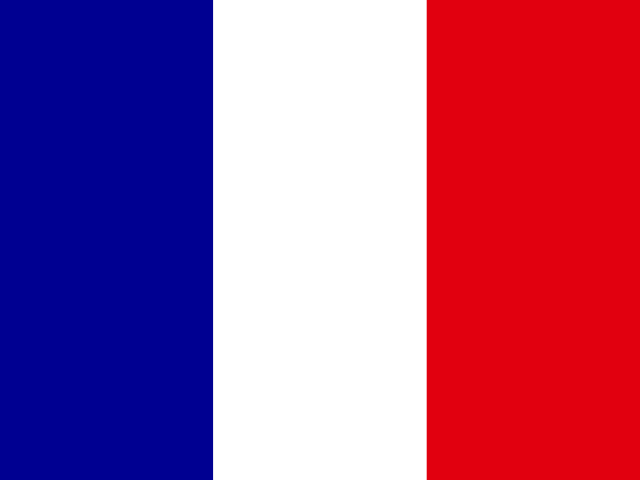
France
Complete data on France: geography, population, economy, culture, institutions, key indicators and statistics. Information updated in real time.
Time and date in France
Overview
France, officially the French Republic, is a unitary state in Western Europe. It is bordered by eight neighbouring countries: Belgium, Luxembourg, Germany, Switzerland, Italy, Monaco, Spain and Andorra. With 69.1 million inhabitants (January 2026), it is the second most populous country in the European Union after Germany.
France is a major economic power, the 7th economy in the world (nominal GDP) and the second in Europe. It is also a central political player within the EU, the G7, the G20 and NATO, and possesses nuclear weapons. Its capital is Paris, and its official language is French. The country is divided into 18 regions (13 metropolitan and 5 overseas) and has a rich history, marked by absolute monarchy, the Revolution of 1789, the two world wars and European construction.
Data on France
Geography of France
France is a Western European country whose varied geography stretches from the plains of the North and West to the imposing mountain ranges of the Alps, the Pyrenees and the Massif Central. With an area of about 551,695 km² (metropolitan France), it is the largest country in the European Union and shares its borders with eight neighbouring countries: Belgium, Luxembourg, Germany, Switzerland, Italy, Monaco, Spain and Andorra. This central position makes it a geographic and cultural crossroads between Northern and Southern Europe.
French relief is divided into several major natural zones. In the north and west, the plains and sedimentary basins (Paris Basin, Aquitaine Basin) offer fertile agricultural landscapes. In the centre and east, the Massif Central and the Vosges form ancient massifs worn by erosion. In the southeast, the Alps are home to the country's highest point, Mont Blanc, which rises to 4,806 metres. In the southwest, the Pyrenees form a natural border with Spain.
The hydrographic network is dominated by major rivers that structure the territory. The Loire, the longest river in France (1,006 km), crosses the country from east to west. The Seine structures the Paris Basin and is a major navigable waterway for trade. The Rhône flows from north to south and empties into the Mediterranean, while the Garonne flows towards the Atlantic. France also has a vast maritime coastline open to the North Sea, the Channel, the Atlantic and the Mediterranean.
Population and demographics
France is the second most populous country in the European Union, with a population of about 69.1 million inhabitants as of 1 January 2026, including 66.8 million in metropolitan France and 2.3 million in the overseas departments. Its average density is about 119 inhabitants/km², but this distribution is very uneven: the Île-de-France region has more than 1,000 inhabitants/km², while some rural areas are much less dense.
The country is experiencing a gradual demographic ageing, with a median age of about 42 years. The birth rate remains one of the highest in Europe, around 1.8 children per woman, close to the generational replacement threshold (2.1). Life expectancy is high: 85.7 years for women and 80.0 years for men.
| Indicator | Value |
|---|---|
| Total population (2026) | 69.1 million |
| Population density | 119 inhab/km² |
| Fertility rate | 1.8 children per woman |
| Infant mortality rate | 3.5 ‰ |
| Life expectancy | 82.8 years (men: 80.0 - women: 85.7) |
| Median age | 42.0 years |
| Urban population | 81 % |
| Immigrant population | 7.0 million (10% of the population) |
France welcomes about 250,000 to 300,000 new immigrants each year, making it one of the main migration destinations in Europe. The main foreign communities come from the Maghreb (Algeria, Morocco, Tunisia), Portugal, Italy and Spain. About 10% of the population was born abroad.
Urban distribution is dominated by the Paris agglomeration, which has nearly 13 million inhabitants with its peri-urban ring. Other major metropolises are Lyon (2.3 million), Marseille (1.9 million), Toulouse (1.5 million) and Lille (1.2 million). The French population is predominantly Christian (about 43%), but the share of non-religious (about 40%) and Muslims (about 7%) is significant.
Population change (1950-2026)
Population by age (2026)
Climate in France: temperatures and precipitation
France lies in a temperate climate zone, but its regional variations are marked by a transition between oceanic influences in the west, continental influences in the east and Mediterranean influences in the south. The country experiences well-differentiated seasons, with generally mild to warm summers and cold but rarely extreme winters, except in mountainous areas.
Regarding temperatures, annual averages range from about 10 °C in the north to 15 °C on the French Riviera. Summers show averages between 18 °C and 25 °C, with peaks that can reach 40 °C during heatwaves. Winters are colder in the east and in the mountains, with averages of 2 °C to 8 °C.
Precipitation is also very contrasted. The national annual average is around 700 to 800 mm. The rainiest regions receive up to 1,500 mm per year (Vosges massif, Cévennes). Conversely, the driest areas are in the southeastern Mediterranean, particularly around Marseille and Provence, where annual precipitation drops to barely 500 mm.
Average monthly temperatures (°C)
Monthly precipitation (mm)
Data based on historical averages (1991-2020) for France. Source: Météo-France.
Languages
The official language and the most spoken in France is French, a Romance language with about 300 million speakers worldwide. Standard French is used in administration, education, media and professional life, but the country is characterised by a dialectal richness (Occitan, Breton, Basque, Corsican, Alsatian, etc.), although these regional languages are not officially recognised by the Constitution.
Native languages spoken in France
France is also a country of immigration and linguistic diversity. The most widely practised foreign languages are English (about 39%), followed by Spanish, German and Italian. Arabic is the most spoken non-European foreign language, with more than 3 million speakers, mainly from Maghreb immigration.
Religions practised in France
France is a country of great religious diversity, marked by a long Catholic tradition and by the principle of laïcité enshrined in the Constitution. Historically, French territory was the cradle of Catholicism, but religious practice has declined sharply since the 1960s. Today, about 43% of the population declares itself Christian, mainly Catholic.
Religions in France
One of the most striking developments is the growth of Islam, which has become the country's second religion. The number of Muslims in France is estimated at about 5 million, i.e. nearly 7% of the adult population. The most striking phenomenon is the spectacular growth of the non-religious: nearly 40% of the population claims no religious affiliation, one of the highest proportions in Western Europe.
Economy and GDP
France is the second economy in Europe and the seventh in the world, with a GDP of about $3,161 billion (2024, World Bank/UNCTAD). This economic weight alone accounts for nearly 17% of the total GDP of the European Union. GDP per capita stands at about $45,961.
Evolution of French GDP (billions $)
The structure of the French economy relies on a diversified model, with a highly developed tertiary sector. The tertiary sector (services) accounts for about 79% of GDP, driven by tourism, finance, trade and business services. The secondary sector (industry) accounts for about 17% of GDP. The flagships are aeronautics (Airbus), luxury (LVMH, L'Oréal), automobiles (Renault, Stellantis), energy (EDF, TotalEnergies) and food processing. The primary sector (agriculture) accounts for about 2% of GDP, but France is the leading agricultural country in Europe.
France is a global export power, with goods exports reaching $639 billion and services exports of $400 billion in 2024. Its main trading partners are Germany, Italy, the United States, Spain and Belgium. France is also the world's leading tourist destination, with nearly 100 million foreign visitors per year.
Breakdown of the economy by sector (% GDP)
Socio-economic indicators
History
The history of France is a millennial epic. The Gaulish territory was conquered by Julius Caesar in 52 BC and became Roman Gaul. The baptism of Clovis in 496 made France the eldest daughter of the Church. The Capetian dynasty, founded in 987, reigned for more than 800 years and saw the emergence of figures such as Saint Louis and Louis XIV, the Sun King, who embodied the apogee of absolute monarchy.
History of France: major periods
The French Revolution of 1789 overthrew the Ancien Régime and proclaimed the rights of man. It was followed by the Napoleonic Empire, which spread revolutionary ideals across Europe. The 19th century was marked by a succession of regimes (Restoration, July Monarchy, Second Republic, Second Empire) until the lasting establishment of the Third Republic in 1870.
The 20th century was one of tragedies and reconstructions: World War I (1914-1918), World War II (1939-1945) with the Occupation and the Resistance, then decolonisation. The Fifth Republic, founded in 1958 by Charles de Gaulle, is the current political regime. France is a founding member of the European Community (1957) and plays a driving role in the construction of the European Union.
The French Revolution remains the founding event of modern France. The national day of 14 July commemorates the storming of the Bastille (1789) and the Fête de la Fédération (1790).
Culture
France has an exceptional cultural heritage. In literature, figures such as Molière, Victor Hugo, Balzac, Flaubert and Proust have left their mark on the French language. In philosophy, France was the birthplace of Descartes, Voltaire, Rousseau, Sartre and Foucault. In sciences, the country shone with Pasteur, Curie and Poincaré.
In art, France was the birthplace of Impressionism (Monet, Renoir, Degas) and welcomed the greatest artists in the world, from Picasso to Van Gogh. French cinema is one of the oldest and most influential in the world, with the New Wave and directors such as Godard and Truffaut. French haute couture (Chanel, Dior, Saint Laurent) is world-renowned.
Popular culture is just as lively. France is world-famous for its gastronomy, inscribed on UNESCO's intangible heritage list, with its cheeses (more than 1,000 varieties), its wines and its cuisine. The Cannes Festival is one of the most prestigious in the world. The Fête de la Musique, created in 1982, is now celebrated in more than 100 countries.
 Nigeria
 Senegal
 Ivory Coast
 South Africa
 Algeria
 United States
 Canada
 China
 India
 Japan
 South Korea
 Turkey
 Saudi Arabia
 Iran
 Germany
 Italy
 United Kingdom
 Spain
 Ukraine
 Russia
 Netherlands
 Belgium
 Switzerland
 Australia
 New Zealand