
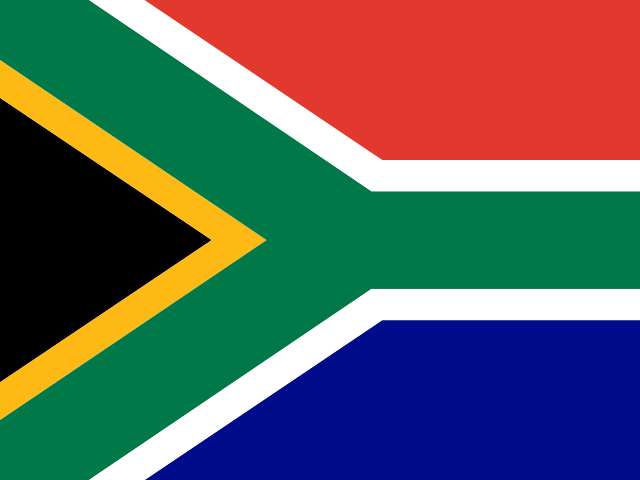
South Africa
Complete data on South Africa: geography, population, economy, culture, key indicators and statistics. Factual information, regularly updated.
Time and date in South Africa (Pretoria)
Overview
South Africa (Republic of South Africa) is a country located at the southern tip of the African continent. With a population estimated at about 63.4 million inhabitants in 2026, it is one of the most populous countries in Africa. A unique feature: the country has three capitals — Pretoria (executive), Cape Town (legislative) and Bloemfontein (judicial).
South Africa has been a parliamentary republic and a constitutional democracy since 1994, the year of the first multiracial elections that ended apartheid. The country is known as the "rainbow nation" because of its ethnic, cultural and linguistic diversity. It has 12 official languages, including English, Afrikaans, Zulu and Xhosa.
Data on South Africa
Geography of South Africa
South Africa covers an area of 1,220,813 km², making it the 25th largest country in the world. It occupies the southern tip of the African continent, with a coastline of over 3,000 km stretching along the Atlantic Ocean to the west and the Indian Ocean to the east and south. The country shares borders with Namibia, Botswana, Zimbabwe, Mozambique and Eswatini (Swaziland), and surrounds Lesotho.
The terrain is dominated by an interior plateau (Highveld) bordered by the Great Escarpment (Drakensberg). The highest point is Mafadi (3,450 m) in the Drakensberg. The country is relatively dry: the Orange River (2,200 km) is the longest, but no watercourse is commercially navigable.
The climate is temperate overall, with significant variations: Mediterranean in the south-west (Cape Town), humid subtropical on the east coast (Durban), semi-arid to desert in the west and north-west (Kalahari, Namaqualand). Average annual precipitation is low (about 464 mm), ranging from less than 100 mm in the Namib desert to over 1,000 mm on the south-east coast.
Population and demographics
South Africa has an estimated population of 63.4 million inhabitants in 2026 (63,419,000 according to Britannica). The population density is low, about 51.9 inhab/km², due to the immensity of the territory. The population is very unevenly distributed, with concentrations in Gauteng (Johannesburg-Pretoria), KwaZulu-Natal (Durban) and the Western Cape (Cape Town).
Demographics are relatively young: the median age is 28.9 years. Life expectancy is about 66.7 years (63.1 years for men, 70.2 years for women). The urbanisation rate reaches 66.9%. Fertility is 2.2 children per woman, close to the replacement threshold.
| Indicator | Value |
|---|---|
| Total population (2026) | ~63.4 million |
| Population density | ~51.9 inhab/km² |
| Birth rate | ~19 / 1,000 |
| Life expectancy | ~66.7 years |
| Median age | 28.9 years |
| Urban population | ~66.9% |
| Ethnic groups | Black African (~81%), Coloured (~8.5%), White (~7.2%), Indian/Asian (~2.6%) |
The population is very diverse: Black Africans represent about 81% of the population, followed by Coloured (~8.5%), Whites (~7.2%) and Indians/Asians (~2.6%). The largest cities are Johannesburg (metropolitan area of about 7.1 million inhabitants), Cape Town (~4.5 million), Durban (~3.2 million) and Pretoria (~1.8 million).
Population change (1950-2026)
Population by age (2026)
Climate in South Africa: temperatures and precipitation
South Africa has a temperate climate overall, but with great regional diversity. The south-west (Cape Town) enjoys a Mediterranean climate, with mild, wet winters (June-August) and hot, dry summers (December-February). The east coast (Durban) has a humid subtropical climate, with hot, rainy summers. The interior (Highveld, Johannesburg) is tempered by altitude, with hot (but mild) summers and dry, cool winters. The west and north-west are semi-arid to desert (Kalahari, Namaqualand).
Temperatures vary by region and season. In Johannesburg (1,694 m altitude), summer highs generally stay below 30°C, while winters are cool, with possible night frosts. In Cape Town, temperatures are milder all year round. The harmattan does not affect the country, but hot, dry winds can blow inland.
Average monthly temperatures (°C) - Cape Town
Monthly precipitation (mm) - Cape Town
Indicative data for Cape Town (Mediterranean climate). The interior (Johannesburg) is drier and tempered by altitude.
Languages
South Africa is a unique case in the world: it recognises 12 official languages. The main ones, by order of native speakers, are Zulu (isiZulu, ~24.7%), Xhosa (isiXhosa, ~15.6%), Afrikaans (~12.1%), Sepedi (~9.8%), Tswana (~8.9%), English (~8.4%), Sotho (~8%), Tsonga (~4%), Swati (~2.6%), Tshivenda (~2.5%) and Ndebele (~1.6%). South African Sign Language is also official.
English is the language of administration, business and higher education, but it is only the mother tongue of a minority. Afrikaans, derived from Dutch, is spoken by the Coloured population and some Whites. Zulu and Xhosa are the most widely spoken languages in the east of the country.
Language breakdown in South Africa (estimate)
Multilingualism is a daily reality for most South Africans, who often speak several languages. The media, education and administration reflect this diversity, although English dominates in official spheres.
Religions practised in South Africa
South Africa is a country with a large Christian majority. Christianity is practised by about 86% of the population, with a great diversity of Churches (Protestant, Pentecostal, Methodist, Catholic, independent African Churches such as the Zionist Christian Church). Traditional African religions represent about 5.4%, followed by the non-religious (~5.2%). Islam is a minority (~1.9%), mainly among Coloured and Indian communities. Hinduism is practised by part of the Indian community (~1.3%).
Freedom of religion is guaranteed by the 1996 Constitution. The country is renowned for its religious tolerance and peaceful coexistence between different faiths. Religious holidays (Christmas, Easter, Eid, Diwali) are celebrated, and some are public holidays.
Religions in South Africa
Religion plays an important role in South African society, notably through independent African Churches, which blend Christian spirituality and African traditions. Interfaith dialogue is encouraged by the authorities.
Economy and GDP
South Africa has the second-largest economy in Africa (after Nigeria) and the most industrialised on the continent. Its nominal GDP was about $419 billion in 2025, with a GDP per capita of about $6,924. Economic growth is weak: 0.5% in 2024, 1.1% in 2025, and it is expected to stabilise around 1.2% in 2026.
The economy is diversified. Services dominate (finance, trade, tourism, telecommunications), but industry (mining, manufacturing, agri-food) and agriculture remain important. The country is a major world producer of platinum group metals, gold, diamonds, coal and many other minerals. The manufacturing sector is relatively developed (automotive, machinery, chemicals). The country faces massive unemployment (33.6% in Q2 2026, 44% in the expanded rate) and poverty affecting nearly 60% of the population. Inflation was 3.2% in 2025, rising to 4.5% in July 2026. Public debt exceeds 77% of GDP.
Evolution of South Africa's GDP (billions $)
The South African economy is dualistic: a modern, productive sector (finance, mining, manufacturing) coexists with an informal economy and a low-skilled workforce. Structural reforms (energy, logistics, governance) are essential to revive inclusive growth. The country is vulnerable to commodity prices and international trade tensions.
Breakdown of the economy by sector (% GDP)
Socio-economic indicators
History and civilisations
The territory of South Africa has been inhabited since prehistory, as evidenced by the archaeological sites of the Cradle of Humankind, a UNESCO World Heritage Site that has yielded many hominid fossils. Over the centuries, San (hunter-gatherer) and Khoikhoi (pastoralist) populations occupied the region, before the arrival of the Bantu peoples (Xhosa, Zulu, Sotho, Tswana, etc.) about 1,500 years ago.
The Dutch established a colony at the Cape in 1652, followed by the British in 1806. The Anglo-Zulu Wars and the Boer Wars (1880-1881, 1899-1902) marked the 19th century. In 1910, the Union of South Africa was created, uniting the British colonies and the Boer republics, but excluding Black people from political power.
In 1948, the National Party came to power and instituted the system of apartheid (separate development of races), which deprived the Black majority of its fundamental rights for over 40 years. Despite resistance (Sharpeville massacre in 1960, Soweto uprising in 1976, imprisonment of Nelson Mandela), apartheid was dismantled in the early 1990s under the presidency of F. W. de Klerk. The first multiracial elections took place in April 1994, and Nelson Mandela became the country's first Black president.
Major periods of South African history
Culture
South African culture is one of the richest and most diverse in the world, reflecting the "rainbow nation". The country is world-renowned for its music: mbaqanga, isicathamiya (Ladysmith Black Mambazo), South African jazz (Hugh Masekela, Miriam Makeba), kwaito and amapiano (an electronic genre that has become global). South African literature is prestigious, with two Nobel Prizes: Nadine Gordimer (1991) and J. M. Coetzee (2003), as well as authors such as André Brink, Zakes Mda and Trevor Noah.
Cinema in South Africa is dynamic, with films such as Tsotsi (Academy Award for Best Foreign Language Film in 2006) and directors such as Gavin Hood. The country is also renowned for its visual arts (San rock art, sculptures, Zulu and Ndebele crafts) and its fashion. Gastronomy is varied: braai (barbecue), biltong (dried meat), bobotie (spiced mince), chakalaka (spiced vegetables), pap (maize porridge) and potjiekos (pot stew). The major festivals are Freedom Day (27 April), Heritage Day (24 September), religious holidays and cultural festivals (National Arts Festival, Cape Town Jazz Festival).
 Nigeria
 Senegal
 Ivory Coast
 Algeria
 United States
 Canada
 China
 India
 Japan
 South Korea
 Turkey
 Saudi Arabia
 Iran
 France
 Germany
 Italy
 United Kingdom
 Spain
 Ukraine
 Russia
 Netherlands
 Belgium
 Switzerland
 Australia
 New Zealand