
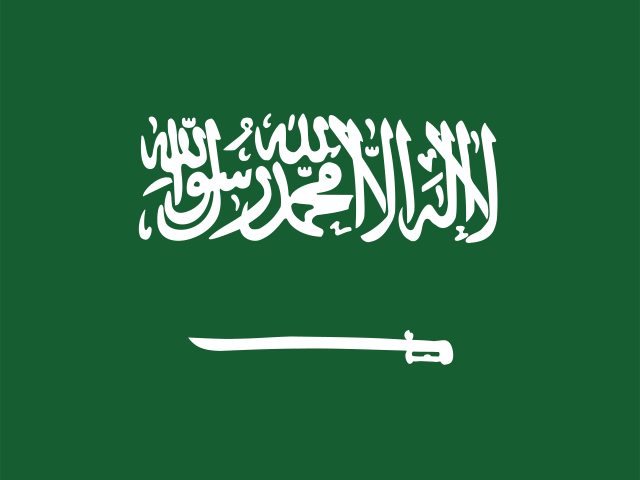
Saudi Arabia
Complete data on Saudi Arabia: geography, population, economy, culture, institutions, key indicators and statistics. Information updated in real time.
Time and date in Saudi Arabia
Overview
Saudi Arabia, officially the Kingdom of Saudi Arabia, is a country in Western Asia that occupies most of the Arabian Peninsula. With an area of about 2.15 million km², it is the fifth largest country in Asia. The country is bordered by the Red Sea to the west and the Persian Gulf to the east, and shares borders with Jordan, Iraq, Kuwait, Qatar, the United Arab Emirates, Oman and Yemen.
Saudi Arabia is the world's leading oil exporter and holds the second largest proven reserves in the world. The country is also the birthplace of Islam, home to the holy cities of Mecca and Medina. Its capital is Riyadh. The kingdom is an absolute monarchy ruled by the Al Saud family, and since 2016 has been implementing a vast economic diversification programme, Vision 2030.
Data on Saudi Arabia
Geography of Saudi Arabia
Saudi Arabia is dominated by a vast desert plateau, the Najd, which occupies the centre of the country. The relief is varied: the Asir mountains in the southwest rise to over 3,000 metres, while coastal plains border the Red Sea (Tihama) and the Persian Gulf (Al-Hasa). The country has no permanent rivers, and water comes mainly from aquifers and desalination plants.
The Rub al-Khali desert (Empty Quarter) in the southeast is one of the largest continuous sand deserts in the world. The climate is desert with extremely hot summers and mild winters. Precipitation is very low, except in the mountainous Asir region, which receives about 300 mm/year.
Population and demographics
Saudi Arabia has a population of about 37.8 million inhabitants (July 2026 estimate). The population is highly urbanised, with a major concentration in Riyadh (about 7.8 million), Jeddah and Mecca. The average density is low, about 17.6 inhabitants/km².
Saudi society is characterised by a high proportion of expatriates: about 44% of the population is foreign (2025), mainly workers from South and Southeast Asia. The population is predominantly Arab (90%), with a minority of African and Asian origin. The fertility rate is about 1.8 children per woman.
| Indicator | Value |
|---|---|
| Total population (2026) | 37.8 million |
| Population density | 17.6 inhab/km² |
| Fertility rate | 1.8 children per woman |
| Foreign population | ~44% (2025) |
| Ethnic composition | Arabs 90%, Afro-Asians 10% |
| Unemployment rate | 7.2% (2025) |
| Capital | Riyadh (~7.8 M inhab.) |
Population change (estimate)
Population breakdown
Climate in Saudi Arabia
The Saudi climate is desert and semi-arid, with extremely hot summers and mild winters. Maximum temperatures range from 20-30°C in winter (December-February) to 35-45°C in summer (June-August), with peaks that can exceed 50°C in some regions.
Precipitation is very low across the territory, except in the mountainous Asir region in the southwest, which receives an average of 300 mm/year. Historical climate data (1961-1990) show a national average of about 6 mm/month, with a peak in April (16.9 mm).
Average monthly temperatures (°C)
Monthly precipitation (mm)
Data based on 1961-1990 normals (CRU, University of East Anglia).
Languages
The official language is Arabic, in its Modern Standard variant used in administration, media and education. English is widely used in business, trade and by expatriate communities, but it does not have official status.
The Saudi population also speaks various regional Arabic dialects (Najdi, Hijazi, etc.). Due to the size of the foreign community, other languages such as Urdu, Tagalog, Hindi and Bengali are commonly spoken in sectors employing migrant workers.
Languages spoken (estimate)
Religions practised in Saudi Arabia
Islam is the state religion and the faith of virtually the entire Saudi population. The country is home to the two holiest sites in Islam: the Great Mosque of Mecca and the Prophet's Mosque in Medina. The Sunni branch, in its Wahhabi interpretation, is dominant and forms the official basis of law and society.
The Saudi population is estimated at about 85-90% Sunni and 10-15% Shia, mainly concentrated in the Eastern Province (Al-Hasa) and in the south (Najran). The public practice of other religions is prohibited, although Christian and Hindu communities exist among foreign workers, practising privately.
Religious breakdown (estimate)
Economy and GDP
Saudi Arabia has the largest economy in the Arab world and is an influential member of the G20. Its nominal GDP is estimated at about $1,389 billion in 2026, placing it 19th in the world. GDP per capita is about $37,811.
The economy remains heavily dependent on oil, which accounts for the majority of exports and budget revenues. However, Vision 2030, launched in 2016, aims to diversify the economy. In 2025, non-oil activities reached about 55% of real GDP, with growth of 4.9%. The private sector contributes 51% of GDP.
Evolution of Saudi nominal GDP (billions $)
Non-oil exports reached a record 622.87 billion riyals in 2025. The unemployment rate fell from 12.3% in 2016 to 7.2% in 2025. Religious tourism (Hajj and Umrah) is a major source of revenue, with about 16.9 million foreign pilgrims for Umrah in 2024.
Breakdown of the economy by sector (% GDP)
Socio-economic indicators
History
The history of Saudi Arabia is closely tied to that of Islam. In the 7th century, the prophet Muhammad unified the Arab tribes and laid the foundations of an empire that would extend from Spain to India. After a long period of fragmentation, the Al Saud family allied in the 18th century with the preacher Muhammad ibn Abd al-Wahhab, founding the first Saudi state.
Modern Saudi Arabia was founded in 1932 by Abdulaziz ibn Saud, who unified the different regions of the peninsula. The discovery of oil in 1938 radically transformed the country, making it one of the richest in the world. The kingdom is an absolute monarchy where the king combines the functions of head of state and head of government.
Since 2016, under the impetus of Crown Prince Mohammed bin Salman, the country has undergone major social and economic reforms (Vision 2030), including opening up to foreign investment, developing tourism and relaxing certain social restrictions.
History of Saudi Arabia: major periods
Culture
Saudi culture is deeply rooted in Islam and the Bedouin traditions of the Arabian Peninsula. Family and tribal ties occupy a central place in society. Hospitality is a fundamental value, symbolised by Arabic coffee (qahwa) and dates offered to visitors.
Arabic calligraphy, poetry (such as Nabati poems) and traditional music (oud, drum) are respected arts. The country is home to major archaeological sites such as Mada'in Saleh (Hegra), a UNESCO World Heritage Site, with its Nabataean tombs carved into the rock.
In recent years, the kingdom has opened up to new forms of entertainment (concerts, cinemas, sport) as part of Vision 2030, while preserving its religious and cultural traditions.
 Nigeria
 Senegal
 Ivory Coast
 South Africa
 Algeria
 United States
 Canada
 China
 India
 Japan
 South Korea
 Turkey
 Iran
 France
 Germany
 Italy
 United Kingdom
 Spain
 Ukraine
 Russia
 Netherlands
 Belgium
 Switzerland
 Australia
 New Zealand