
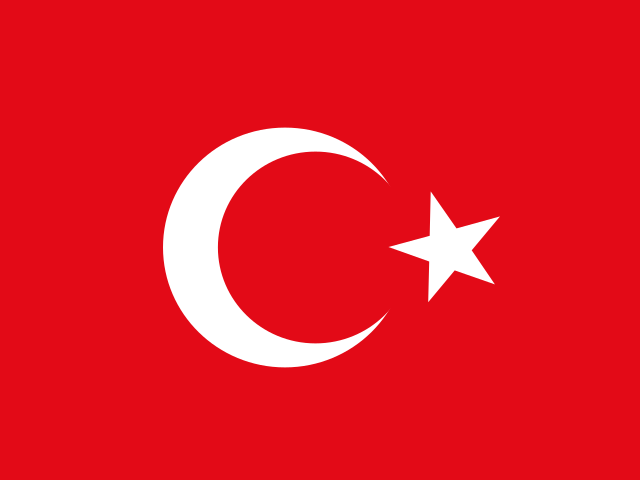
Turkey
Complete data on Turkey: geography, population, economy, culture, key indicators and statistics. Factual information, regularly updated.
Time and date in Turkey (Ankara)
Overview
Turkey (Türkiye), officially the Republic of Türkiye, is a transcontinental country located mostly in Western Asia (Anatolia) and in Southeast Europe (East Thrace). It covers an area of 783,562 km² and has about 87.9 million inhabitants in 2026. Its capital is Ankara, and its largest city is Istanbul.
Turkey is an emerging economy ranked among the twenty largest economies in the world (17th nominal GDP in 2025). It is a member of the G20, the OECD, NATO and the EU Customs Union. The country is a strategic crossroads between Europe, the Middle East and Asia, and plays a key role in regional energy and trade corridors.
Data on Turkey
Geography of Turkey
Turkey is a transcontinental country: about 97% of its territory lies in Asia (Anatolia) and 3% in Europe (East Thrace), on either side of the Bosphorus and Dardanelles straits. It shares borders with eight countries: Greece, Bulgaria, Georgia, Armenia, Azerbaijan, Iran, Iraq and Syria. It is bordered by the Black Sea to the north, the Aegean Sea to the west and the Mediterranean Sea to the south.
Turkey's terrain is dominated by plateaus and mountains: more than half of the territory lies above 1,000 metres. The country is framed by two major mountain ranges: the Pontic Mountains in the north (up to 3,600 m) and the Taurus Mountains in the south (up to 4,000 m). The highest point is Mount Ararat (5,166 m), located in the east. The central plateaus (Central Anatolia) and eastern plateaus (Armenian Highlands) alternate with narrow coastal plains. The Tigris and Euphrates rivers rise in the east of the country.
Population and demographics
Turkey had approximately 87.9 million inhabitants in 2026 according to United Nations estimates. The population density is about 114 inhabitants/km², but distribution is very uneven: the coastal regions of the west and north (Marmara, Aegean) are densely populated, while the mountainous east is much more sparsely inhabited.
The Turkish population is experiencing progressive ageing: the median age is 33.9 years in 2026. The fertility rate is 1.6 children per woman, below the replacement threshold. Life expectancy is 78.4 years (75.5 years for men, 81.3 years for women). Urbanisation is high: 77.5% of the population lives in cities.
| Indicator | Value |
|---|---|
| Total population (2026) | ~87.9 million |
| Population density | ~114 inhab/km² |
| Fertility rate | 1.6 children per woman |
| Life expectancy | 78.4 years (M: 75.5 / F: 81.3) |
| Median age | 33.9 years |
| Urban population | 77.5% |
| Ethnic groups | Turks ~70-75%, Kurds ~19%, others ~6-11% |
Turks constitute the majority group (70 to 75%), followed by Kurds (about 19%). Other minorities (Arabs, Armenians, Greeks, Circassians, Bosniaks, etc.) represent 6 to 11% of the population. The largest cities are Istanbul (over 15 million inhabitants), Ankara (3.6 million), Izmir (2.6 million), Bursa (2.3 million) and Antalya (1.3 million).
Population change (1950-2026)
Population by age (2026)
Climate in Turkey: temperatures and precipitation
Turkey has a great diversity of climates due to its relief and its position between the sea and the continents. Broadly speaking: a Mediterranean climate on the southern and western coasts (hot, dry summers, mild, rainy winters), an oceanic climate on the Black Sea coast (cool summers, mild winters, abundant precipitation all year round) and a continental climate on the interior plateaus (cold winters, hot, dry summers).
Average temperatures vary greatly by region: in Istanbul, the annual average is about 13-14°C, with winters around 3-9°C and summers around 20-29°C. In Antalya, the annual average reaches 18-20°C, with summers exceeding 30°C. Precipitation is abundant on the Black Sea coast (over 1,000 mm/year in the east), while the central plateaus receive less than 400 mm/year.
Average monthly temperatures (°C) - Istanbul
Monthly precipitation (mm) - Istanbul
Data based on Istanbul climate normals. Regional variations are considerable.
Languages
The official language of Turkey is Turkish, spoken by about 87.6% of the population. Kurdish is the second most spoken language (about 10.4%), mainly in the south-east of the country. Arabic (about 1.4%) and other minority languages (Circassian, Armenian, Greek, Laz, etc.) are also present. Turkish has used the Latin alphabet since the 1928 reform, and the language has been deeply modernised and standardised under Atatürk's impulse.
Turkey is a de facto multilingual country, but Turkish is the language of administration, education and the media. Kurdish (Kurmanji and Zazaki) is spoken by the Kurdish minority, and its use in public life was long restricted before a partial liberalisation in the 2000s. English is widely taught in schools and used in tourism and business.
Languages spoken in Turkey
Turkish is an Altaic language, agglutinative, with characteristic vowel harmony. It is written with a modified Latin alphabet (29 letters). Dialectal richness is significant, but standard Istanbul Turkish dominates the media and education.
Religions practised in Turkey
Turkey is a country with an overwhelming Muslim majority: about 99% of the population declares itself Muslim. Among Muslims, the vast majority is Sunni (about 85%), mainly of the Hanafi rite. The Alevis, a minority branch of Islam (often associated with Shiism), represent a significant but difficult-to-quantify share: estimates vary from 6% (KONDA survey) to 25-31% according to Alevi representatives. Shia (Ja'fari) Muslims represent about 4%.
Non-Muslims are very much a minority (about 0.2%): mainly Christians (Greek Orthodox, Armenians, Syriacs, Catholics) and Jews. Turkey has been officially a secular state since 1937, and freedom of religion is guaranteed by the Constitution, although its exercise is regulated.
Religions in Turkey
Sunni Islam has deeply shaped Turkish culture and society, but the country experienced significant secularisation in the 20th century, especially in the large western cities. Alevis practise a heterodox Islam, with their own ceremonies (cem) and traditions. The Christian minority, once much larger, is now very small but preserves a significant cultural and architectural heritage (churches, monasteries).
Economy and GDP
Turkey is an emerging economy ranked 17th in the world by nominal GDP in 2025, with a GDP of about $1,565 billion. GDP per capita is about $18,676 (nominal, 2025). The country has experienced sustained growth in recent years (+3.6% in 2025), but it faces high inflation (30.9% in March 2026) and an unemployment rate of about 8.5%.
The structure of the Turkish economy is dominated by services (over 50% of GDP), followed by industry (about 30%) and agriculture (about 6-7%). Key sectors include automotive, textiles, home appliances, steel, tourism and agriculture (hazelnuts, tea, fruit and vegetables). Turkey is a major exporter ($273 billion in 2025) and an importer ($365 billion). Its public debt is relatively low (about 24% of GDP).
Evolution of Turkey's GDP (billions $)
The minimum wage for 2026 was set at 28,075 TL net (about €550). The average gross salary is about 47,346 TL per month (2024). The Turkish lira (TRY) has depreciated significantly in recent years, which has fuelled inflation. The country attracts foreign direct investment (stock of $164.9 billion in 2022) and relies on its strategic positioning between Europe and Asia.
Breakdown of the economy by sector (% GDP)
Socio-economic indicators
History and civilisations
Turkey's history is of exceptional richness, as the Anatolian territory has been the cradle of many civilisations: Hittite, Greek, Roman, Byzantine and Ottoman. The Seljuks then the Ottomans dominated the region from the 11th century. The Ottoman Empire, founded around 1299, reached its peak in the 16th century under Suleiman the Magnificent, extending over three continents.
After World War I and the fall of the Empire, Mustafa Kemal Atatürk proclaimed the Republic in 1923 and launched a vast programme of modernising reforms (abolition of the caliphate, secularisation, Latin alphabet, women's emancipation). Turkey has since remained a republican, secular and unitary state, a NATO member since 1952 and a candidate for EU membership since 1987 (negotiations opened in 2005).
Major periods of Turkish history
Culture
Turkish culture is a unique blend of influences: it draws its roots from the Central Asian steppes, the Ottoman Empire, Islam and Mediterranean and Anatolian civilisations. This richness is reflected in literature (Orhan Pamuk, Nobel Prize 2006; Yaşar Kemal), music (Ottoman classical music, türkü, arabesk, pop), dance (regional folk dances, whirling dervishes) and the arts (Iznik ceramics, carpets, marquetry).
Turkish gastronomy is one of the most renowned in the world: kebab (şiş, döner, adana), mezzes, baklava, lokum (Turkish delight), tea (çay) and Turkish coffee. The major festivals are Ramazan Bayramı (end of Ramadan) and Kurban Bayramı (Feast of the Sacrifice), as well as the Republic Day (29 October) and Youth and Sports Day (19 May). The Turkish bath (hamam) culture and çay (tea) punctuate daily life.
Turkey is also a global tourist crossroads: Istanbul (Hagia Sophia, Blue Mosque, Topkapı), Cappadocia and its fairy chimneys, Ephesus, Pamukkale, the Mediterranean coast (Antalya) and the archaeological sites of Troy and Göbekli Tepe (one of the oldest known temples).
 Nigeria
 Senegal
 Ivory Coast
 South Africa
 Algeria
 United States
 Canada
 China
 India
 Japan
 South Korea
 Saudi Arabia
 Iran
 France
 Germany
 Italy
 United Kingdom
 Spain
 Ukraine
 Russia
 Netherlands
 Belgium
 Switzerland
 Australia
 New Zealand