
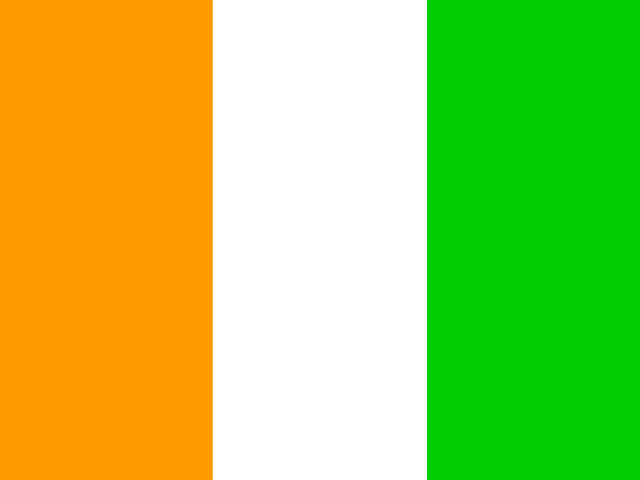
Ivory Coast
Complete data on Ivory Coast: geography, population, economy, culture, key indicators and statistics. Factual information, regularly updated.
Time and date in Ivory Coast (Abidjan)
Overview
Ivory Coast (Republic of Côte d'Ivoire) is a country in West Africa, located in the Gulf of Guinea. With a population estimated at about 33.5 million inhabitants in 2026, it is one of the most populous countries in the sub-region. Its political capital is Yamoussoukro, but the economic capital and largest city is Abidjan, which concentrates most of the activity.
Ivory Coast is a presidential republic. The official language is French, but Dioula serves as the lingua franca in much of the country. The country is the world's largest cocoa producer (over 40% of the market) and plays a driving role in WAEMU, accounting for about 40% of its GDP.
Data on Ivory Coast
Geography of Ivory Coast
Ivory Coast covers an area of 322,462 km². It is bordered to the south by the Atlantic Ocean (Gulf of Guinea) with about 550 km of coastline, to the west by Liberia and Guinea, to the north by Mali and Burkina Faso, and to the east by Ghana.
The terrain is low, consisting of plains and plateaus. The highest point is Mount Nimba (1,752 m), on the border with Guinea and Liberia. The country is watered by four major rivers: the Bandama (1,050 km, entirely Ivorian), the Comoé (1,160 km), the Sassandra (650 km) and the Cavally (700 km, border with Liberia).
The climate is tropical, with a north-south gradient: humid equatorial climate in the south (two rainy seasons, dense forests), transitional tropical climate in the centre, and Sahelian climate in the north (a single rainy season, dry savannah). Precipitation ranges from over 2,000 mm/year on the south-west coast to less than 1,000 mm in the north.
Population and demographics
Ivory Coast has an estimated population of 33.5 million inhabitants in 2026 (33,494,346 according to the UN). The population density is about 105 inhab/km², with a strong concentration in the south (Abidjan) and the forest zones, while the north is less densely populated.
Demographics are very young: the median age is 18.5 years. Life expectancy is about 62.4 years (60.5 years for men, 64.7 years for women). The urbanisation rate reaches 49.5%. Fertility remains high, with a total fertility rate of 4.1 children per woman.
| Indicator | Value |
|---|---|
| Total population (2026) | ~33.5 million |
| Population density | ~105 inhab/km² |
| Birth rate | ~32 / 1,000 |
| Life expectancy | ~62.4 years |
| Median age | 18.5 years |
| Urban population | ~49.5% |
| Ethnic groups | Akan (~38%), Gur/Voltaic (~22%), Krou (~9%), Mandé (~15%), others |
The population is diverse: the Akan (Baoulé, Agni, etc.) constitute the majority group (~38%), followed by the Gur/Voltaic (~22%), Mandé (~15%) and Krou (~9%). The largest cities are Abidjan (metropolitan area of about 6.6 million inhabitants), Bouaké (~725,000), Daloa, Korhogo, San-Pédro and Yamoussoukro (political capital).
Population change (1950-2026)
Population by age (2026)
Climate in Ivory Coast: temperatures and precipitation
Ivory Coast has a tropical climate with three main zones. The south (Abidjan, San-Pédro) is humid equatorial, with two rainy seasons (May-July and October-November) and abundant precipitation (often > 1,500 mm/year). The centre (Yamoussoukro, Bouaké) has a transitional climate, with a main rainy season (June-October). The north (Korhogo, Odienné) is Sahelian, with a single rainy season (July-September) and lower precipitation (< 1,200 mm/year).
Temperatures are high throughout the year, with averages of 25 to 30°C on the coast and more marked variations in the north. The harmattan, a dry, dusty wind from the Sahara, blows from December to February in the north, bringing a dry haze and cooler nights.
Average monthly temperatures (°C) - Abidjan
Monthly precipitation (mm) - Abidjan
Indicative data for Abidjan. The north of the country is significantly drier and experiences a single rainy season.
Languages
The official language of Ivory Coast is French, used in administration, education and business. However, Dioula (a variant of Manding) is the most widely spoken lingua franca, used throughout much of the country, particularly in the north and urban centres. The country has over 60 ethnic languages, the main ones being Baoulé, Bété, Sénoufo, Yacouba and Agni.
Most of these languages belong to the Niger-Congo family (notably the Kwa and Gur branches). Arabic is also used in Quranic teaching and trade.
Language breakdown in Ivory Coast (estimate)
French remains the language of administration and official writing, while Dioula dominates daily exchanges in many regions. Local languages are used in family life, regional media and culture.
Religions practised in Ivory Coast
Ivory Coast is a country of great religious diversity. Islam is the largest religion, with about 42.5% of the population, followed by Christianity (~39.8%), mainly Catholic and Evangelical. About 12.6% of the population declares no religion, and a small minority (~2.2%) practises traditional African religions.
The geographic distribution is fairly clear: Islam is dominant in the north and centre-west, while Christianity dominates in the south and east. The country is known for its peaceful coexistence between communities, although tensions have occasionally existed locally. Religious holidays (Eid al-Fitr, Eid al-Adha, Christmas, Easter) are celebrated, and some are public holidays.
Religions in Ivory Coast
Freedom of religion is guaranteed by the Constitution. Political authorities regularly attend ceremonies of the various faiths, emphasising the importance of interfaith dialogue for national cohesion.
Economy and GDP
Ivory Coast is the leading economy of the WAEMU (about 40% of the zone's GDP) and one of the most dynamic in West Africa. Its nominal GDP was about $87.1 billion in 2024, with real growth of 6.0% expected for 2026. GDP per capita remains around $2,700.
The economy is diversified. Services dominate (about 52 to 56% of GDP), driven by telecommunications, transport, trade and finance. Industry accounts for about 22 to 24% (agri-food, refining, construction, mining). Agriculture contributes about 17 to 22% of GDP and employs a large share of the population. The country is the world's leading cocoa producer (> 40% of the market), and also exports coffee, cashew nuts, cotton, gold and oil.
Evolution of Ivory Coast's GDP (billions $)
Growth is supported by household consumption, public investment (PND 2026-2030) and dynamic exports. The country faces challenges: rising public debt (around 55% of GDP in 2026), high youth unemployment (2.3% according to official figures, but underestimated) and persistent poverty. Inflation is under control (~3.5% in 2025).
Breakdown of the economy by sector (% GDP)
Socio-economic indicators
History and civilisations
The territory of Ivory Coast has been inhabited since prehistory. Over the centuries, several kingdoms and empires developed: the Kong kingdom in the north, the Akan chiefdoms (Baoulé, Agni) and Krou societies in the west. The country was also marked by the Atlantic slave trade and the influence of neighbouring empires (Mali, Songhai).
French colonisation began with the establishment of protectorates in the 1840s, and Ivory Coast became a French colony in 1893. After World War II, the country became an overseas territory, then an autonomous republic within the Community in 1958. Independence was proclaimed on 7 August 1960, with Félix Houphouët-Boigny as its first president.
Houphouët-Boigny ruled the country until his death in 1993, a period marked by sustained economic growth (the "Ivorian miracle") but also by growing authoritarianism. The 1990s and 2000s were marked by political tensions and a civil war (2002-2011), which ended with the 2010-2011 post-electoral crisis. Since then, the country has regained relative stability and strong growth, despite persistent challenges (national cohesion, youth, dependence on raw materials).
Major periods of Ivorian history
Culture
Ivorian culture is rich and diverse, reflecting the many ethnic groups (Akan, Gur, Mandé, Krou) and rapid urbanisation. The country is world-renowned for its music: zouglou (Alpha Blondy, Magic System), coupé-décalé (DJ Arafat, A'salfo), but also reggae, jazz and traditional music. Ivorian literature is dynamic, with authors such as Ahmadou Kourouma (The Suns of Independence), Véronique Tadjo and Werewere Liking.
Ivorian cinema is one of the oldest in Africa, with directors such as Désiré Ecaré and Roger Gnoan M'Bala. Téranga (hospitality) is an important value. The country is also renowned for its crafts (masks, Baoulé and Dioula fabrics, sculptures) and its traditional festivals (yam festival, dipri festival, etc.).
Gastronomy is tasty: attieké (cassava semolina) with fish, kedjenou (stewed chicken or fish), alloco (fried plantains), garba (attiéké with tuna), foutou (yam or banana dough), sauce graine (palm seed sauce). The major festivals are Independence Day (7 August), religious holidays (Eid, Christmas, Easter) and cultural festivals such as FESPACO (cinema) and MASA (performing arts).
 Nigeria
 Senegal
 South Africa
 Algeria
 United States
 Canada
 China
 India
 Japan
 South Korea
 Turkey
 Saudi Arabia
 Iran
 France
 Germany
 Italy
 United Kingdom
 Spain
 Ukraine
 Russia
 Netherlands
 Belgium
 Switzerland
 Australia
 New Zealand