
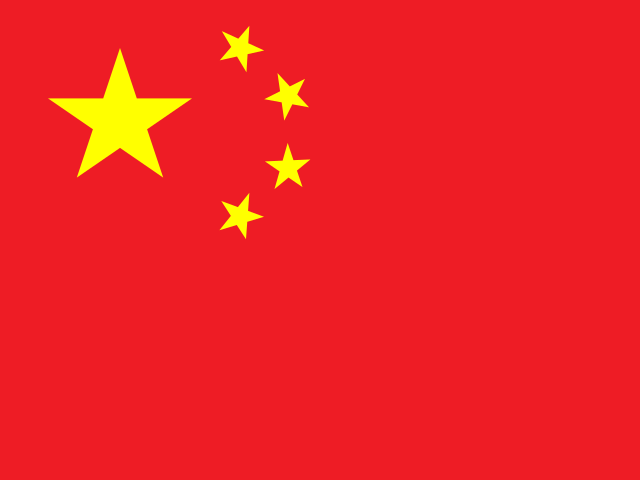
China
Complete data on China: geography, population, economy, culture, indicators and key statistics. Factual information, kept up to date.
Time and date in China (Beijing)
Overview
China (People's Republic of China) is a country in East Asia and the second most populous country in the world, with about 1.412 billion inhabitants in 2026. It covers an area of about 9.6 million km², making it the third largest country in the world by total area. Its capital is Beijing, and the official language is Mandarin (putonghua).
China is a major economic power, ranked as the world's second-largest economy with a nominal GDP of about $18,000 billion (estimate). Its GDP per capita is about $13,806 (nominal, 2025). The country is the world's largest exporter and a central player in international trade. Its economic growth, although slower in recent years, remains one of the most dynamic among the major economies (target of 4.5 to 5% for 2026).
Data on China
Geography of China
China is the third largest country in the world with an area of about 9.6 million km². Its terrain is organised into three great steps that descend from west to east:
The first step (average altitude above 4,000 m) is dominated by the Tibetan Plateau, known as "the roof of the world", surrounded by the Himalayas, the Kunlun and the Tian Shan. This is the region where China's great rivers originate.
The second step (1,000 to 2,000 m) includes the Inner Mongolia Plateau, the Loess Plateau, the Yunnan-Guizhou Plateau and the Sichuan Basin. The Loess Plateau, with sedimentary deposits that can reach 200 metres in thickness, explains the exceptional sediment load of the Yellow River.
The third step (below 500 m) consists of the great plains of the east: the North China Plain, the plain of the middle and lower Yangtze, and the Northeast Plain. This is the most densely populated region and the agricultural and industrial heartland of the country. Mountainous areas make up about 33.3% of the territory, plateaus 26%, basins 18.8%, plains 12% and hills 9.9%.
The main rivers are the Yangtze (Chang Jiang, 6,300 km), the longest in Asia, and the Yellow River (Huang He, 5,464 km), considered the cradle of Chinese civilisation. The country has more than 2,000 lakes.
Population and demographics
China had about 1.412 billion inhabitants in 2026, making it the second most populous country in the world behind India. The population density is about 150 inhabitants/km², but the distribution is very uneven: the population is heavily concentrated in the eastern plains and coastal areas, while the west (Tibet, Xinjiang) is very sparsely populated.
The country is experiencing rapid demographic ageing and a population decline since 2022. The median age is about 40.6 years (2026). The fertility rate has fallen to about 1.0 child per woman, one of the lowest in the world. Life expectancy reached 79.25 years in 2025. Urbanisation is progressing rapidly: about 67.9% of the population lived in cities in 2025.
| Indicator | Value |
|---|---|
| Total population (2026) | 1.412 billion |
| Population density | ~150 inhab/km² |
| Fertility rate | ~1.0 child per woman |
| Life expectancy | 79.25 years (2025) |
| Median age | 40.6 years (2026) |
| Urban population | 67.9% (2025) |
| Rural population | ~32% |
| Ethnic groups | Han ~91%, 55 recognised minorities |
The Chinese population is predominantly Han (over 90%), but the country officially recognises 56 ethnic groups, including the Zhuang, Hui, Manchu, Uyghur, Miao, Yi, Tujia, Tibetans and Mongols. The largest urban areas are Shanghai (over 24 million), Beijing (21 million), Chongqing (16 million), Guangzhou (13 million) and Shenzhen (12 million).
Population change (1950-2026)
Population by age (2026)
Climate in China: temperatures and precipitation
China has a very wide variety of climates because of its size and terrain. Broadly speaking, there is a subtropical climate in the south (Guangzhou, Hong Kong), a temperate climate in the centre-east (Shanghai, Beijing), a continental climate in the northeast (Harbin), a desert climate in the northwest (Xinjiang, Gobi) and a high-mountain climate in Tibet. The average annual temperature in Beijing is about 12 to 13 °C, with hot and humid summers (up to 30-35 °C in July) and cold, dry winters (sub-zero temperatures).
Precipitation gradually decreases from the southeast to the northwest. The southeast receives more than 1,500 mm/year, while the desert northwest receives less than 100 mm/year. The rainy season (monsoon) runs from May to September in the south and centre-east. Extreme weather events include typhoons on the southeast coast, spring sandstorms in the north, and floods along the Yangtze.
Average monthly temperatures (°C) - Beijing
Monthly precipitation (mm) - Beijing
Data based on Beijing climate normals. Regional variations are considerable.
Languages
The official language of China is Mandarin (putonghua), a Sino-Tibetan language based on the Beijing dialect. Mandarin is spoken by the vast majority of the population, but there is a great diversity of languages and dialects: no fewer than 292 living languages are recorded in China. The main families are Chinese (with its varieties: Mandarin, Cantonese, Wu, Min, Hakka, etc.), the Tibeto-Burman languages, the Altaic languages (Mongolian, Uyghur, Manchu) and the Tai-Kadai languages (Zhuang).
Standard Mandarin is used in government, education and the media. Other Chinese varieties (Cantonese, Shanghainese, Hokkien, etc.) remain very much alive in the regions and in overseas communities. China also recognises official minority languages in certain autonomous regions (Tibetan, Uyghur, Mongolian, Zhuang, etc.). Chinese writing, made up of Han characters, is a millennia-old logographic system that unifies the country beyond dialect differences.
Language distribution in China
Mandarin is the mother tongue of about 70% of the population, followed by Wu (Shanghainese, ~8%), Cantonese (about 5%) and other varieties. Language policy promotes the spread of putonghua, but local languages remain important in daily life and regional culture.
Religions practised in China
China is a country of great religious and spiritual diversity, marked by the coexistence of Buddhism, Taoism, Chinese folk religions, Islam and Christianity. According to estimates, about 44.4% of the population declares no religious affiliation (or is atheist), while 28.5% practise Chinese folk religions (ancestor worship, local deities), 12.5% are Buddhist, 5.3% are Christian, 4.6% follow traditional ethnic religions and 1.9% are Muslim.
Buddhism is the most important organised religion, with the number of practitioners estimated between 185 and 250 million depending on the source. Taoism, an indigenous religion, has fewer than 1% formal adherents, but its cultural influence (philosophy, traditional medicine, martial arts) is profound. Islam is practised by about 20 million people, mainly among ethnic minorities (Hui, Uyghurs, Kazakhs). Christianity is growing rapidly, although estimates vary.
Religions in China
Religious freedom is guaranteed by the Constitution, but its exercise is regulated by law. Traditional Chinese religions (Confucianism, Taoism, Buddhism) have profoundly shaped the country's culture, ethics and social values. Confucianism, although not religious in the strict sense, remains a major moral and philosophical reference.
Economy and GDP
China is the world's second-largest economy, with a nominal GDP estimated at about $18,000 billion. GDP per capita is about $13,806 (nominal, 2025), which places China in the upper-middle-income category according to the World Bank. Economic growth remains solid, with an official target of 4.5 to 5% for 2026.
The sectoral structure of the Chinese economy has changed profoundly: services now account for more than 50% of GDP, industry about 40% and agriculture less than 8%. The country is the world's largest manufacturer (steel, solar panels, electric vehicles, etc.) and the largest exporter of goods. The main trading partners are ASEAN, the European Union, the United States, Japan and South Korea.
Evolution of Chinese GDP (billions $)
The urban unemployment rate is about 5.5% (2026 target). Inflation is low, at around 2%. Public debt is estimated at about 80-90% of GDP, a level that is still manageable but rising. The average salary has risen sharply in recent decades, but income inequality remains marked between coastal regions and the interior, and between urban and rural areas. The minimum wage varies by province and city (for example, Shanghai: 2,690 CNY/month in 2025).
Breakdown of the economy by sector (% GDP)
Socio-economic indicators
History and civilisations
China is one of the oldest continuous civilisations in the world, with a history of more than 4,000 years. The first dynasties (Xia, Shang, Zhou) laid the foundations of a lasting culture, marked by the invention of writing, silk, paper, gunpowder and the compass. Confucianism, Taoism and Buddhism have profoundly shaped Chinese thought and the arts.
In the 19th and early 20th centuries, China went through a period of turmoil and transformation (the Opium Wars, the fall of the Empire, the establishment of the Republic). Since the late 1970s, the country has pursued a policy of reform and opening up that has led to spectacular economic growth and massive urbanisation, lifting hundreds of millions of people out of poverty. Today, China is an essential player in the global economy and geopolitics, while facing major demographic and environmental challenges.
Major periods of Chinese history
Culture
Chinese culture is one of the richest and oldest in the world. It rests on a millennia-old philosophical and artistic heritage, blending Confucianism, Taoism and Buddhism. Calligraphy, ink painting, ceramics (porcelain), opera (Peking opera, kunqu) and gastronomy (eight great regional cuisines) are jewels of this heritage. Traditional festivals punctuate social life: the Chinese New Year (Spring Festival), the Lantern Festival, the Dragon Boat Festival and the Mid-Autumn Festival.
Chinese literature is prestigious, from Confucius' Analects to the great classic novels (Dream of the Red Chamber, Water Margin, Journey to the West). Traditional Chinese medicine (acupuncture, herbal medicine, tai chi) is practised and recognised around the world. Chinese cinema (Zhang Yimou, Chen Kaige, Wong Kar-wai) and music (opera, traditional instruments such as the guzheng and the erhu) also enjoy international reach.
Chinese gastronomy is extremely varied, with eight great regional culinary traditions (Cantonese, Sichuan, Shandong, etc.). Emblematic dishes include Peking duck, dumplings (jiaozi), rice and noodles, tofu, and tea (green, black, oolong, pu-erh). Martial arts (kung fu, tai chi) and qigong are also major cultural practices, combining sport, health and spirituality.
 Nigeria
 Senegal
 Ivory Coast
 South Africa
 Algeria
 United States
 Canada
 India
 Japan
 South Korea
 Turkey
 Saudi Arabia
 Iran
 France
 Germany
 Italy
 United Kingdom
 Spain
 Ukraine
 Russia
 Netherlands
 Belgium
 Switzerland
 Australia
 New Zealand