
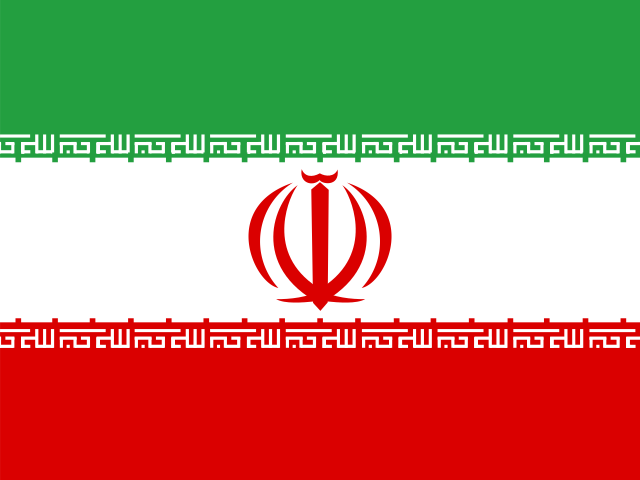
Iran
Complete data on Iran: geography, population, economy, culture, institutions, key indicators and statistics. Information updated in real time.
Time and date in Iran
Overview
Iran, officially the Islamic Republic of Iran, is a country in Western Asia covering an area of 1,648,195 km². It shares borders with Iraq, Turkey, Armenia, Azerbaijan, Turkmenistan, Afghanistan and Pakistan. The country is bordered by the Caspian Sea to the north and the Persian Gulf to the south.
Iran is a major energy power, holding the second-largest proven natural gas reserves and the fourth-largest oil reserves in the world. Its capital is Tehran. The country is an Islamic republic where the Supreme Leader holds ultimate authority. The population is predominantly Persian (61%), with significant Azeri (16%), Kurdish (10%) and Luri (6%) minorities.
Data on Iran
Geography of Iran
Iran is dominated by a vast central plateau surrounded by mountain ranges. The Alborz mountains in the north culminate at Mount Damavand (5,610 m), the country's highest point. The Zagros mountains stretch from northwest to southeast. The country has two major deserts: the Dasht-e Kavir and the Dasht-e Lut, the latter being one of the hottest places on the planet.
The climate is arid and semi-arid, with very hot summers and cold winters. Precipitation is low, except in the mountainous regions of the west and north, and on the Caspian coast, which receives much more rain. Iran has only one navigable river, the Karun.
Population and demographics
Iran has a population of about 88.8 million inhabitants (July 2026 estimate). The population is highly urbanised, with a strong concentration in Tehran (more than 9 million inhabitants in the metropolitan area), Mashhad, Isfahan, Shiraz and Tabriz. The average density is about 58 inhabitants/km².
The ethnic composition is diverse: Persians (61%), Azeris (16%), Kurds (10%), Luris (6%), Arabs and Baloch (4%) and others (2%). The official language is Persian (Farsi). The fertility rate has fallen sharply in recent decades, reaching about 1.7 children per woman.
| Indicator | Value |
|---|---|
| Total population (2026) | 88.8 million |
| Population density | ~58 inhab/km² |
| Ethnic composition | Persians 61%, Azeris 16%, Kurds 10%, Luris 6%, others 7% |
| Unemployment rate | ~9.2% (2026, IMF) |
| Inflation | ~78.6% (2026, IMF) |
| Capital | Tehran |
Population change (estimate)
Ethnic breakdown
Climate in Iran
The Iranian climate is arid and semi-arid, with extremely hot summers and cold winters inland. Temperatures in Tehran range from an average of 4.9°C in January to 31.3°C in July. In the south, summer temperatures can exceed 45°C.
Precipitation is very low in most regions, with a national average of about 20 rainy days per year. The Caspian coast is much more humid, receiving up to 1,000 mm/year, while the central deserts receive less than 50 mm/year.
Average monthly temperatures in Tehran (°C)
Monthly precipitation in Tehran (mm)
Data based on Tehran (Mehrabad) normals. Source: Japan Meteorological Agency (JMA).
Languages
The official language is Persian (Farsi), used in administration, education and the media. Iran is a multilingual country with a great diversity of regional languages and dialects. According to UNESCO, 67 living indigenous languages are spoken in Iran.
The main minority languages are Azeri (spoken by about 16% of the population), Kurdish, Luri, Arabic (in Khuzestan), Balochi (in Sistan and Baluchestan) and Turkmen. Smaller languages such as Armenian, Assyrian and Georgian are also present in certain communities.
Languages spoken in Iran (estimate)
Religions practised in Iran
Islam is the state religion, and about 99% of the population is Muslim. Twelver Shia Islam is overwhelmingly dominant (about 90-95% of Muslims), followed by Sunni Islam (5-10%), mainly among Kurds, Baloch and Turkmens.
About 1% of the population belongs to recognised religious minorities: Christians (Armenians and Assyrians), Jews and Zoroastrians. The Bahá'í community, not officially recognised, is the largest non-Muslim minority, estimated at about 300,000 people.
Religious breakdown in Iran
Economy and GDP
Iran has an economy heavily dependent on hydrocarbons, but it is also one of the most diversified in the Middle East (agriculture, automotive industry, handicrafts, services). Nominal GDP is estimated at about $312 billion in 2026, with GDP per capita of about $3,548.
The Iranian economy suffers from international sanctions that limit its oil exports and its access to the global financial system. According to the IMF, inflation is expected to reach 78.6% in 2026, before falling to 42% in 2027. The unemployment rate is estimated at 9.2%.
Evolution of Iranian nominal GDP (billions $)
The oil and gas sector accounts for a large share of public revenues and exports. The country holds the second-largest natural gas reserves and the fourth-largest oil reserves in the world. Agriculture (wheat, rice, fruit, saffron) employs a significant share of the population, and industry (automotive, petrochemicals, textiles) is developed despite the constraints.
Socio-economic indicators
History
Iran is the heir to the Persian Empire, one of the greatest civilisations in history. Founded by Cyrus the Great in the 6th century BC, the Achaemenid Empire stretched from Greece to India. After Alexander's conquests, Persia experienced the Seleucid, Parthian and Sassanid dynasties, before the Arab conquest in the 7th century and the Islamisation of the country.
The Safavid dynasty (1501-1736) imposed Twelver Shia Islam as the state religion, lastingly shaping Iranian identity. In the 20th century, the Pahlavi dynasty (1925-1979) modernised the country, but its authoritarian regime provoked the 1979 Islamic Revolution, which established the Islamic Republic under the leadership of Ayatollah Khomeini.
Since 1979, Iran has been an Islamic republic where the Supreme Leader (currently Ali Khamenei) holds ultimate authority. The country experienced the Iran-Iraq War (1980-1988) and has faced international sanctions linked to its nuclear programme for several decades.
Culture
Iranian culture is one of the richest in the world, with a history of 2,500 years. Persian poetry is world-renowned, with figures such as Rumi, Hafez, Saadi and Ferdowsi, author of the Book of Kings (Shahnameh). Nowruz (Persian New Year, 21 March) is the most important holiday, celebrated since antiquity.
Iranian art is renowned for its carpets, calligraphy, ceramics and architecture (mosques of Isfahan, Persian gardens). Iranian cuisine is refined, with dishes such as chelow kabab, ghormeh sabzi and fesenjan, and saffron is an emblematic spice.
 Nigeria
 Senegal
 Ivory Coast
 South Africa
 Algeria
 United States
 Canada
 China
 India
 Japan
 South Korea
 Turkey
 Saudi Arabia
 France
 Germany
 Italy
 United Kingdom
 Spain
 Ukraine
 Russia
 Netherlands
 Belgium
 Switzerland
 Australia
 New Zealand