
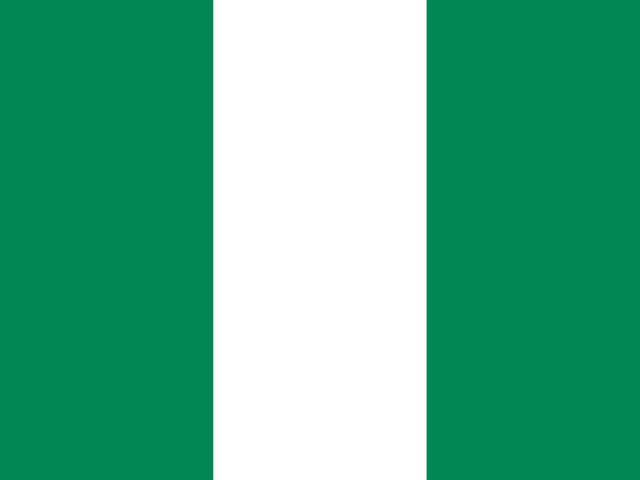
Nigeria
Complete data on Nigeria: geography, population, economy, culture, key indicators and statistics. Factual information, regularly updated.
Time and date in Nigeria (Abuja)
Overview
Nigeria (Federal Republic of Nigeria) is a country in West Africa, located in the Gulf of Guinea. With a population estimated at about 242 million inhabitants in 2026, it is by far the most populous country in Africa. Its capital is Abuja, but the largest city is Lagos, which constitutes the country's main economic and cultural centre.
Nigeria is a federal republic made up of 36 states and a Federal Capital Territory. The official language is English, but over 500 languages are spoken there, reflecting the country's great ethnic diversity (over 250 groups). The three main ethnic groups are the Hausa-Fulani (north), the Yoruba (west) and the Igbo (east).
Data on Nigeria
Geography of Nigeria
Nigeria covers an area of 923,773 km², making it the 14th largest country in Africa. It is bordered to the north by Niger, to the east by Chad and Cameroon, to the west by Benin, and to the south by the Atlantic Ocean (Gulf of Guinea), with about 853 km of coastline.
The terrain is varied: coastal plains in the south, plateaus and high plateaus in the centre, and mountains in the east (Mandara Mountains) and north-east. The highest point is Chappal Waddi (2,419 m). The country is crossed by two major rivers: the Niger (4,180 km, of which 1,400 km in Nigeria) and the Benue, its main tributary. The Niger Delta, in the south, is a region of mangroves and marshes, rich in oil.
The climate is tropical, with a rainy season (May-October) and a dry season (November-April). Precipitation varies greatly: from over 3,000 mm/year in the Niger Delta to less than 500 mm in the Sahelian north. Temperatures are high throughout the year, with averages of 25 to 30°C.
Population and demographics
Nigeria is the most populous country in Africa, with a population estimated at 242.4 million inhabitants in 2026. The population density is about 261 inhab/km², but distribution is very uneven: the southern regions (Lagos, Niger Delta) and the north (Kano) are densely populated, while some areas of the centre and east are emptier.
Nigerian demographics are extremely young: the median age is only 19.4 years, and the birth rate is high (~32/1000). Life expectancy remains relatively low, around 54.6 years. The country is experiencing rapid urbanisation, with cities such as Lagos (metropolitan area estimated at over 17 million inhabitants) and Kano attracting millions of people.
| Indicator | Value |
|---|---|
| Total population (2026) | ~242.4 million |
| Population density | ~261 inhab/km² |
| Birth rate | ~32 / 1,000 |
| Life expectancy | ~54.6 years |
| Median age | 19.4 years |
| Urban population | ~54% |
| Ethnic groups | Hausa-Fulani (~29%), Yoruba (~21%), Igbo (~18%), others |
The population is extremely diverse ethnically and linguistically. The Hausa-Fulani dominate the north, the Yoruba the west and the Igbo the east. The country has over 250 ethnic groups and 500 languages. The largest cities are Lagos (economic centre), Kano (north), Ibadan, Abuja (political capital) and Port Harcourt (oil centre).
Population change (1950-2026)
Population by age (2026)
Climate in Nigeria: temperatures and precipitation
Nigeria has a tropical climate, with significant regional variations. The south (Niger Delta, coast) is very humid, with a long rainy season (March-October) and annual precipitation that can exceed 3,000 mm. The centre (Abuja, Ibadan) has a tropical savannah climate, with a marked dry season (November-March). The north (Kano, Maiduguri) is semi-arid (Sahelian climate), with annual precipitation often below 600 mm and very high temperatures in the dry season (which can exceed 40°C).
Temperatures are high throughout the year, with averages of 25 to 30°C in the south and more marked variations in the north. The harmattan, a dry, dusty wind from the Sahara, blows from December to February in the north, bringing a dry haze and cooler night temperatures.
Average monthly temperatures (°C) - Abuja
Monthly precipitation (mm) - Abuja
Indicative data for Abuja. Regional variations are considerable (heavy rain in the south, drought in the north).
Languages
The official language of Nigeria is English, chosen to facilitate national unity in an extremely diverse country. However, English is only the mother tongue of a minority of the population. Nigerian Pidgin (Naija) is widely used as a lingua franca, especially in cities and the south of the country. The three main languages are Hausa (north), Yoruba (west) and Igbo (east), which are spoken by tens of millions of people and serve as vehicular languages in their respective regions.
The country has over 500 distinct languages, making it one of the most linguistically diverse countries in the world. Most of these languages belong to the Niger-Congo family. French is also present, particularly in border areas with Benin, Niger, Chad and Cameroon.
Language breakdown in Nigeria (estimate)
English remains the language of administration, education and business. Local languages are used in daily life, regional media and culture. Pidgin is the most spoken language in terms of number of speakers, as it serves as a lingua franca across the country.
Religions practised in Nigeria
Nigeria is a country of great religious diversity, with two main religions that roughly share the population: Islam (about 50%) and Christianity (about 40%), to which are added traditional religions (about 10%). The geographic distribution is fairly clear: Islam is majority in the north, while Christianity dominates in the south and centre.
Nigeria is home to the fifth-largest Muslim population in the world and the sixth-largest Christian population. Traditional African religions, although minorities, remain culturally influential, particularly among the Yoruba (orisha worship) and Igbo. The country is also the scene of interreligious tensions in some regions, notably in the "Middle Belt" (centre), where Muslim and Christian communities meet.
Religions in Nigeria
Freedom of religion is guaranteed by the Nigerian Constitution. Religious festivals (Eid al-Fitr, Eid al-Adha, Christmas, Easter) are celebrated and some are national holidays. Religion plays an important role in the country's social and political life.
Economy and GDP
Nigeria is Africa's third-largest economy in 2026, with a nominal GDP estimated at about $386.67 billion according to the IMF. The country was long the continent's leading economy, but the depreciation of the naira reduced the dollar value of its GDP, causing it to fall behind South Africa and Egypt. GDP per capita remains low, around $1,590.
Contrary to popular belief, oil accounts for only a minority share of GDP (about 5.5% in 2024). Services dominate the economy (about 42.8% of GDP), driven by telecommunications (17.7% of GDP), trade (15.46%) and finance (5.5%). Agriculture contributes about 22.7% of GDP and employs a large part of the population. However, oil remains crucial for export revenues (about 90% of exports), making the economy vulnerable to price fluctuations.
Evolution of Nigeria's GDP (billions $)
Economic growth is sustained, with a rate of 4.2% expected for 2026. However, this growth does not always translate into improved living conditions: unemployment and underemployment remain high, and poverty affects a large part of the population (63% according to national measures). Inflation is also a major challenge, although it has declined from the peaks of 2023-2024. The naira has depreciated significantly, which increases the cost of imports.
Breakdown of the economy by sector (% GDP)
Socio-economic indicators
History and civilisations
The territory of Nigeria has been inhabited for millennia, as evidenced by the archaeological remains of the Nok culture (an advanced iron civilisation, between 1500 BC and 500 AD). Over the centuries, several kingdoms and empires developed in the region: the Kanem-Bornu Empire in the northeast, the Yoruba kingdoms (Ife, Oyo) in the west, the Kingdom of Benin in the south, and the Hausa city-states in the north.
The 19th century was marked by British penetration and colonisation. Nigeria became a British protectorate in 1914, merging north and south. The country gained independence on 1 October 1960. The post-independence period was marked by military coups, the Biafra War (1967-1970) and decades of political instability, interspersed with brief democratic periods. The discovery of oil in the Niger Delta profoundly transformed Nigeria's economy and society.
The country returned to a lasting civilian regime in 1999. Since then, Nigeria has experienced political alternation and regular elections, although challenges persist (corruption, insecurity, inequalities). The country plays a major role in West Africa and on the continental stage (ECOWAS, African Union).
Major periods of Nigerian history
Culture
Nigerian culture is one of the richest and most dynamic in Africa, reflecting the diversity of the 250 ethnic groups that make up the country. Nigeria is world-renowned for its film industry, Nollywood, which is the second largest in the world in terms of production. Nigerian music (afrobeats, highlife, juju, fuji) is enjoying growing international success, with artists such as Burna Boy, Wizkid and Davido.
Nigerian literature is prestigious, with world-renowned writers such as Chinua Achebe (Things Fall Apart), Wole Soyinka (Nobel Prize in Literature 1986), Chimamanda Ngozi Adichie and Ben Okri. Traditional arts (wood sculpture, Benin bronzes, textiles) are also remarkable.
Nigerian gastronomy is varied and tasty: jollof rice (the emblematic dish, subject of friendly rivalry with Ghana), egusi soup, pounded yam, suya (spicy skewers), pepper soup and puff-puff (doughnuts). There are many festivals: traditional festivals (Osun-Osogbo, Eyo), religious festivals (Eid, Christmas, Easter) and national holidays (Independence Day on 1 October, Democracy Day on 12 June).
 Senegal
 Ivory Coast
 South Africa
 Algeria
 United States
 Canada
 China
 India
 Japan
 South Korea
 Turkey
 Saudi Arabia
 Iran
 France
 Germany
 Italy
 United Kingdom
 Spain
 Ukraine
 Russia
 Netherlands
 Belgium
 Switzerland
 Australia
 New Zealand