
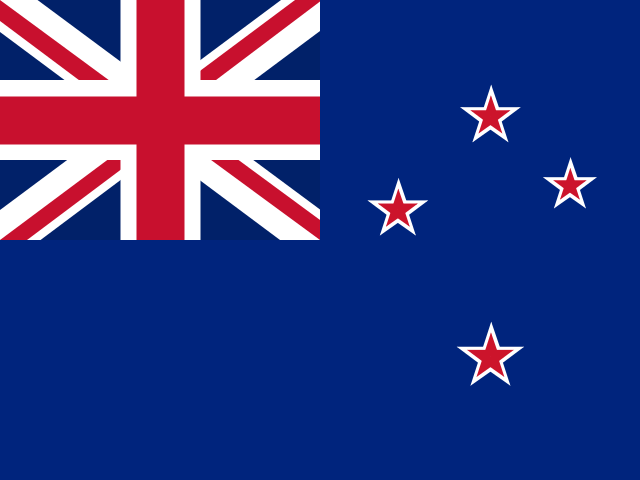
New Zealand
Complete data on New Zealand: geography, population, economy, culture, institutions, key indicators and statistics. Information updated in real time.
Time and date in New Zealand
Overview
New Zealand (Aotearoa in Māori) is an island country in Oceania located in the South Pacific. It consists mainly of two main islands (North Island and South Island) and many smaller islands. Its capital is Wellington, and its largest city is Auckland. New Zealand is a constitutional monarchy and a member of the Commonwealth.
The country is known for its spectacular landscapes: mountains, fjords, volcanoes, beaches and primeval forests. Māori culture, the indigenous Polynesian people, occupies a central place in the national identity. The New Zealand economy is diversified, heavily dependent on agricultural exports (dairy products, meat, wool, kiwifruit) and a dynamic tourism sector.
Data on New Zealand
Geography of New Zealand
New Zealand is an archipelago located in the South Pacific, about 1,600 km southeast of Australia. It covers an area of 268,021 km², making it comparable to Italy or Japan. The country consists of two main islands: the North Island, marked by volcanism and geothermal springs, and the South Island, dominated by the Southern Alps and Mount Cook (3,724 m), the country's highest point.
The landscapes are highly diverse: black sand beaches, fjords (Milford Sound), glaciers (Franz Josef and Fox), agricultural plains, kauri forests and volcanic areas (Rotorua, Tongariro). The country is bordered by the Tasman Sea to the west and the Pacific Ocean to the east. It also has territories in the Pacific (Cook Islands, Niue, Tokelau) and a claim in Antarctica (Ross Dependency).
Population and demographics
New Zealand has a population of about 5.36 million inhabitants (March 2026). The population is highly urban (about 86%) and concentrated in major cities: Auckland (about 1.7 million), Christchurch, Wellington and Hamilton. Population density is low, at around 19.8 inhabitants/km².
The ethnic composition is diverse: about 71.8% European, 16.5% Māori, 9% Asian and 1.5% Pacific peoples. English is the main language, but Māori has also been an official language since 1987. The fertility rate is about 1.8 children per woman.
| Indicator | Value |
|---|---|
| Total population (2026) | 5,361,300 |
| Population density | 19.8 inhab/km² |
| Fertility rate | 1.8 children per woman |
| Unemployment rate | 5.3 % (2026) |
| Employment rate | 66.7 % |
| Inflation (CPI) | +3.1 % (March 2026) |
| Urban population | ~86 % |
Population change (estimate)
Ethnic composition (2023)
Climate in New Zealand
The New Zealand climate is temperate oceanic, with mild summers and cool winters. Temperatures generally range between 10°C and 20°C over the year, with marked regional differences: warmer in the north (Auckland), cooler in the south (Invercargill) and in the mountains. Precipitation is abundant, especially on the west coast of the South Island, where some areas receive more than 6,000 mm/year.
New Zealand is exposed to oceanic influences and prevailing westerly winds. The country experiences various weather phenomena: tropical cyclones (occasional), cold fronts and generous sunshine in some regions (Nelson, Marlborough).
Average monthly temperatures (°C)
Monthly precipitation (mm)
Climate data based on 1991-2020 normals (ERA5). Source: World Bank / ECMWF.
Languages
New Zealand has three official languages: English (de facto language, spoken by almost the entire population), Māori (Polynesian language of the indigenous people, official since 1987) and New Zealand Sign Language (NZSL).
New Zealand English has a distinctive accent and vocabulary, influenced by Māori (e.g. "kia ora" for hello, "whānau" for family). Māori has been experiencing a revival since the 1970s, with immersion schools (kōhanga reo) and increased presence in the media.
Main languages spoken (estimate)
Religions practised in New Zealand
New Zealand is an increasingly secularised society. According to available data, 48.6% of the population declares no religion, while 37.3% declare themselves Christian (Anglican, Catholic, Presbyterian, etc.). Other religions include Hinduism (2.7%), Islam (1.3%), Buddhism (1.1%) and other faiths (2.3%).
Māori culture retains an important spiritual dimension, with concepts such as tapu (sacred) and mana (prestige, authority). Māori Christian churches (Ratana, Ringatu) incorporate traditional cultural elements.
Religions in New Zealand
Economy and GDP
New Zealand is a developed and open economy, heavily dependent on international trade. Nominal GDP is estimated at about NZ$285 billion (2026 projection). The economy contracted in 2024, followed by a gradual recovery, with growth projected at 1.4% in 2026 and 2.2% in 2027.
Exports are dominated by dairy products (milk powder, butter, cheese), meat (beef, lamb), wool, fruit (kiwifruit, apples) and wood. In May 2026, exports reached NZ$8.9 billion, up 18% year-on-year, driven by meat and dairy products. The main trading partners are China, Australia, the United States and the European Union.
Evolution of New Zealand nominal GDP (billions NZD)
The primary sector (agriculture, livestock, forestry, fishing) remains a pillar of the economy, but tourism and services (finance, technology, film) are gaining importance. The unemployment rate is 5.3% and inflation is 3.1% (March 2026).
Socio-economic indicators
History
New Zealand was first settled by the Māori, Polynesians who settled there around the 13th century. The Dutch navigator Abel Tasman sighted the country in 1642, but it was the British captain James Cook who explored the coasts in 1769-1770. British colonisation intensified in the 19th century, notably with the Treaty of Waitangi signed in 1840 between the British Crown and Māori chiefs.
Territorial wars (New Zealand Wars) pitted settlers against Māori in the 1840s-1870s. New Zealand became a dominion in 1907 and gained full independence in 1947, although it remains a member of the Commonwealth. The country was the first in the world to grant women the right to vote in 1893.
In the 20th century, New Zealand participated in both world wars and developed a robust welfare state. Since the 1980s, the country has undergone neoliberal economic reforms and a rapprochement with Asia-Pacific.
History of New Zealand: major periods
Culture
New Zealand culture is a unique blend of Māori heritage and British and multicultural influences. Māori culture is omnipresent: the haka (ritual dance), the hongi (traditional greeting), the marae (meeting place) and the art of whakairo (carving) are central elements of national identity.
New Zealand is world-famous for its film scene (Peter Jackson, director of "The Lord of the Rings"), its music (Lorde, Crowded House) and its literature (Keri Hulme, Booker Prize). The country is also renowned for its rugby (the All Blacks and their haka) and its outdoor culture (hiking, surfing, sailing).
New Zealand gastronomy highlights local products: lamb, seafood (mussels, oysters), kumara (sweet potato), pavlova (emblematic dessert) and a renowned specialty coffee scene.
 Nigeria
 Senegal
 Ivory Coast
 South Africa
 Algeria
 United States
 Canada
 China
 India
 Japan
 South Korea
 Turkey
 Saudi Arabia
 Iran
 France
 Germany
 Italy
 United Kingdom
 Spain
 Ukraine
 Russia
 Netherlands
 Belgium
 Switzerland
 Australia