
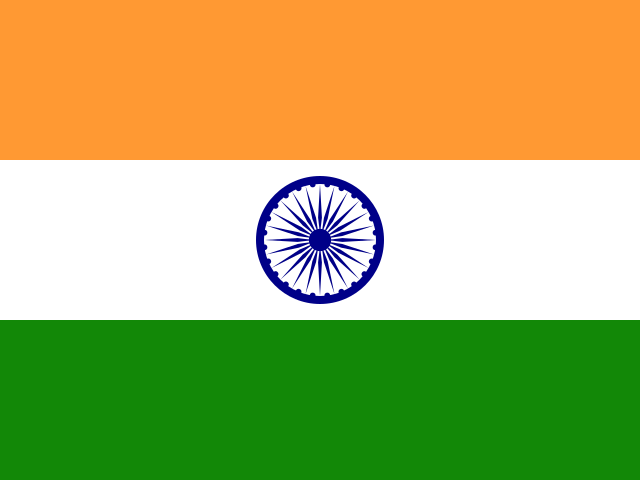
India
Complete data on India: geography, population, economy, culture, institutions, key indicators and statistics. Information updated in real time.
Time and date in India (New Delhi)
Overview
India, officially the Republic of India (Bharatiya Ganarajya), is a federal state in South Asia. It has been the most populous country in the world since 2023, with a population estimated at about 1.48 billion inhabitants in 2026. It is bordered by the Indian Ocean to the south, the Arabian Sea to the west and the Bay of Bengal to the east, and shares land borders with Pakistan, China, Nepal, Bhutan, Bangladesh and Myanmar.
India is a federal parliamentary republic and the world's largest democracy. It is a member of the G20, BRICS, the World Trade Organization and the Shanghai Cooperation Organisation. Its capital is New Delhi, and its official languages at the federal level are Hindi and English, while the Constitution recognises 22 regional official languages. The country is known for its cultural and religious diversity, its film industry (Bollywood) and its rapid economic rise.
Data on India
Geography of India
India covers an area of 3,287,260 km², making it the seventh largest country in the world. Its territory is made up of three major geographic regions: in the north, the Himalaya range, the highest mountain range in the world, which contains fourteen peaks exceeding 8,000 metres; in the centre, the Gangetic Plain, a vast, very fertile and densely populated alluvial region; in the south, the Deccan Plateau, a triangular peninsula bordered by the Western Ghats and the Eastern Ghats.
The hydrographic network is dominated by major rivers: the Ganges (3,090 km), the sacred river of Hinduism, which rises in the Himalayas and flows into the Bay of Bengal; the Brahmaputra (2,880 km), which forms a common delta with the Ganges; the Indus (3,040 km); the Yamuna, the Godavari, the Narmada and the Kaveri. The country also has a coastline of more than 7,500 km and the Lakshadweep and Andaman and Nicobar archipelagos.
Population and demographics
India has been the most populous country in the world since April 2023, with a population estimated at 1.48 billion inhabitants in 2026. The population density is very high: about 497 inhabitants/km². The country is predominantly rural (about 64% of the population), but urbanisation is progressing rapidly. The largest metropolitan areas are Delhi (36 million), Mumbai (28 million), Kolkata (18 million), Bengaluru (15.6 million) and Chennai (13.1 million).
The Indian population is very young: the median age is about 30 years. The fertility rate is declining and now stands around the replacement level (about 2.0 children per woman). Life expectancy is about 72.7 years (71.2 years for men, 74.4 years for women). The demographic transition is nevertheless uneven: some southern states (Kerala, Tamil Nadu) have a fertility rate below 1.6 children per woman, while northern states remain more fertile.
| Indicator | Value |
|---|---|
| Total population (2026) | 1.48 billion |
| Population density | ~497 inhab/km² |
| Fertility rate | ~2.0 children per woman |
| Life expectancy | 72.7 years (men: 71.2 - women: 74.4) |
| Median age | ~30 years |
| Urban population | ~35.7% |
| Rural population | ~64.3% |
| Ethnic groups | Indo-Aryans 72%, Dravidians 25%, others 3% |
The Indian population is multiethnic and multilingual. Indo-Aryans represent about 72% of the population and speak Indo-European languages (Hindi, Bengali, Marathi, etc.), while Dravidians (about 25%) speak Dravidian languages (Telugu, Tamil, Kannada, Malayalam) in the south of the country. The country is experiencing a massive rural exodus and rapid urban growth, with major challenges in housing, infrastructure and employment.
Population change (1950-2026)
Population by age (2026)
Climate in India: temperatures and precipitation
India has a broadly tropical climate, with significant regional variations due to the size of the territory. The country is subject to the monsoon phenomenon, which determines a dry season (from October to May) and a wet season (from June to September), bringing most of the annual precipitation. The south of India is relatively uniform, while the north experiences greater variation: desert and hot in the west (Rajasthan), cold at altitude in the Himalayas, humid and hot in the east (West Bengal, Assam).
Temperatures vary considerably: in the plains, maximums can exceed 40 °C in May-June before the monsoon, while winter minimums drop to around 10-15 °C in the north. Average annual precipitation is about 1,100 mm, but it is very unevenly distributed: some regions of the Northeast (Cherrapunji) receive more than 10,000 mm/year, while the Thar Desert receives less than 200 mm/year.
Average monthly temperatures (°C) - New Delhi
Monthly precipitation (mm) - New Delhi
Indicative data for New Delhi. Regional variations are considerable (Himalayas, Thar Desert, Malabar Coast, etc.).
Languages
India is a country of extraordinary linguistic diversity: more than 400 languages and dialects are spoken there, divided into two major families: Indo-Aryan languages (in the north, spoken by about 77% of the population) and Dravidian languages (in the south, about 20%). The Indian Constitution recognises 22 regional official languages, including Hindi, Bengali, Marathi, Telugu, Tamil, Gujarati, Urdu, Kannada, Odia, Malayalam and Punjabi.
At the federal level, the official languages are Hindi (spoken by about 43.6% of the population as their mother tongue) and English, which is the language of administration, business and justice, and the most important lingua franca for national communication. English is spoken by about 10-15% of the population, mainly urban elites and educated populations. Hindi is the most widely spoken language, but there is a resistance movement in the southern states (Tamil Nadu, Karnataka) against its imposition as a single language.
Most widely spoken mother tongues in India
Multilingualism is a daily reality for millions of Indians, who often speak three or more languages: their regional mother tongue, Hindi and/or English. Language policy is a sensitive political issue, particularly in the Dravidian states of the South, which are attached to their linguistic identity in the face of Hindi.
Religions practised in India
India is the birthplace of several major world religions: Hinduism, Buddhism, Jainism and Sikhism were born there. Today, Hinduism is the majority religion, practised by about 79.8% of the population. Islam is the second religion, with about 14.2% of the population, making India one of the countries with the largest number of Muslims in the world. Christians represent about 2.3%, Sikhs 1.7%, and Buddhists, Jains and other faiths about 2%.
The Indian Constitution guarantees religious freedom and defines India as a secular state. However, interreligious tensions, particularly between Hindus and Muslims, periodically lead to violence. The country is also the scene of caste tensions, despite the abolition of the caste system and affirmative action policies (reservations) in favour of Dalits (untouchables) and Other Backward Classes.
Religions in India
The holy sites of Hinduism (Varanasi, Tirupati, Amritsar for Sikhs, Bodh Gaya for Buddhists) attract millions of pilgrims. Religious festivals (Diwali, Holi, Durga Puja, Eid, Christmas) are celebrated with fervour throughout the country and are important moments of social and cultural life.
Economy and GDP
India is the fifth largest economy in the world in terms of nominal GDP, with a GDP estimated at about $3.9 trillion in 2025. The country is experiencing rapid economic growth: real GDP growth was 7.3% in 2025, driven by the industrial and services sectors. GDP per capita remains low, however, at around $2,700 to $2,800 (nominal) and $11,748 in purchasing power parity (PPP).
The sectoral structure of the Indian economy is dominated by services (about 55% of GDP), followed by industry (about 25%) and agriculture (about 15-20%), which still employs nearly half of the working population. Cutting-edge sectors (information technology, pharmaceuticals, aerospace, renewable energy) are growth drivers, and India is a global hub for IT services and development centres (Global Capability Centers).
Evolution of Indian GDP (billions $)
The unemployment rate is about 4.2% (2025), but underemployment and informal work remain massive. Inflation is moderate (about 4-5%). Public debt is high, at around 80% of GDP (2026-2030). The average salary is low: about $300 to $400 per month, and the minimum wage varies by state (about 8,000 to 15,000 rupees per month, or $100 to $180). Income inequality is significant, with a growing share of billionaires in the economy.
Breakdown of the economy by sector (% GDP)
Socio-economic indicators
History
India's history is one of the oldest and richest in the world. The Indus Valley Civilisation (around 2700-1700 BC) is one of the first great urban civilisations, with planned cities such as Harappa and Mohenjo-Daro. It is followed by the Vedic period (around 1500-500 BC), during which the foundations of Hinduism and the caste society were formed. Buddhism and Jainism emerged in the 6th century BC.
India then experienced a succession of great empires: the Maurya Empire (322-185 BC), with Ashoka spreading Buddhism; the Gupta Empire (320-550 AD), considered the golden age of classical Indian civilisation (mathematics, astronomy, literature). From the 8th century, Islam took root in the subcontinent, and the Delhi Sultanate then the Mughal Empire (1526-1857) dominated much of India. European trading posts (Portuguese, French, British) were established from the 16th century, and the British East India Company gradually took control of the territory.
After the Sepoy Rebellion (1857), India came under direct rule of the British Crown (British Raj). The independence movement, led by Mahatma Gandhi (non-violence, satyagraha), Jawaharlal Nehru and others, led to independence on 15 August 1947, accompanied by the partition with Pakistan. India became a republic in 1950, with a democratic constitution. Since the economic reforms of 1991, the country has experienced rapid growth and is asserting itself as a world power, while facing persistent challenges (poverty, inequality, religious and regional tensions).
History of India: major periods
Culture
Indian culture is one of the oldest and most diverse in the world, marked by a civilisational continuity of more than four millennia and an extraordinary regional variety. It is deeply influenced by Hinduism, Buddhism, Jainism, Sikhism and Islam, as well as by the Dravidian traditions of the South and Persian, Mughal and British influences. Indian literature is rich: the Vedas, the epics of the Mahabharata and the Ramayana, the Kamasutra, the plays of Kalidasa, and more recently the works of Rabindranath Tagore (Nobel Prize 1913), R.K. Narayan, Salman Rushdie and Arundhati Roy.
Indian cinema (Bollywood and the regional industries) is the most prolific in the world, with more than 1,500 films per year. Music (Hindustani in the north, Carnatic in the south), dance (Bharatanatyam, Kathak, Odissi, Kathakali) and the visual arts are essential components of the cultural heritage. The festivals are numerous and colourful: Diwali (festival of lights), Holi (festival of colours), Durga Puja, Eid, Christmas, Pongal, Onam and many others.
Indian gastronomy is world-renowned for its spices and regional diversity: curry, biryani, dosa, idli, samosa, naan, paneer, tandoori, and a multitude of vegetarian dishes. Cricket is the most popular sport, followed by field hockey (national sport) and kabaddi. Yoga and ayurveda, traditional medicine, are major contributions of India to the world.
 Nigeria
 Senegal
 Ivory Coast
 South Africa
 Algeria
 United States
 Canada
 China
 Japan
 South Korea
 Turkey
 Saudi Arabia
 Iran
 France
 Germany
 Italy
 United Kingdom
 Spain
 Ukraine
 Russia
 Netherlands
 Belgium
 Switzerland
 Australia
 New Zealand