
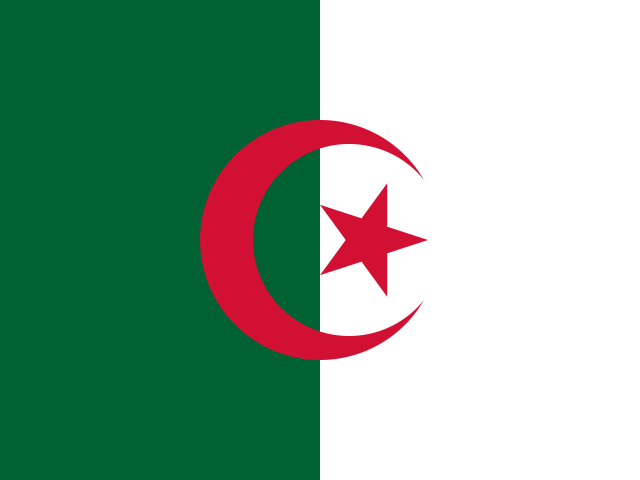
Algeria
Complete data on Algeria: geography, population, economy, culture, key indicators and statistics. Factual information, regularly updated.
Time and date in Algeria (Algiers)
Overview
Algeria (People's Democratic Republic of Algeria) is a country in North Africa (Maghreb), the largest on the African continent by area. With a population estimated at about 48.1 million inhabitants in 2026, it is one of the most populous countries in Africa. Its capital is Algiers.
Algeria is a presidential republic. Its official languages are Arabic and Tamazight (Berber), and French remains widely used in administration, business and higher education. Islam is the state religion, practised by virtually the entire population.
Data on Algeria
Geography of Algeria
Algeria covers an area of 2,381,741 km², making it the largest country in Africa and the 10th largest country in the world by area. It is bordered to the north by the Mediterranean (with about 1,200 km of coastline), to the east by Tunisia and Libya, to the south by Niger, Mali and Mauritania, and to the west by Morocco and Western Sahara.
The terrain is dominated by two major sets: in the north, the Tell Atlas and Saharan Atlas, separated by the steppe-like High Plateaus; in the south, the vastness of the Sahara, which covers about 87% of the territory, with the volcanic massif of the Hoggar (highest point: Mount Tahat, 2,918 m). The country has only wadis (temporary watercourses), except for a few coastal rivers.
The climate is Mediterranean on the coast (hot, dry summers, mild, wet winters), semi-arid on the High Plateaus, and desert in the Sahara. Average annual precipitation is low (about 89 mm/year nationally), but reaches about 600 mm on the coast, and can exceed 1,000 mm in some eastern reliefs.
Population and demographics
Algeria has an estimated population of 48.1 million inhabitants in 2026. The population density is very low, about 20 inhab/km², but the population is extremely concentrated: 91% of Algerians live on 12% of the territory, along the Mediterranean coast.
Demographics are relatively young, but the country is completing its demographic transition. Life expectancy is high, at 79.6 years (78.2 years for men, 81 years for women). The urbanisation rate reaches 75%. Fertility is 2.53 children per woman (2023), close to the replacement threshold.
| Indicator | Value |
|---|---|
| Total population (2026) | ~48.1 million |
| Population density | ~20 inhab/km² |
| Birth rate | ~19.3 / 1,000 |
| Life expectancy | ~79.6 years |
| Median age | ~29 years |
| Urban population | ~75% |
| Ethnic groups | Arab (~73.6%), Berber (~26.2%), others |
The population is predominantly Arab (~73.6%), with a significant Berber minority (~26.2%), mainly in Kabylie, the Aurès and the south (Mozabites, Tuaregs). The largest cities are Algiers (metropolitan area of about 3.9 million inhabitants), Oran (~1.5 million), Constantine (~1 million), Annaba and Blida.
Population change (1950-2026)
Population by age (2026)
Climate in Algeria: temperatures and precipitation
Algeria has three main climate types. The northern coastal strip enjoys a Mediterranean climate: hot, dry summers (July-August), mild, wet winters (December-February). The High Plateaus and the Saharan Atlas experience a semi-arid climate, with cold winters and very hot summers. The Sahara, which covers 87% of the country, has a desert climate: extreme temperatures (which can exceed 45°C in summer and drop close to 0°C at night in winter) and virtually no precipitation.
In Algiers, average temperatures range from about 7°C in January to 38°C in August (highs). Annual precipitation on the coast is about 600 mm, concentrated between October and April. In the Sahara, daily temperature ranges are very large, and sand winds (sirocco) can blow in spring and summer.
Average monthly temperatures (°C) - Algiers
Monthly precipitation (mm) - Algiers
Indicative data for Algiers (Mediterranean climate). The Sahara (87% of the territory) is desert.
Languages
The official languages of Algeria are Arabic and Tamazight (Berber), since the constitutional revision of 2016. Algerian Arabic (derja) is the mother tongue of the majority of the population and the everyday lingua franca. Tamazight is spoken by Berber communities (Kabylie, Aurès, M'zab, Tuareg).
French, although without official status, remains very widely used in administration, business, media and higher education. It is often considered a working language. English is increasingly present, especially among young people and in the digital sector.
Language breakdown in Algeria (estimate)
The Algerian linguistic landscape is complex and dynamic: dialectal Arabic dominates in daily exchanges, Tamazight has been promoted since its officialisation, and French retains an important place in scholarly and economic spheres.
Religions practised in Algeria
Islam is the state religion and is practised by about 97% of the population, almost exclusively in the Sunni rite. A small Ibadi minority (~1.3%) exists in the M'zab valley. Christianity represents about 1% of the population (Catholics and Protestants), and the Jewish community, once significant, has almost entirely emigrated.
The Constitution guarantees freedom of worship, but Sunni Islam is the state religion and strongly permeates society and institutions. Muslim religious holidays (Eid al-Fitr, Eid al-Adha, Mawlid) are national public holidays.
Religions in Algeria
Religion plays a central role in Algerian national identity. The country is home to important religious sites, and religious education is regulated by the State.
Economy and GDP
Algeria has the 4th largest economy in Africa and the 1st in the Maghreb. Its nominal GDP is estimated at about $317 to $332 billion in 2026, depending on the source. GDP per capita (nominal) is about $6,000 to $6,600. Real growth is sustained, around 3.8% in 2026.
The economy is heavily dependent on hydrocarbons (oil and gas), which account for the bulk of exports and a major share of budget revenues. However, services and industry (excluding hydrocarbons) contribute the majority of GDP. Agriculture, although limited by climate, employs a significant share of the population. The country faces high unemployment (11.4% in 2026), rising inflation (~5.5% in 2026), and a large budget deficit (-9.6% of GDP in 2026). Public debt remains contained (~53% of GDP in 2026).
Evolution of Algeria's GDP (billions $)
The major challenge for Algeria is economic diversification to reduce its dependence on hydrocarbons and create jobs for its youth. The country has substantial foreign exchange reserves and low external debt, but its model of subsidies and high public spending is under pressure.
Breakdown of the economy by sector (% GDP)
Socio-economic indicators
History and civilisations
The territory of Algeria has been inhabited since prehistory (Mechta-Afalou man, Tassili rock art). In Antiquity, it was the cradle of Berber kingdoms (Numidia, Mauretania), before falling under Roman, then Vandal and Byzantine domination.
The Arab-Muslim conquest in the 7th century profoundly transformed the region, which was then integrated into various empires (Almoravids, Almohads, Zianids). From the 16th century, Algeria was placed under the suzerainty of the Ottoman Empire, until the French conquest began in 1830. French colonisation lasted over a century and caused a profound destructuring of Algerian society.
The War of Independence began on 1 November 1954 and ended with the Évian Accords (March 1962). Independence was proclaimed on 5 July 1962. The country was ruled for decades by the FLN (National Liberation Front) in a one-party system, before opening to multiparty politics in 1989. The 1990s were marked by a civil war ("black decade") between the State and Islamist groups. Since the 2000s, the country has regained relative stability, despite persistent social and political tensions.
Major periods of Algerian history
Culture
Algerian culture is rich and mixed, at the crossroads of Berber, Arab, Mediterranean and African influences. Music is a pillar: chaâbi and andalusian in Algiers, raï in Oran (Khaled, Rachid Taha), malouf in Constantine, and Kabyle music (Idir, Matoub Lounès). Algerian literature is prestigious, with authors such as Mouloud Mammeri, Kateb Yacine (Nedjma), Assia Djebar and Yasmina Khadra.
Algerian cinema has produced major works (Chronicle of the Years of Fire, Palme d'Or 1975). Gastronomy is tasty: couscous (the national dish), chorba (soup), rechta, mhadjeb, tajine, and delicious pastries (baklava, makrout). The major festivals are Eid, Mawlid, Yennayer (Berber New Year, celebrated on 12 January), Independence Day (5 July) and Revolution Day (1 November).
 Nigeria
 Senegal
 Ivory Coast
 South Africa
 United States
 Canada
 China
 India
 Japan
 South Korea
 Turkey
 Saudi Arabia
 Iran
 France
 Germany
 Italy
 United Kingdom
 Spain
 Ukraine
 Russia
 Netherlands
 Belgium
 Switzerland
 Australia
 New Zealand