
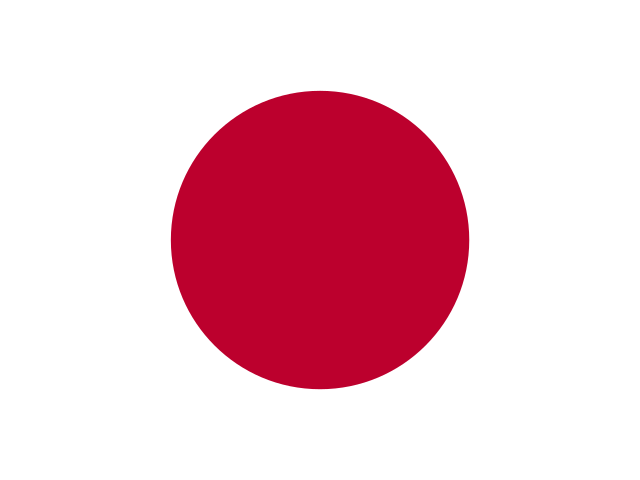
Japan
Complete data on Japan: geography, population, economy, culture, institutions, key indicators and statistics. Information updated in real time.
Time and date in Japan (Tokyo)
Overview
Japan (日本, Nihon or Nippon) is an island nation in East Asia, located in the Pacific Ocean. It consists of 6,852 islands, the four largest being Honshu, Hokkaido, Kyushu and Shikoku. With an area of 378,000 km², the country stretches about 3,000 km from north to south. Its population is estimated at about 123.8 million inhabitants in 2025, making it the 11th most populous country in the world.
Japan is a constitutional monarchy with a parliamentary system. The Emperor is the symbol of the State and of the unity of the people, while the Prime Minister holds executive power. The country is a member of the G7, G20, OECD and the UN. Its capital is Tokyo, one of the largest metropolitan areas in the world. The official language is Japanese. Japan is known for its technological power, rich culture and exceptional life expectancy.
Data on Japan
Geography of Japan
Japan is a volcanic archipelago of 6,852 islands stretching about 3,000 km from northeast to southwest along the eastern coast of Asia. Its total area is 378,000 km², comparable to that of Germany or California. Mountains cover three-quarters of the territory, and habitable areas are concentrated in narrow coastal plains. The country is located on the Pacific Ring of Fire, which explains the presence of many volcanoes (including Mount Fuji, the highest point at 3,776 m) and frequent earthquakes.
The four main islands are Honshu (the largest), Hokkaido (north), Kyushu (south) and Shikoku. The country is bordered by the Pacific Ocean to the east and the Sea of Japan to the west. The climate is temperate humid, with four distinct seasons: hot and humid summers (influenced by Pacific winds) and cold winters (influenced by continental winds). The country experiences a rainy season (tsuyu) in June-July and is regularly hit by typhoons in summer and autumn.
Population and demographics
Japan had about 123.8 million inhabitants in 2024, with a very high density (about 334 inhabitants/km²) due to limited habitable land. The population is highly urbanised (over 91%) and concentrated in major metropolises such as Tokyo (37 million in Greater Tokyo), Osaka, Nagoya and Fukuoka. The country faces extreme demographic ageing: the median age is 49.8 years, and those over 65 represent nearly 29% of the population.
The fertility rate is among the lowest in the world (1.15 children per woman in 2024), and life expectancy is one of the highest: 85 years on average (87.1 years for women and 81.1 years for men). The total population has been declining since 2010 and is expected to continue decreasing. Immigration remains low compared to other developed countries, but the number of foreign residents is increasing (about 3.2% of the population).
| Indicator | Value |
|---|---|
| Total population (2025) | 123.8 million |
| Population density | ~334 inhab/km² |
| Fertility rate | 1.15 children per woman |
| Life expectancy | 85 years (87.1 F / 81.1 M) |
| Median age | 49.8 years |
| Urban population | ~91.8% |
| Foreign population | ~3.2% of population |
| Population growth | -0.5% (2024) |
The population is ethnically very homogeneous (about 98% Japanese), with small minorities (Koreans, Chinese, Brazilians of Japanese descent, etc.). The main cities are Tokyo (13.9 million in the city, 37 million in Greater Tokyo), Yokohama (3.7 million), Osaka (2.7 million), Nagoya (2.3 million) and Sapporo (1.9 million).
Population change (1950-2025)
Population by age (2025)
Climate in Japan: temperatures and precipitation
Japan lies in the temperate zone, but its climate varies considerably from north to south. Hokkaido (north) has a subarctic climate with cold, snowy winters and an average annual temperature of about 9.5°C and precipitation of about 1,250 mm/year. Tokyo and the Honshu region have a humid temperate climate with hot, humid summers (average July temperature: 26°C, often >30°C) and cool winters (lowest temperature in January: 1°C). The Okinawa islands (south) enjoy a subtropical climate with an average annual temperature of 22°C and precipitation exceeding 2,000 mm/year.
The country experiences a rainy season (tsuyu) from June to July, and summer is marked by typhoons (about 20 per year). Precipitation is abundant (between 1,000 and 2,500 mm/year depending on the region), and the country is regularly struck by natural disasters (earthquakes, tsunamis, volcanic eruptions).
Average monthly temperatures (°C) - Tokyo
Monthly precipitation (mm) - Tokyo
Data based on 1991-2020 climate normals for Tokyo. Regional variations are considerable (from Hokkaido to Okinawa).
Languages
The official language and the most spoken in Japan is Japanese (日本語, Nihongo), spoken by about 99% of the population. Japanese is a Japonic language (language isolate) that uses three writing systems: kanji (Chinese characters), hiragana and katakana. There are many regional dialects (kansai-ben, tohoku-ben, etc.), but standard Japanese (hyōjungo) is used in the media, education and administration.
Japan is a relatively linguistically homogeneous country, but there are minority languages: Ainu (indigenous language of Hokkaido, endangered), Ryukyuan (languages of the Ryukyu Islands) and Korean (spoken by the Korean community). English is the main foreign language taught in schools, but it is less fluently spoken than in other developed countries.
Languages spoken in Japan
Japanese is a polite language with different levels of speech (keigo, sonkeigo, kenjōgo) depending on the social context. Japanese writing is considered one of the most complex in the world, with thousands of kanji characters to master.
Religions practised in Japan
Japan is a country of great religious diversity, but the particularity is that most Japanese practise both Shintoism and Buddhism, without necessarily considering themselves "religious" in the Western sense. According to statistics, about 48.6% of the population declares themselves Shintoist and 46.4% Buddhist (the figures exceed 100% because many people adhere to both). Christianity represents about 1.1% of the population, and other religions 4%.
Shintoism is the indigenous religion of Japan, centred on the worship of kami (spirits of nature and ancestors). Buddhism arrived in Japan in the 6th century and has deeply influenced Japanese culture (temples, arts, philosophy). Secularisation is strong: many Japanese declare no religion, but participate in traditional rituals (temple visits, festivals, weddings, funerals).
Religions in Japan
Japan guarantees freedom of religion by its constitution. New religions (shinshūkyō) are also present, such as Sōka Gakkai (lay Buddhism). Japanese spirituality is also marked by Confucianism and Taoism, which influence social values and traditions.
Economy and GDP
Japan has the fourth-largest economy in the world (after the United States, China and Germany). Its nominal GDP was about $4,435 billion in 2025, and its GDP per capita about $35,973. The country is a member of the G7 and G20, and its currency is the yen (JPY).
The sectoral structure of the Japanese economy is dominated by services (about 70% of GDP), followed by industry (about 29%) and agriculture (about 1%). Advanced sectors (automotive, electronics, robotics, biotechnology) are essential drivers of Japan's competitiveness. The main trading partners are China, the United States, the European Union, South Korea and Australia. The country is the fourth-largest exporter and the fifth-largest importer in the world.
Evolution of Japan's GDP (billions $)
The unemployment rate is very low (about 2.6% in 2025-2026), and inflation is about 3.3% in 2025. Public debt is the highest in the developed world, representing about 230% of GDP in 2025. The average gross salary was about 487,000 yen per year (about €3,200/month) in 2025. The minimum wage varies by prefecture, around 1,000 yen per hour (about €6.50).
Breakdown of the economy by sector (% GDP)
Socio-economic indicators
History
Japan's history is one of the oldest and richest in the world. The first traces of settlement date back to the Jōmon period (about 14,000 BC – 300 BC), followed by the Yayoi period (300 BC – 250 AD) which saw the introduction of rice cultivation and bronze. The Kofun period (250-538) is marked by the emergence of large tumuli and the formation of a centralised state around the Yamato imperial court.
The Nara period (710-794) saw the founding of the first permanent capital (Nara) and the rise of Buddhism. The Heian period (794-1185) is considered the golden age of aristocratic culture, with the move of the capital to Kyoto and the emergence of classical literature (The Tale of Genji). The Kamakura period (1185-1333) marks the beginning of the shogunate and the establishment of a feudal regime led by samurai. The Muromachi period (1333-1568) is marked by wars between feudal lords and the arrival of the first Europeans (Portuguese) in 1543.
The Edo period (1603-1867) was an era of peace and isolation under the Tokugawa shogunate, with the country closed to foreign influences. The Meiji Restoration (1868) paved the way for rapid modernisation and industrialisation. The country became an imperialist power and won wars against China (1894-1895) and Russia (1904-1905). World War II ended with Japan's defeat in 1945, after the atomic bombings of Hiroshima and Nagasaki. Japan was then occupied by the United States and adopted a new pacifist constitution in 1947. Since then, the country has become a stable democracy and a major economic power.
History of Japan: major periods
Culture
Japanese culture is unique and fascinating, marked by a blend of millennial traditions and modernity. The country is famous for its traditional arts: the tea ceremony (chanoyu), ikebana (flower arranging), noh and kabuki theatre, calligraphy (shodō) and origami. Japanese literature is rich, with authors such as Murasaki Shikibu (The Tale of Genji, 11th century), Matsuo Bashō (haiku master), Yasunari Kawabata (Nobel Prize 1968) and Haruki Murakami (contemporary).
Japanese popular culture (manga, anime, video games, J-pop) has conquered the world. Works such as Dragon Ball, One Piece, Naruto, Pokémon and films from Studio Ghibli (Hayao Miyazaki) are global phenomena. Japanese cinema has also produced masters such as Akira Kurosawa (Seven Samurai, Rashomon).
Japanese gastronomy (washoku) is inscribed on UNESCO's intangible cultural heritage list. It is famous for its sushi, ramen, tempura, yakitori, okonomiyaki and sake. Traditional festivals (matsuri) are numerous, such as Hanami (cherry blossom viewing), Gion Matsuri in Kyoto and Tanabata. Japan is also the land of onsen (hot springs), zen gardens and castles (Himeji, Osaka).
 Nigeria
 Senegal
 Ivory Coast
 South Africa
 Algeria
 United States
 Canada
 China
 India
 South Korea
 Turkey
 Saudi Arabia
 Iran
 France
 Germany
 Italy
 United Kingdom
 Spain
 Ukraine
 Russia
 Netherlands
 Belgium
 Switzerland
 Australia
 New Zealand