
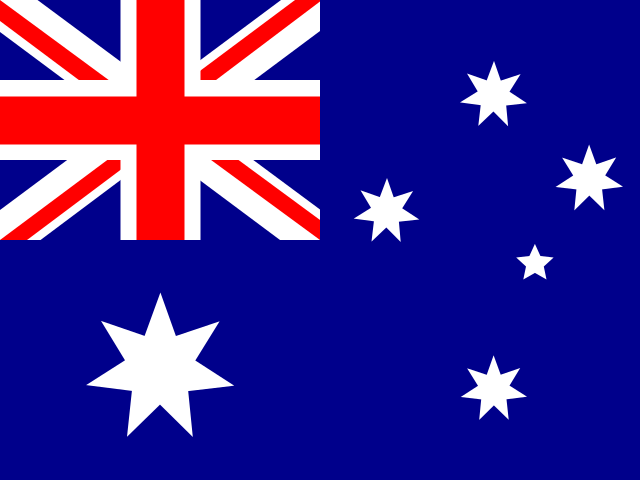
Australia
Complete data on Australia: geography, population, economy, culture, institutions, key indicators and statistics. Information updated in real time.
Time and date in Australia
Overview
Australia, officially the Commonwealth of Australia, is a country in the Southern Hemisphere, comprising the Australian continent and many islands. It is the sixth largest country in the world by area. It is bordered by the Indian and Pacific Oceans. Its capital is Canberra, and its official language is English. The country is a federal constitutional monarchy and a member of the Commonwealth.
Australia is a developed economy with a nominal GDP of about US$1,800 billion (2025). The country is rich in natural resources and is a major player in the mining, agricultural and services sectors. Its population is highly urbanised and culturally diverse, with more than half of the inhabitants having foreign origins.
Data on Australia
Geography of Australia
Australia is the largest country in Oceania and the sixth largest in the world, with an area of 7,688,200 km². The country consists mainly of a vast low plateau, with arid central plains and mountainous areas to the east (the Great Dividing Range). The highest point is Mount Kosciuszko (2,228 m).
The country is bordered by the Indian Ocean to the west and south, and the Pacific Ocean to the east. It shares land borders with Papua New Guinea (via the island of New Guinea), and maritime borders with Indonesia and East Timor. Australia also has external territories, including Tasmania.
The climate is very varied: tropical in the north, desert or semi-arid in the centre, and temperate in the south and on the coasts. The main rivers are the Murray and the Darling, which form the country's largest drainage basin.
Population and demographics
Australia has a population of about 27.8 million inhabitants in 2025. The population is highly urban (about 86.5%) and concentrated along the coasts, particularly in major cities such as Sydney, Melbourne, Brisbane, Perth and Adelaide. Population density is one of the lowest in the world, at around 3.5 inhabitants/km².
The country is experiencing sustained demographic growth, mainly due to immigration. The median age is about 38 years and the fertility rate is 1.64 children per woman. Life expectancy is high, exceeding 81 years for men and 85 years for women.
| Indicator | Value |
|---|---|
| Total population (2025) | 27.8 million |
| Population density | ~3.5 inhab/km² |
| Fertility rate | 1.64 children per woman |
| Life expectancy | 81.2 years (men) / 85.3 years (women) |
| Median age | 38.3 years |
| Urban population | 86.5 % |
| Population born abroad | ~30 % |
Australia is a major immigration country. According to the 2021 census, nearly half of Australians have a parent born abroad. The main foreign communities come from the United Kingdom, China, India, New Zealand and the Philippines.
Population change (1950-2025)
Population by age (estimate)
Climate in Australia: temperatures and precipitation
The Australian climate is highly contrasted due to the immensity of the territory. Generally, there are:
- A tropical climate in the north (Darwin, Cairns) with a wet season (November-April) and a dry season (May-October).
- A desert or semi-arid climate in the centre (Alice Springs) with extreme temperatures and very low precipitation.
- A temperate climate in the south (Sydney, Melbourne, Adelaide) with four distinct seasons.
- A Mediterranean climate in the west and southwest (Perth).
National average temperatures range from about 14°C in July to 28°C in January. Precipitation is very uneven, ranging from less than 200 mm/year in the desert to more than 1,500 mm/year in humid tropical areas.
Average monthly temperatures (°C)
Monthly precipitation (mm)
Data based on national averages (1961-1990). Source: CRU / University of East Anglia.
Languages
The official language is English, spoken by the vast majority of the population. However, Australia is a multicultural society with great linguistic diversity. According to the 2021 census, 22.3% of the population speaks a language other than English at home.
The most spoken languages at home (excluding English) are:
- Mandarin: ~685,000 speakers (2.7%)
- Arabic: ~367,000 speakers (1.4%)
- Vietnamese: ~321,000 speakers (1.3%)
- Cantonese: ~295,000 speakers (1.2%)
- Punjabi: ~239,000 speakers (0.9%)
Languages spoken at home in Australia (2021)
Religions practised in Australia
Australia is a country of great religious diversity. According to the 2021 census, Christianity remains the majority religion with 43.9% of the population, but this proportion is declining (52.1% in 2016). The main Christian denominations are Catholicism (20.0%) and Anglicanism (9.8%).
The most striking phenomenon is the rapid growth of people with no religion, who represent 38.9% of the population in 2021, compared with 30.1% in 2016. Other religions are also growing, driven by immigration: Islam (3.2%), Hinduism (2.7%), Buddhism (2.4%) and Sikhism (0.8%).
Religions in Australia (2021)
Economy and GDP
Australia is a developed economy and one of the largest in Asia-Pacific. Its nominal GDP is estimated at about US$1,800 billion in 2025. GDP per capita is about US$68,000.
The Australian economy is dominated by the services sector (about 67% of GDP), but the country is also a major exporter of natural resources: iron ore, coal, natural gas, gold, and agricultural products (wool, meat, wheat). China, Japan, South Korea and the United States are its main trading partners.
Evolution of Australian nominal GDP (billions US$)
The country experienced remarkable economic growth for nearly 30 years without a recession before the COVID-19 pandemic. The mining sector accounts for a significant share of exports and investment. The unemployment rate is relatively low, around 4%.
Breakdown of the economy by sector (% GDP)
Socio-economic indicators
History
The history of Australia begins with the Aboriginal peoples, present on the continent for at least 65,000 years. The Dutch navigator Willem Janszoon was the first European to land in 1606, but it was the British captain James Cook who claimed the coast for Britain in 1770.
British colonisation began in 1788 with the arrival of the First Fleet at Sydney Cove, establishing a penal colony. In the 19th century, exploration of the interior and the gold rush (1850s) accelerated development and immigration. The six British colonies federated on 1 January 1901 to form the Commonwealth of Australia.
Australia participated in both world wars alongside the United Kingdom. After World War II, the country strengthened its ties with the United States and Asia. Today, Australia is a stable federal democracy and an important player in the Indo-Pacific region.
History of Australia: major periods
Culture
Australian culture is a unique blend of Aboriginal, British and multicultural heritages. Aboriginal peoples possess one of the oldest continuous cultures in the world, with a rich artistic (bark painting, desert art), musical and spiritual heritage (the Dreamtime).
Contemporary culture is marked by a relaxed, outdoor lifestyle, linked to the climate and vast natural spaces. The country is world-famous for its dynamic cultural scene: cinema (Mad Max, Crocodile Dundee), music (AC/DC, INXS, Kylie Minogue) and literature (Patrick White, Nobel Prize in Literature).
Sport plays a central role in Australian society, with a particular passion for cricket, Australian rules football (AFL), rugby and swimming. Festivals and celebrations are numerous, celebrating the country's cultural diversity.
 Nigeria
 Senegal
 Ivory Coast
 South Africa
 Algeria
 United States
 Canada
 China
 India
 Japan
 South Korea
 Turkey
 Saudi Arabia
 Iran
 France
 Germany
 Italy
 United Kingdom
 Spain
 Ukraine
 Russia
 Netherlands
 Belgium
 Switzerland
 New Zealand