
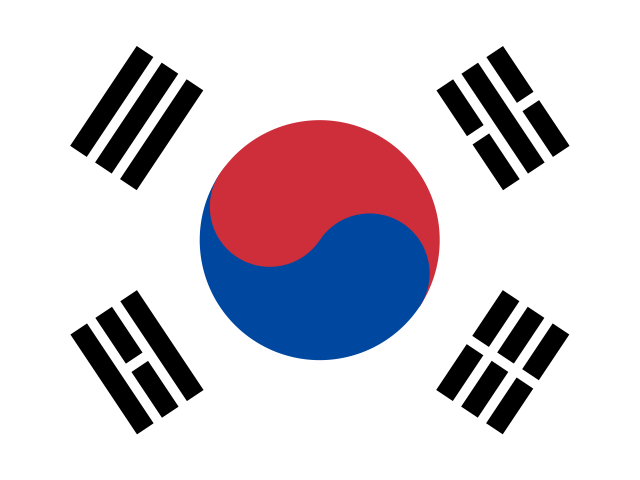
South Korea
Complete data on South Korea: geography, population, economy, culture, indicators and key statistics. Factual information, kept up to date.
Time and date in South Korea (Seoul)
Overview
South Korea (Republic of Korea) is a country in East Asia, located on the southern half of the Korean Peninsula. It is bordered by the Yellow Sea to the west, the East China Sea to the south and the Sea of Japan to the east. Its only land border is with North Korea (238 km), along the demilitarised zone (DMZ). Its capital is Seoul, and the official language is Korean.
South Korea is an advanced economy and one of the "four Asian tigers". It is a member of the OECD, the G20 and APEC. The country is globally known for its industrial conglomerates (chaebols) such as Samsung, Hyundai, LG and SK, as well as for the worldwide reach of its popular culture (K-pop, K-dramas, cinema).
Data on South Korea
Geography of South Korea
South Korea covers an area of 100,210 km² (or 98,480 km² according to some sources), making it slightly smaller than Bulgaria. The country is about 70% mountainous, with north-south ranges that make east-west communication difficult. The highest mountains are in the east, while the west is characterised by coastal plains and river basins.
The highest point is Hallasan (1,950 m), a volcano located on Jeju Island, south of the country. The Nakdong is the longest river in South Korea (521 km), followed by the Han (which flows through Seoul) and the Geum. The coastline extends over 2,413 km, with many islands and jagged bays, particularly on the west coast (Yellow Sea).
The country is divided into nine provinces (do), six metropolitan cities (Seoul, Busan, Incheon, Daegu, Daejeon, Gwangju) and one special city (Sejong). Jeju Island in the south is a major tourist destination with its volcano and unique volcanic landscapes.
Population and demographics
South Korea had about 51.6 million inhabitants in 2026, according to United Nations and KOSIS estimates. The population density is very high: about 530 inhabitants/km² (compared with 37 inhab/km² in the United States). The population is heavily urbanised (about 82.8%) and concentrated in the Seoul region (more than 25 million inhabitants in the metropolitan area).
The country is experiencing very rapid demographic ageing and a very low fertility rate: the fertility rate fell to about 0.76 children per woman in 2026, one of the lowest in the world. The median age is about 46.2 years. Life expectancy is high, around 83 years. The population is expected to start declining in the coming decades if the trend continues.
| Indicator | Value |
|---|---|
| Total population (2026) | ~51.6 million |
| Population density | ~530 inhab/km² |
| Fertility rate | 0.76 children per woman |
| Life expectancy | ~83 years |
| Median age | 46.2 years |
| Urban population | 82.8% |
| Rural population | ~17% |
| Ethnic composition | Koreans ~96%, others ~4% |
The population is very ethnically homogeneous (about 96% Korean), but the country is home to a growing foreign population (migrant workers, expatriates, students). The main cities are Seoul (~9.3 million in the city, more than 25 million in the metropolitan area), Busan (3.4 million), Incheon (3.0 million), Daegu (2.4 million) and Daejeon (1.5 million).
Population change (1950-2026)
Population by age (2026)
Climate in South Korea: temperatures and precipitation
South Korea has a temperate climate with four distinct seasons. Winters are cold and dry, under the influence of Siberian air masses: in Seoul, the average January temperature is about -2 to -5 °C, with lows that can drop to -10 °C. Summers are hot and humid, with an August average of about 25-27 °C and peaks that can reach 35 °C.
Precipitation is concentrated during the rainy season (jangma) in June-July, and the country can be affected by typhoons in late summer. Average annual precipitation ranges from 1,000 to 1,500 mm depending on the region. Spring (April-May) and autumn (September-October) are generally the most pleasant seasons, with clear skies and mild temperatures.
Average monthly temperatures (°C) - Seoul
Monthly precipitation (mm) - Seoul
Data based on Seoul climate normals. Regional variations are significant.
Languages
The official language of South Korea is Korean (한국어), spoken by virtually the entire population. Korean is a language isolate (or related to the Altaic family according to some theories), written with the hangul alphabet, a writing system created in the 15th century under King Sejong. Hangul is renowned for its simplicity and logic, making it one of the easiest alphabets to learn in the world.
According to the data, about 87.1% of South Koreans speak Korean at home, and 10.3% use English as their main language at home (often in combination with Korean). English is widely taught in schools and used in business and tourism, but proficiency varies by generation and region. There is no officially recognised minority language, but Chinese and Japanese communities use their respective languages.
Languages spoken at home in South Korea
Standard Korean is based on the Seoul dialect. There are several regional dialects (Gyeongsang, Jeolla, Chungcheong, Gangwon, Jeju), but the differences remain mutually intelligible, except for the Jeju dialect which is distinct. The romanisation of Korean (Revised system) is used for place names and official documents.
Religions practised in South Korea
South Korea is a country of great religious diversity, marked by the coexistence of Buddhism, Christianity (Protestantism and Catholicism) and a large proportion of people with no religious affiliation. According to the most recent surveys (2025), about 51% of the population declares no religion. Among believers, Protestantism is the largest denomination (about 20%), followed by Buddhism (about 16-17%) and Catholicism (about 11%).
Buddhism is historically the dominant religion and has profoundly influenced Korean culture (temples, arts, philosophy). Christianity experienced remarkable growth in the 20th century, and South Korea is today one of the Asian countries where Christianity is most dynamic. Traditional religions (shamanism, Confucianism) survive culturally but are not always counted as formal religious affiliations.
Religions in South Korea
Religious freedom is guaranteed by the Constitution. South Korean society is largely secularised in its public life, but religious practices remain important for part of the population, particularly during traditional holidays (Seollal, Chuseok) where ancestral rituals are still observed.
Economy and GDP
South Korea is the 13th largest economy in the world (nominal GDP) and a member of the OECD and the G20. In 2026, its nominal GDP is estimated at about $1,931 billion (IMF), after $1,872 billion in 2025. Real GDP growth is projected at 1.9% in 2026, after 1.0% in 2025, supported by semiconductor exports and the recovery of consumption. Gross national income per capita in purchasing power parity is about $53,180 (2023).
The structure of the economy is dominated by services (about 60% of GDP) and industry (about 31.6% of GDP in 2023, one of the highest shares among developed countries). The chaebols (Samsung, Hyundai, SK, LG, etc.) are the pillars of South Korean industry, active in electronics, automotive, shipbuilding, chemicals and information technology. Exports of semiconductors, vehicles and electronic products are the main drivers of the economy.
Evolution of South Korean GDP (billions $)
The unemployment rate is historically low, around 2.8% in 2025 and 2026. Inflation is under control (about 2.1% in 2025), close to the Bank of Korea's 2% target. Public debt is moderate, at about 54.4% of GDP in 2026. The minimum wage is set at 10,030 won/hour in 2025 (about $7.5). The country faces structural challenges: demographic ageing, energy dependence and growing international competition.
Breakdown of the economy by sector (% GDP)
Socio-economic indicators
History and civilisations
Korea's history is rich and ancient, with roots going back to the time of Gojoseon (around 2333 BC according to tradition). The Three Kingdoms period (Goguryeo, Baekje, Silla) saw the formation of centralised kingdoms, and the peninsula was eventually unified by Silla in the 7th century. The Goryeo dynasty (918-1392) gave Korea its name, and the Joseon dynasty (1392-1910) marked an era of cultural prosperity and territorial consolidation.
In 1910, Korea was annexed by Japan, a period of domination that lasted until liberation in 1945, at the end of World War II. The peninsula was then divided into two occupation zones, and the Korean War (1950-1953) consolidated the separation between North and South. After the 1953 armistice, South Korea began a rapid industrialisation and a spectacular economic development, often called the "miracle on the Han River", which made it one of the most advanced economies in Asia in just a few decades.
Major periods of Korean history
Culture
South Korean culture is a fascinating blend of millennia-old traditions and modernity. Confucianism has deeply shaped social values (respect for elders, importance of family and education). Buddhism has left an exceptional artistic and architectural heritage (temples, sculptures). Traditional holidays such as Seollal (Lunar New Year) and Chuseok (harvest festival) are important moments of family gathering.
The Korean Wave (Hallyu) has propelled South Korean popular culture onto the world stage: K-pop (BTS, BLACKPINK, etc.), K-dramas, cinema (Palme d'Or for Bong Joon-ho's Parasite in 2019), video games and fashion. Korean gastronomy is also very popular: kimchi, bibimbap, bulgogi, tteokbokki, Korean barbecue. Martial arts (taekwondo) and traditional games (ssireum, Korean wrestling) are part of the cultural heritage.
South Korean society is highly connected and urban, with high penetration of the Internet and smartphones. Education is a national priority, and South Korean universities (Seoul National, KAIST, Yonsei, Korea University) are among the best in Asia. The country is also recognised for its efficient healthcare system and its safety.
 Nigeria
 Senegal
 Ivory Coast
 South Africa
 Algeria
 United States
 Canada
 China
 India
 Japan
 Turkey
 Saudi Arabia
 Iran
 France
 Germany
 Italy
 United Kingdom
 Spain
 Ukraine
 Russia
 Netherlands
 Belgium
 Switzerland
 Australia
 New Zealand